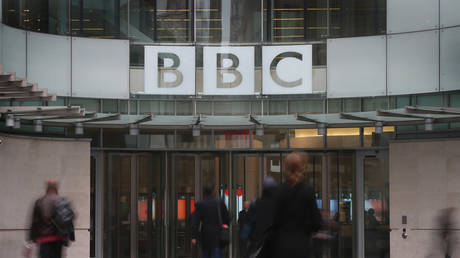
The structural integrity of a public service broadcaster rests on the alignment between its editorial output and its stated mission of impartiality. When a significant cohort of internal stakeholders—the journalists and producers responsible for content creation—publicly identifies a systemic bias in coverage, the organization faces a crisis of "institutional dissonance." This occurs when the operational mechanics of news gathering and the final editorial product diverge so sharply that the internal culture begins to cannibalize the brand’s external authority. The allegations leveled against the BBC regarding its coverage of the Gaza conflict suggest a breakdown in the feedback loops meant to ensure objective reporting, creating a measurable deficit in perceived reliability.
The Tripartite Framework of Editorial Distortion
To understand how a legacy institution fails to meet its own standards, one must examine the three specific layers where information is filtered, weighed, and ultimately presented to the audience. These layers function as a funnel, where institutional pressure and inherited stylistic norms can distort raw data before it reaches the consumer.
1. Linguistic Asymmetry and Value-Laden Terminology
The most immediate point of failure in conflict reporting is the application of uneven descriptors for identical phenomena. Precise reporting requires a consistent lexicon. When "killed" is used for one side and "died" or "passed away" for the other, the agency of the perpetrator is linguistically erased. This creates a subconscious hierarchy of victimhood.
Internal critics point to a refusal to use specific, legally defined terms—such as "apartheid" or "genocide"—even when referencing reports from recognized international bodies like the United Nations or Human Rights Watch. While the BBC maintains that these are contested terms, the selective exclusion of the arguments supporting these definitions constitutes an editorial choice. In a data-driven newsroom, the omission of expert-led legal frameworks is a dereliction of the duty to provide full context.
2. The Contextual Vacuum in Breaking News
Legacy media often prioritizes the "immediacy bias"—reporting what happened in the last 60 minutes while ignoring the structural history of the preceding decades. By starting the clock of a conflict at a specific moment of escalation (for example, October 7), the broadcaster inadvertently frames all subsequent events as reactive rather than part of a continuous cycle of occupation and resistance.
The mechanism of this failure is the "de-historicization" of news. When a blockade or a long-term military occupation is treated as a static background element rather than an active, daily driver of conflict, the audience is deprived of the variables necessary to calculate cause and effect. A rigorous analytical model requires that the starting conditions of a system be clearly defined; omitting 75 years of regional history renders the current data points unintelligible.
3. Asymmetric Humanization and Narrative Depth
Quantifiable data reveals a disparity in how individual stories are told. Humanization is a powerful editorial tool used to build empathy. It involves naming victims, interviewing their families, and detailing their aspirations. A "humanization gap" occurs when this depth is afforded to one group while the other is relegated to mere statistics or "collateral damage."
In the Gaza coverage, staff members highlighted a trend where Israeli victims were profiled in multi-part features, while Palestinian casualties were frequently reported as bulk numbers. This is not merely a matter of taste; it is a failure of human rights accounting. From a strategic consulting perspective, this creates a "single-point-of-failure" in the brand's reputation: if the audience detects that some lives are weighted more heavily than others, the entire platform’s claim to universality is invalidated.
The Economics of Institutional Inertia
The BBC operates within a unique financial and political ecosystem. Its funding is tied to a license fee, the renewal of which is subject to government approval. This creates a "safety-first" editorial culture. When faced with a highly polarized conflict, the path of least resistance is often to mirror the language of the prevailing political establishment.
The Over-Correction Loop
Institutional fear of accusations of bias (specifically from powerful political lobbies) leads to an "over-correction" where the broadcaster adopts a defensive posture. In an attempt to avoid being labeled anti-state or anti-ally, editors may suppress investigative findings that are critical of those entities. This results in "balanced" reporting that is factually "unbalanced." If one side provides verifiable evidence and the other provides a blanket denial, presenting both as equally valid perspectives is a logical fallacy known as "false equivalence."
The Burden of Access
A primary bottleneck in Gaza reporting is the lack of physical access for international journalists. Israel’s control over the borders means that legacy outlets must rely on local Palestinian stringers or heavily controlled military-embedded tours. This creates a data asymmetry. However, the failure to clearly state these limitations to the audience—and the subsequent skepticism applied to reports coming from within Gaza—signals an inherent distrust of the very people the broadcaster relies on for information.
Quantifying the Damage to Global Influence
The BBC World Service is a soft-power asset. Its value is derived from its "Trust Quotient" among global audiences, particularly in the Global South. When internal dissent goes public, it suggests that the rot is not external, but structural.
- Audience Fragmentation: As viewers detect a lack of transparency, they migrate to "unfiltered" social media channels or rival international networks (like Al Jazeera), which may have their own biases but are perceived as being more direct about the ground reality.
- Talent Attrition: When high-caliber journalists feel their integrity is being compromised by editorial mandates, they exit the institution. This leaves behind a "compliance-heavy" workforce that lacks the critical edge required for complex investigative work.
- Diplomatic Capital: A broadcaster that loses its reputation for neutrality loses its ability to function as a mediator in the global information space.
The Mechanics of Editorial Recalibration
To restore institutional integrity, a media organization must move beyond vague promises of "reviewing guidelines" and implement a hard-coded framework for conflict reporting.
- Standardized Descriptor Protocols: Establishing a mandatory, uniform lexicon for casualties and military actions, regardless of the actors involved. If a strike on a civilian building is described as "targeted" for one military, it must be subjected to the same scrutiny and evidence-based labeling for all militaries.
- Explicit Contextual Requirements: Every major update must include a "Contextual Baseline"—a brief summary of the historical and legal status of the territory involved (e.g., "Gaza is considered occupied territory under international law"). This prevents de-historicization.
- Proportional Representation Audits: Real-time monitoring of airtime and humanization features. If X minutes are spent on the grief of one side, a comparable effort must be made to document the grief of the other, adjusted for the scale of the human loss.
- Internal Dissent Channels: Replacing the culture of "whistleblowing" with formal, anonymized feedback loops where journalists can flag editorial bias without fear of professional reprisal.
The current crisis at the BBC is not a localized disagreement over a single story; it is a stress test of the legacy media model in a multi-polar, digital age. When the internal machinery of an organization signals that its output is "misleading," the market value of that organization’s truth is effectively zeroed. The only path forward is a radical commitment to transparency, even when that transparency reveals uncomfortable truths about the institution's own proximity to power.
The strategic play for the BBC is not to "defend the brand," but to dismantle the opaque editorial hierarchies that prioritize political safety over factual density. Failure to do so will result in the permanent transition of the BBC from a "global standard-bearer" to a "state-adjacent mouthpiece," a shift that would be terminal for its international relevance.
Implement a mandatory "Mechanism of Accountability" audit where every disputed claim by a combatant is explicitly labeled as "unverified" until independent forensic evidence is produced, removing the institutional habit of laundering government press releases as objective news.