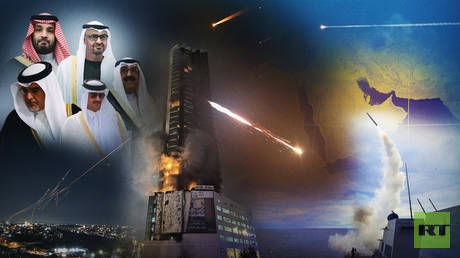
The pundits are waiting for a mushroom cloud that will never come. They scan the horizon for a 1914-style mobilization, expecting a formal declaration of hostilities between the Gulf monarchies and Iran. They cite "regional stability" and "economic interdependency" as the reasons for a supposed peace.
They are dead wrong. Discover more on a similar issue: this related article.
The Gulf isn't avoiding a war; it is currently losing one. The conventional definition of "war"—tank divisions crossing borders and jets dogfighting over the desert—is a relic of the twentieth century. While analysts at think tanks in D.C. and London talk about "deterrence," the reality on the ground has shifted into a permanent state of high-intensity kinetic friction.
The missiles have already flown. The drones have already hit. The infrastructure has already burned. If you’re waiting for the war to start, you’ve missed the opening three chapters. More reporting by Associated Press explores similar perspectives on the subject.
The Myth of the "Cold" Peace
The lazy consensus suggests that because Riyadh and Tehran haven't traded formal declarations, the region remains in a "Cold War." This is a fundamental misunderstanding of modern asymmetric capabilities.
In 2019, the Abqaiq–Khurais attack knocked out 5% of the global oil supply in a single morning. It wasn't a skirmish. It was a strategic masterclass in deniable warfare. By using low-cost UAVs and cruise missiles, the aggressor achieved what a carrier strike group couldn't: the temporary paralysis of the world's most critical energy node.
The Gulf states didn't "avoid" war after Abqaiq. They realized their multi-billion dollar traditional defense systems—the Patriots, the Aegis-equipped destroyers, the shiny F-15 fleets—were optimized for a war that no longer exists.
The Cost-Asymmetry Trap
The math of modern Middle Eastern conflict is brutal.
- Offense: A $20,000 "suicide" drone built with off-the-shelf components.
- Defense: A $2 million interceptor missile fired from a battery that costs $1 billion to deploy.
You don't need to "go to war" when you can bleed your opponent's treasury dry through sheer attrition. This is the Cost-Asymmetry Trap. Every time a Houthi rebel launches a flight of drones toward a Red Sea shipping lane or a Saudi desalination plant, the defensive response costs the Gulf states 100 times more than the attack.
I’ve sat in rooms with defense contractors who salivate over these numbers. They aren't selling "peace"; they are selling a subscription service for survival. The Gulf knows this. They aren't holding back out of some noble desire for harmony; they are pivoting because they realize their current armor is a sieve.
The "Interdependency" Fallacy
Standard geopolitical theory argues that trade prevents conflict. The "Golden Arches Theory of Conflict Prevention" suggested that no two countries with a McDonald's would fight. It was a cute idea for the 1990s. In 2026, interdependency is exactly what makes the Gulf so vulnerable.
The UAE and Saudi Arabia are attempting to build the world’s most advanced "post-oil" economies. Projects like NEOM or the expansion of Dubai’s financial districts require one thing above all: The Perception of Safety.
You don't need to sink a country's navy to destroy its economy. You just need to make the insurance premiums for cargo ships too expensive to pay. You just need to make a foreign tech worker in Riyadh wonder if a drone will hit their apartment building.
The Gulf isn't refusing to fight Iran because they’re partners; they aren't fighting because their entire economic model is a "glass house." Iran, conversely, has spent decades building a "basement" economy. They are already sanctioned to the bone. They have less to lose from a shattered regional status quo. When one side is a skyscraper and the other is a bunker, the skyscraper doesn't "choose" peace. It prays for it.
The Proxy Delusion
We need to stop using the word "proxy." It implies a puppet master and a mindless string-puppet. It suggests that if you just talk to the master, the puppet stops moving.
The "Axis of Resistance" is not a collection of proxies; it is a franchised insurgency. Groups in Yemen, Iraq, and Lebanon operate with varying degrees of autonomy, sharing technology and ideology but making local tactical decisions.
The "lazy consensus" article you read likely argued that the Gulf won't fight because they can't win a direct confrontation. The nuance they missed is that there is no direct confrontation to be had. If Saudi Arabia strikes Iranian soil, they face a swarm of attacks from four different directions, none of which are technically "Iran." This is the perfection of "Gray Zone" warfare. It creates a strategic paralysis where the victim has no clear target for retaliation that wouldn't trigger a global catastrophe.
The Intelligence Failure: Why We Can’t See the Front Lines
Most people think of intelligence as "finding out what the enemy is doing." In the Gulf, intelligence is now about "proving who the enemy is."
The attribution problem is the greatest weapon of the twenty-first century. When a pipeline in the middle of the desert explodes, was it a cyber-attack? A local insurgent with a mortar? A drone launched from a boat in the international waters of the Gulf?
While the "insiders" talk about the "risk of escalation," the escalation has already happened in the digital and covert realms.
- Cyber-Kinetic Warfare: Stuxnet was the beginning, not the end. The Gulf's water systems and power grids are under constant, daily electronic bombardment.
- Financial Sabotage: The manipulation of regional markets through disinformation and coordinated short-selling.
- The Maritime Squeeze: The creeping control of the Bab el-Mandeb and the Strait of Hormuz.
This is what war looks like now. It’s quiet. It’s deniable. It’s constant.
Stop Asking "Will They Fight?"
The question itself is flawed. It’s like asking if two people in a dark room are going to start punching each other while they’re already strangling one another.
The real question is: Who can survive the exhaustion?
The Gulf states are currently trying to buy their way out of this reality. They are investing heavily in domestic defense industries, laser-directed energy weapons to flip the cost-asymmetry, and diplomatic hedging with China and Russia.
Imagine a scenario where the U.S. security umbrella continues to fray. The Gulf doesn't turn to war; it turns to a "Security Realignment." We are seeing the beginning of a world where the Gulf monarchies may decide that a nuclear Iran is a reality they must manage through tribute or accommodation rather than confrontation.
That isn't "avoiding war." That is a negotiated surrender of the old order.
The Tech Reality Nobody Admits
The primary reason a "hot war" hasn't broken out is not diplomacy—it’s the Total Transparency of the Battlefield.
Between commercial satellite imagery, SIGINT (Signals Intelligence), and the sheer density of smartphones, you cannot move a division of tanks without the world seeing it in real-time on social media. Surprise is dead.
In the 1973 Yom Kippur War or the 1980 Iran-Iraq War, you could mask intentions. Today, the moment a battery of missiles is fueled, the thermal signature is flagged by a dozen different private and state actors.
This transparency makes "traditional" war almost impossible to win quickly. And if you can't win quickly, you don't start. Instead, you move the conflict into the shadows, into the proxies, and into the code.
The Bottom Line
The "Competitor Reference" article wants you to feel safe. It wants you to believe that rational actors are keeping the lid on a boiling pot because they like the flavor of the soup.
I’m telling you the pot has already melted.
The Gulf states are in a fight for their existential lives. They are burning through capital at an unsustainable rate to defend against "cheap" threats. They are being forced to rewrite their social contracts to fund a military evolution they weren't prepared for.
Iran isn't "staying its hand." It is successfully executing a strategy of maximum pressure that bypasses the Gulf's strengths and exploits every single one of its weaknesses.
The war isn't coming. It’s been here for years. You’re just looking for the wrong kind of fire.
Stop reading the maps of 1990. Start looking at the fiber optic cables, the drone flight paths, and the insurance premiums in the Persian Gulf. That is where the bodies are being buried.
Accept the fact that "stability" is a marketing term used to keep foreign investment flowing into a combat zone. If you want to understand the Middle East, stop waiting for the first shot. It was fired a decade ago.
Go look at the wreckage of the Abqaiq plant and tell me again why they "won't go to war." They are in the thick of it, and they are struggling to find the exit.
End the delusion. The "Long War" is the only war we have left.