The religious firewall that supposedly held back Iran’s nuclear ambitions for two decades has dissolved, not through a change of heart, but through the death of its author. For years, Western diplomats and Iranian reformists clung to Ayatollah Ali Khamenei’s 2003 fatwa—a religious edict declaring nuclear weapons "haram" or forbidden—as the ultimate security guarantee. That guarantee died in February 2026 when an Israeli airstrike reportedly killed the Supreme Leader, triggering a succession crisis and a military-led scramble for the ultimate deterrent.
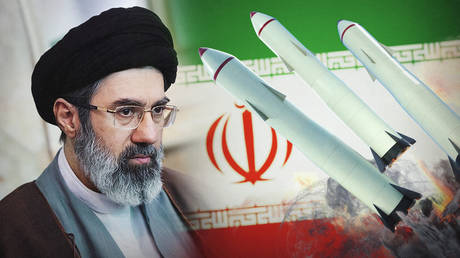
In the weeks since, the technical "breakout time" has become a redundant metric. Iran is no longer hovering at the threshold; it is systematically dismantling the jurisprudential and political barriers that kept it there. The ascent of Mojtaba Khamenei, the late leader's son, to the position of Wali al-Faqih has notably lacked a reaffirmation of his father’s nuclear prohibition. In his first major address to the nation, the younger Khamenei pointedly omitted any mention of the fatwa, focusing instead on "all necessary actions" to preserve the Islamic Republic against what he termed an existential war of annihilation.
The Jurisprudential Void
To understand why the fatwa’s disappearance is more than a rhetorical shift, one must understand the mechanics of Shia authority. A fatwa is not a permanent law. It is a legal opinion tied to the living authority of a Marja’ al-Taqlid, or source of emulation. When the Marja’ dies, his fatwas often lose their binding force for new followers, and even for existing ones, they can be superseded by a successor’s decree.
Khamenei’s ban was never codified as a "hukm-e hukumati"—a state decree that remains in force across leadership transitions. It was a religious opinion. By leaving it in the grave, the new leadership has granted itself a clean slate. This is not a subtle pivot. It is a calculated removal of a self-imposed constraint that the Islamic Revolutionary Guard Corps (IRGC) has long viewed as a strategic liability.
The IRGC’s influence over the transition is absolute. For years, commanders like Majid Musawi have signaled that "extraordinary surprises" were necessary to counter the combined pressure of Israeli strikes and American "maximum pressure" 2.0. The twelve-day war in June 2025, which saw the first major direct strikes on Iranian nuclear infrastructure at Natanz, convinced the hardliners that conventional deterrence—missiles and proxies—had failed. The October 2024 missile exchanges with Israel proved that even hundreds of ballistic missiles could be largely neutralized by sophisticated air defenses. In the eyes of the Tehran's military elite, the only remaining logic is the logic of the mushroom cloud.
Technical Reality Meets Strategic Desperation
The International Atomic Energy Agency (IAEA) is currently blind. Following the February strikes, inspectors were withdrawn for safety, and the "continuity of knowledge" regarding Iran’s centrifuge production and uranium stockpiles has been severed. Before the blackout, the IAEA confirmed Iran held over 400 kilograms of 60% enriched uranium.
Mathematically, the path to 90%—weapons-grade—is a matter of days, not months. The enrichment process follows a non-linear curve; reaching 60% represents roughly 90% of the work required to reach bomb-grade material. Iran already possesses the feedstock. What it lacks, or claimed to lack, was the political will to cross the final five percent.
Key Nuclear Indicators as of March 2026
| Metric | Status | Strategic Implication |
|---|---|---|
| Enrichment Level | 60% (Verified pre-Feb) | Near-instant "breakout" capability. |
| Uranium Stockpile | >400kg of 60% | Enough for approximately 5-7 warheads. |
| IAEA Oversight | Zero | Detection of weaponization is now impossible. |
| Legal Framework | Fatwa expired | No religious barrier to weaponization. |
The Dimona Retaliation and the New Doctrine
The strike near Israel’s Dimona nuclear facility on March 21, 2026, was the opening salvo of this new doctrine. It was a symbolic mirror. By targeting the vicinity of Israel’s own "opaque" nuclear center, Tehran signaled that the era of "strategic patience" is over. This is the "eye for an eye" strategy articulated by the Aerospace Force.
The danger now is no longer a secret program, but an overt one. If Iran conducts a nuclear test—perhaps in the eastern deserts or underground facilities deep within the Zagros mountains—it will fundamentally reorder the Middle East. A nuclear-armed Iran would likely prompt immediate proliferation in Saudi Arabia and Turkey, ending the era of the Non-Proliferation Treaty in the region.
Western intelligence agencies are currently debating whether the February 28 meeting of senior Iranian officials, which was struck by Israel, was the final "go" order for weaponization. Evidence suggests the meeting included top metallurgists and explosives experts from the Defense Innovation and Research Organization (SPND), the entity historically linked to warhead design.
Why Diplomacy Failed
The collapse of the 2025 Oman talks was the final nail. The U.S. demand for a total dismantling of the enrichment program was viewed in Tehran as a demand for unconditional surrender. When Israel struck Natanz mid-negotiation, the "diplomatic track" was exposed as a hollow exercise to the Iranian hardliners.
We are now in a period of "threshold maximum." Iran has the material, the delivery systems (the Fattah-2 hypersonic missiles), and now, the political vacuum necessary to justify the final assembly. The religious barrier is gone. The diplomatic barrier is shattered. The only thing standing between Tehran and the bomb is a final technical decision that may have already been made in the chaos of a leadership transition.
The world spent twenty years debating a piece of paper and a religious ruling. It ignored the reality that in a revolutionary state under siege, theology always bows to survival. The fatwa was a tool of statecraft, and like any tool, it was discarded the moment it no longer served the user. The Islamic Republic is no longer rethinking its doctrine; it has already moved past it.
Would you like me to analyze the specific technical hurdles Iran still faces in miniaturizing a warhead for its current missile fleet?