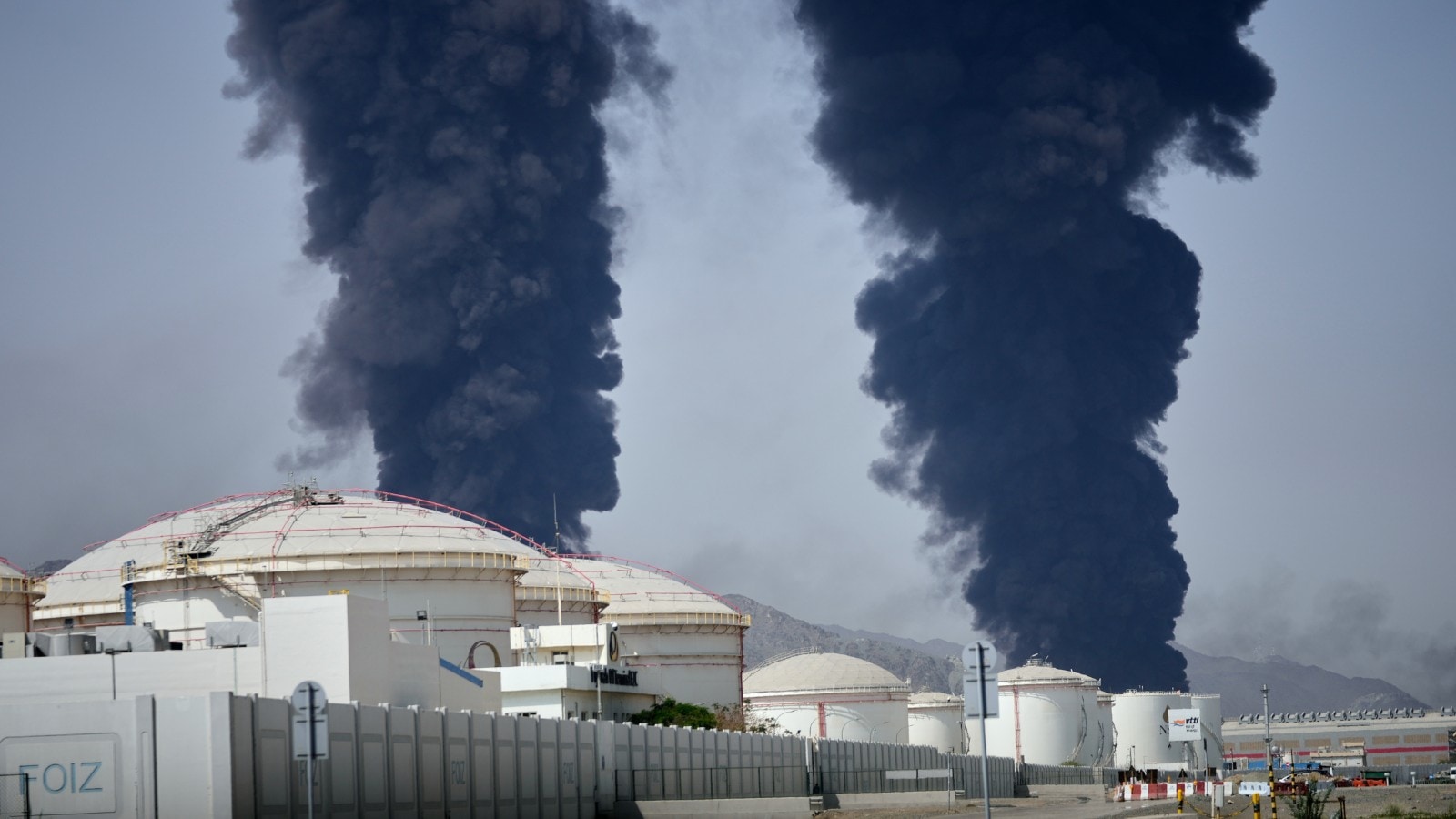
The Port of Fujairah is currently grappling with the operational fallout of a targeted drone strike that has forced a partial suspension of oil loading activities. This is not merely a localized security breach; it is a structural shock to the global energy supply chain. While initial reports focused on the immediate damage to infrastructure, the deeper reality involves a calculated disruption of the world’s third-largest bunkering hub. When a drone penetrates the airspace of a facility that handles over 70% of the UAE’s crude exports, the market reacts not to the fire, but to the fragility.
The strike targeted specific loading arms and storage manifolds, forcing tankers to anchor offshore as safety protocols were triggered. This forced idle time translates to millions of dollars in demurrage costs and a sudden tightening of regional supply. Investors often view the UAE as a safe harbor in a volatile Middle East, but this incident strips away that illusion of invulnerability. It proves that despite sophisticated missile defense systems and heavy naval presence, low-cost "suicide drones" can still bypass multi-billion-dollar security umbrellas to hit the commercial heart of the energy sector.
The Mechanics of a Strategic Bottleneck
Fujairah’s primary value lies in its geography. It sits outside the Strait of Hormuz, providing a vital bypass for oil shipments that would otherwise be at the mercy of Iranian threats to close the narrow waterway. By piping oil from the Habshan fields directly to Fujairah on the Gulf of Oman, the UAE created a strategic "exit door."
However, this centralization of infrastructure has created a massive, fixed target. The recent drone activity reveals that the exit door is just as vulnerable as the hallway leading to it. When loading operations stop, the entire Habshan-Fujairah pipeline—a 360-kilometer artery capable of carrying 1.5 million barrels per day—effectively becomes a stagnant reservoir.
The technical challenge of a drone strike on a loading terminal is the precision of the damage. Unlike a traditional missile that might cause a large, obvious explosion, small-scale loitering munitions are designed to hit "soft" points like valve stations, control rooms, or the flexible hoses used for ship-to-shore transfers. Replacing these components is not a matter of simple construction. They require specialized engineering and testing to ensure they can handle the high-pressure environment of crude oil transfer. This means a single successful hit can lead to weeks of operational delays even if the fire is extinguished within hours.
Market Psychology and the Risk Premium
Oil markets hate uncertainty more than they hate bad news. The immediate reaction to the Fujairah suspension was a spike in Brent crude prices, reflecting a "risk premium" that had been largely dormant. For years, traders assumed the UAE’s domestic security was impenetrable. That assumption has been retired.
The cost of shipping oil from the region is now climbing. Insurers are already reassessing "war risk" premiums for vessels calling at Fujairah. If a tanker is forced to sit in the Gulf of Oman waiting for a berth that may or may not be secure, the daily charter rates become ruinous. Shipowners are now faced with a choice: wait out the repairs or divert to other hubs like Singapore or Rotterdam, both of which are thousands of miles away and already operating near capacity.
The Hidden Cost of Maritime Insurance
Insurance companies use complex models to determine the likelihood of a total loss. When a port like Fujairah is hit, the "breach area" for insurance purposes expands.
- Hull and Machinery (H&M) premiums increase because the physical risk to the ship's structure is higher.
- Protection and Indemnity (P&I) clubs raise rates to cover the potential environmental catastrophe of a spill resulting from an attack.
- Loss of Hire insurance becomes more expensive, as the likelihood of a port being shut down by state or non-state actors is no longer theoretical.
These costs are never absorbed by the oil majors or the shipping companies. They are passed directly down the line to the consumer at the pump. This is the "tax" that geopolitical instability levies on the global economy.
Engineering the Security Response
The failure to intercept the drones points to a specific technical gap in modern electronic warfare. Most radar systems are tuned to look for fast-moving jets or large missiles. A small drone, often made of plastic or carbon fiber and flying at low altitudes, has a radar cross-section no larger than a bird.
Fujairah is surrounded by rugged, mountainous terrain. This topography provides the perfect cover for drones to use "terrain masking," staying below the line of sight of coastal defense batteries until the very last moment. To counter this, the port authority and the UAE military must now look at a "layered" defense strategy. This involves:
- Acoustic Sensors: Deploying microphones that can pick up the specific hum of drone motors long before they appear on radar.
- Directed Energy Weapons: Using high-powered microwaves or lasers to fry the internal electronics of incoming drones without causing a kinetic explosion that could ignite nearby fuel vapors.
- Radio Frequency Jamming: Creating a "black hole" of signal around the loading berths to sever the link between the drone and its pilot or GPS satellite.
The problem with these solutions is their interference with the port’s own communications. A port is a noisy environment, both physically and electronically. Implementing a total electronic shield risks disrupting the very automation systems that keep the oil moving.
The Geopolitical Chessboard
While no group has claimed responsibility with absolute certainty in the immediate aftermath, the fingerprints of regional proxy warfare are visible. The use of drones as a tool of economic sabotage is a hallmark of asymmetric warfare. It allows an aggressor to cause maximum financial pain with minimum resource investment.
For the UAE, the stakes go beyond oil. Fujairah is a cornerstone of their "Vision 2031" economic plan, which aims to diversify the economy while strengthening their role as a global logistics hub. If the world’s shipping fleets begin to view Fujairah as a "hot zone," the billions invested in bunkering facilities, refineries, and liquefied natural gas (LNG) terminals are at risk of becoming stranded assets.
The reaction from the international community has been predictable: calls for de-escalation and the protection of maritime lanes. But words do little to secure a loading arm. The U.S. Fifth Fleet, based in nearby Bahrain, has increased patrols, but they cannot be everywhere at once. The burden of security falls squarely on the UAE, which must now prove it can protect its most valuable piece of real estate.
Infrastructure Resilience and the Path Forward
True resilience in the oil industry is not about preventing every attack; it is about the speed of recovery. The fact that some loading operations were stopped suggests a "fail-safe" mechanism worked, but the duration of the stoppage suggests a lack of redundant hardware on-site.
Moving forward, the industry must treat port security with the same intensity it treats fire safety. This means stockpiling critical components and creating mobile loading stations that can be deployed if a permanent berth is damaged. It also requires a shift in how these facilities are designed. Future terminals may need to be "hardened," with vital piping buried underground or encased in reinforced concrete shelters.
The disruption at Fujairah is a warning shot for every major energy hub in the world. From the Houston Ship Channel to the Port of Al Basrah, the threat of low-cost, high-impact aerial disruption is the new reality of the 21st century.
Companies operating in the region must now conduct a brutal audit of their physical security. If a $2,000 drone can stop a multi-billion dollar operation, the current security model is obsolete. The priority is no longer just "throughput" at any cost, but "defensibility" at all costs. Check the status of your maritime insurance policies and demand a clear, audited security plan from your terminal operators.