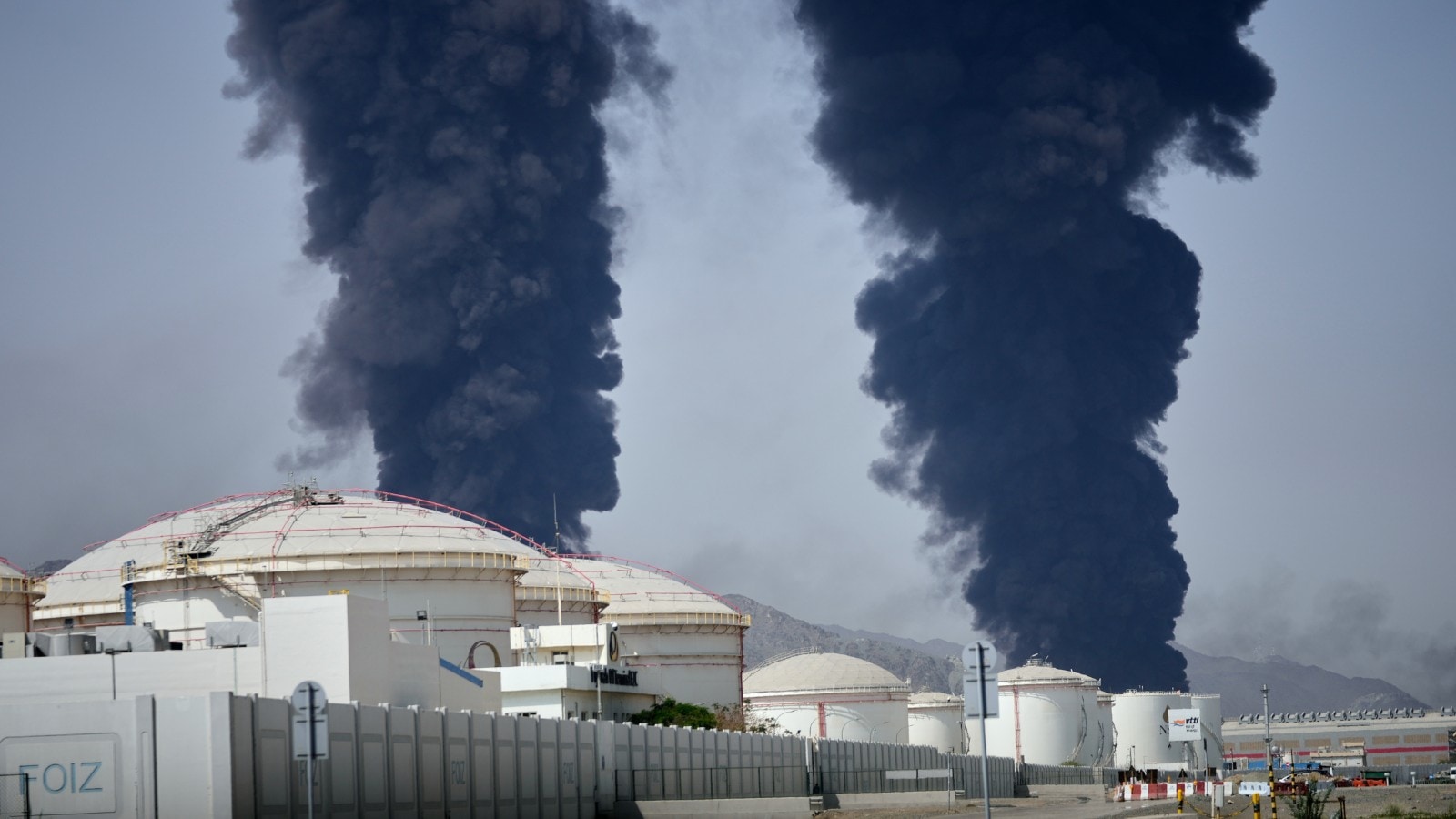
The headlines are screaming. Fujairah is in flames. Iran is rattling sabers over Kharg Island. The "experts" are dusting off their 1973 oil crisis playbooks and telling you to prepare for $150 barrels.
They are wrong. They are lazily connecting dots that don't exist in a modern energy market.
If you are staring at a ticker and waiting for the global economy to collapse because a storage tank in the UAE caught fire, you’ve been fed a narrative built on outdated geography and a fundamental misunderstanding of how the Strait of Hormuz actually functions in 2026. The consensus says we are on the brink of a supply-side catastrophe. The reality is that we are witnessing the dying gasps of the "geopolitical risk premium" as a meaningful market driver.
The Fujairah Fallacy
Let’s dismantle the first myth: that Fujairah is a single point of failure.
The media treats the Port of Fujairah like a fragile glass vase. It isn’t. It is a massive, sprawling industrial complex designed specifically to survive regional instability. When a fire breaks out, the immediate reaction is "Supply Disruption!" In reality, Fujairah’s strategic importance lies in its role as a bypass.
The Habshan-Fujairah pipeline exists for the sole purpose of moving 1.5 million barrels per day (bpd) of Abu Dhabi’s Murban crude to the Gulf of Oman, completely skipping the Strait of Hormuz. A localized fire at a bunkering hub or a storage farm does not shut down the pipeline infrastructure. I have seen traders dump positions because of "smoke over the Gulf" when the actual pumping stations were operating at 105% capacity.
The market has a "visual bias." It sees fire and assumes scarcity. It ignores the fact that global inventories and "oil on water" (tankers currently in transit) provide a buffer that a few burned-out tanks in the UAE cannot penetrate.
Kharg Island and the Retaliation Performance
Now, let’s talk about Iran’s "vow of retaliation" for the US strike on Kharg Island.
Kharg Island handles roughly 90% of Iran’s crude exports. If the US hit Kharg, they didn’t just poke a hornet’s nest; they effectively removed Iran’s primary source of hard currency. When Tehran "vows" to retaliate, you need to look at their balance sheet, not their rhetoric.
The conventional wisdom suggests Iran will shut down the Strait of Hormuz. This is the ultimate "paper tiger" threat.
- Economic Suicide: Closing the Strait stops Iran’s remaining illicit trade and its imports of refined products.
- The Chinese Factor: Who is the biggest buyer of Iranian "ghost" crude? China. Who relies most on a stable Strait of Hormuz? China. Iran is not going to bite the only hand that feeds it by disrupting Beijing’s energy security.
- The Military Reality: Closing a waterway is easy. Keeping it closed against the combined naval power of the US Fifth Fleet and regional players who are tired of the instability is impossible. It would be a 48-hour event, not a months-long blockade.
The "retaliation" will likely be asymmetric and annoying—cyberattacks on desalination plants or drone irritations—but it won’t be the systemic energy shock the doomsdayers are selling.
The Death of the Geopolitical Risk Premium
In the 1990s and early 2000s, a sneeze in the Middle East added $10 to the price of a barrel. Today, that premium is evaporating. Why? Because the supply map has fundamentally shifted.
The United States is the world's largest oil producer. Guyana is ramping up. Brazil is hitting record numbers. The world is no longer hostage to the Persian Gulf's internal dramas. When the "consensus" tells you that a fire in Fujairah is a global threat, they are ignoring the massive surplus of spare capacity held by OPEC+ members outside the immediate conflict zone.
The real threat to your portfolio isn't the fire; it's the overcorrection. High prices are the best cure for high prices. Every time a geopolitical flare-up sends Brent north of $90, it triggers two things: demand destruction in emerging markets and an immediate spike in Western production.
Stop Asking if the Oil Will Run Out
People are asking the wrong questions. They ask, "Will the oil keep flowing?"
The answer is yes. It always does. The profit motive is stronger than the religious or nationalist motive. Even in the height of the Iran-Iraq "Tanker War" in the 1980s, the oil moved.
The question you should be asking is: "Who benefits from the perception of scarcity?"
The beneficiaries are the hedge funds who front-run the news cycle and the state-owned entities that need a temporary price spike to balance their budgets. If you buy into the panic, you are the liquidity they use to exit their positions.
The Logistics Logic
Let’s get technical for a moment. Modern VLCCs (Very Large Crude Carriers) are not easily deterred. The insurance premiums (War Risk Surcharges) will go up, yes. This is a cost-of-doing-business adjustment, not a supply-chain-broken event.
When you see a headline about a fire in the UAE, look at the "Freight on Board" (FOB) prices versus the delivered prices. If the gap isn't widening significantly, the physical market is telling you the news is noise. Right now, the physical market is yawning.
The Contrarian Playbook for Energy Volatility
Most investors do exactly what the media wants: they buy energy stocks at the peak of the fear. This is a recipe for getting trapped.
If you want to actually navigate this:
- Short the Hype, Not the Oil: When the "breaking news" banners appear, wait 4 hours. The initial "algo" trade always overshoots.
- Watch the Tanker Rates: If shipping rates aren't skyrocketing, the "blockade" isn't real. Ships are the ultimate truth-tellers.
- Ignore the "retaliation" rhetoric: Political leaders speak to their domestic audiences. Iranian generals talk big to keep their jobs. Look at where their tankers are moving; that’s their real policy.
The Fujairah fire is a tragic industrial accident, and the strike on Kharg Island is a significant military escalation. But neither of these events changes the fact that the world is currently awash in oil and that the infrastructure of the Middle East is far more resilient than a 280-character tweet suggests.
Stop trading on fear. Start trading on physics and logistics.
The fire will go out. The tankers will keep spinning. The only thing that will truly be lost is the capital of those who mistook a headline for a trend.
Sell the panic. The world isn't running out of energy; it's just running out of new ways to scare you into overpaying for it.