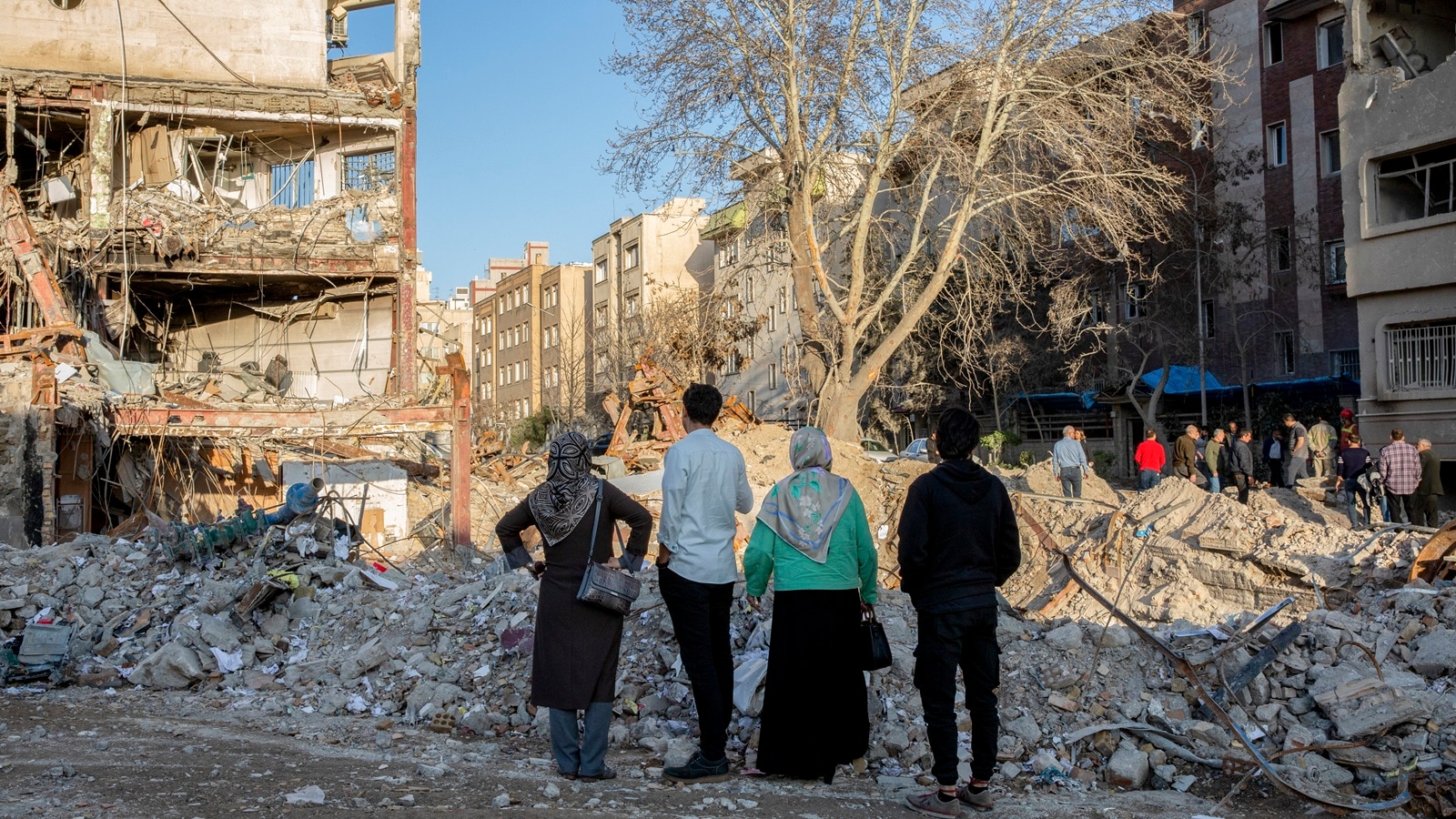
The assumption that targeted kinetic strikes and economic attrition can trigger a grassroots rebellion in a highly securitized state represents a fundamental misunderstanding of the Authoritarian Survival Function. Israel’s strategic calculation—that by degrading the Iranian Islamic Revolutionary Guard Corps (IRGC) and stressing the domestic economy, the Iranian populace would spontaneously move to overthrow the clerical establishment—ignores the structural mechanics of internal repression and the psychology of besieged nationalism. For an external actor to spur rebellion, they must not only degrade the state's capacity to govern but also provide a credible, organized alternative that can overcome the "collective action problem" inherent in high-risk environments.
The Triad of State Resilience
The survival of the Iranian state is not a matter of popularity but of institutional design. Three distinct pillars maintain the status quo, each requiring a different type of pressure to crack:
- The Monopoly on Coercive Logistics: The IRGC and its paramilitary wing, the Basij, are not merely military organizations; they are integrated economic and social entities. When Israel targets IRGC infrastructure or high-ranking personnel, it often strengthens the internal cohesion of these groups by validating their narrative of external existential threat.
- The Fragmented Opposition Matrix: For a rebellion to succeed, the opposition requires horizontal integration (uniting different social classes) and vertical depth (leadership and resources). External strikes are surgically precise but socially blunt; they do not build the communication networks or trust required for the Iranian middle class and the urban poor to coordinate a simultaneous uprising.
- The Rentier-Securitized Economy: While sanctions and "gray zone" operations damage the macroeconomy, the Iranian leadership has mastered the "Economy of Resistance." This involves redirecting dwindling resources to the security apparatus first, ensuring that those responsible for suppressing dissent are the last to feel the financial pinch.
The Cost Function of Dissent
From the perspective of an individual Iranian citizen, the decision to rebel is a rational calculation of risk versus reward. We can model this using a basic Dissent Cost Function:
$$C_d = (P_a \times S_s) - (V_r \times P_s)$$
Where:
- $C_d$ is the net cost of dissent.
- $P_a$ is the probability of apprehension.
- $S_s$ is the severity of state sanction (imprisonment, execution).
- $V_r$ is the perceived value of a successful regime change.
- $P_s$ is the probability of that success.
Israel’s strategy has successfully increased the economic hardship (potentially increasing $V_r$), but it has simultaneously allowed the Iranian state to justify an increase in $P_a$ and $S_s$ under the guise of national security. As long as the state maintains a high $P_a$ (probability of apprehension), the individual cost of rebellion remains prohibitively high for the average citizen. Kinetic operations against nuclear facilities or military commanders do nothing to lower the state’s ability to monitor and arrest its own citizens; in fact, they often provide the pretext for expanded surveillance and "emergency" crackdowns.
The Misalignment of Kinetic Action and Social Catalysis
A primary flaw in the "spur rebellion" theory is the belief that a population will blame their own government for the hardships caused by a foreign adversary. This is the Rally 'Round the Flag effect, a well-documented sociopolitical phenomenon where external threats increase domestic support for the incumbent leadership, regardless of previous grievances.
Structural analysis shows that the Iranian public differentiates between the regime's incompetence and foreign aggression. While the 2022 "Woman, Life, Freedom" protests demonstrated a deep-seated domestic desire for change, those protests were notably organic and detached from foreign military intervention. When Israel or the West is perceived as the primary driver of instability, it allows the regime to frame all domestic dissent as foreign espionage. This "securitization of dissent" is the most effective tool in the IRGC’s arsenal, as it alienates the cautious middle class from the radicalized youth.
The Infrastructure of Repression vs. The Infrastructure of Rebellion
The Iranian state has invested heavily in Sovereign Internet technology and localized surveillance. This creates a technical bottleneck for any rebellion.
- Information Asymmetry: The state can shut down the internet (the "Kill Switch") during periods of unrest, severing the horizontal links between protesters.
- Targeted Neutralization: Using AI-driven facial recognition and signal intelligence, the state can identify and remove "nodes" (protest leaders) before a movement reaches critical mass.
External actors like Israel possess the cyber-capability to disrupt these systems temporarily, but a temporary disruption is not a permanent solution. To facilitate a rebellion, the technical infrastructure of the opposition must be more resilient than the state’s ability to suppress it. Current strategies focus on destroying the state's external-facing military hardware rather than providing the populace with decentralized, unhackable communication tools.
The Economic Paradox of Regime Change
There is a prevailing myth that "starving" a regime leads to its collapse. Historically, the opposite is often true. In a resource-constrained environment, the state becomes the sole provider of essentials. This creates a Dependency Loop:
- Sanctions/Strikes weaken the private sector.
- The state-controlled "Bonyads" (charitable trusts) and IRGC-linked firms monopolize the remaining black and gray markets.
- Citizens become more dependent on state-rationed goods or employment within state-adjacent sectors to survive.
By weakening the independent merchant class (the Bazaaris), external pressure inadvertently destroys the very demographic that has historically funded and led Iranian revolutions.
The Intelligence Gap: Intent vs. Capability
Intelligence agencies often suffer from Confirmation Bias, interpreting small-scale acts of defiance (graffiti, social media posts) as signs of an imminent collapse. However, the gap between discontent and insurrection is vast. To bridge this gap, an opposition needs:
- Defection Incentives: High-ranking military or bureaucratic officials must believe they have a safe harbor if they turn against the regime.
- Institutional Substitutes: There must be a "shadow government" ready to prevent total state collapse, which usually leads to civil war rather than democracy.
Israel’s strategy has focused almost exclusively on the "destruction of the old" without any visible investment in the "construction of the new." This leaves the Iranian public with a choice between a repressive but stable status quo and the chaotic uncertainty of a power vacuum—a choice that usually favors the status quo.
Strategic Reorientation: The Long-Term Equilibrium
The current stalemate suggests that the Iranian regime has reached a "low-level equilibrium." It is strong enough to prevent a coup or a revolution, but too weak to project power without incurring significant external costs. Israel’s kinetic strikes maintain this equilibrium by "mowing the grass"—limiting the IRGC’s reach—but they do not change the soil.
If the objective is truly domestic transformation within Iran, the strategy must shift from Degradation of Hardware to Empowerment of Software. This involves:
- Bypassing the Sovereign Web: Not just through VPNs, but through hardware-level satellite communication that the state cannot physically seize.
- Economic Decoupling: Creating financial rails that allow the Iranian diaspora to fund domestic labor strikes without the funds being intercepted by the central bank.
- Psychological Disruption: Moving away from threats of "total destruction," which empower hardliners, toward a strategy that highlights the specific corruption of the IRGC elite compared to the suffering of the regular army (Artesh).
The failure to spur rebellion is not a failure of intelligence; it is a failure of sociology. You cannot bomb a population into a revolution; you can only provide the conditions where the risk of staying quiet finally exceeds the risk of speaking out. Currently, the IRGC ensures that the risk of speaking out remains absolute, while the external threats ensure the population remains too frightened to risk the alternative.
The strategic play is to stop targeting the IRGC's missiles and start targeting their HR department. Undermining the loyalty of the mid-level officer who has to choose between firing on his neighbor or joining the crowd is the only path to structural change. Kinetic strikes on the neighbor’s house only make the officer’s job easier.