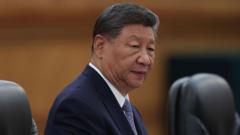
Beijing just signaled that the long-standing truce between the old guard and the current administration is over. By stripping three retired generals—Liao Xilong, Zhang Yang (posthumously), and a cohort of high-ranking veterans—of their positions within the Chinese People’s Political Consultative Conference (CPPCC), the central leadership has moved beyond mere housekeeping. This is a deliberate dismantling of the power bases that once dictated the internal logic of the People’s Liberation Army (PLA).
The removal of these figures is not a routine administrative update. In the opaque world of Zhongnanhai, the "national advisory body" serves as a gilded cage for the retired elite. When the doors of that cage are kicked open, it signifies a total loss of political protection. The core message is simple. No one, regardless of their past service or their distance from active duty, is immune to the ongoing consolidation of power. For a different view, check out: this related article.
The Ghost of the General Logistics Department
To understand why these specific removals matter, one must look at the General Logistics Department (GLD). This was once the engine room of military corruption, a multi-billion dollar machine that managed land, housing, and food supplies for millions of personnel.
Historically, the GLD operated with almost zero oversight. It was the primary source of the "gray income" that allowed generals to build private fortunes while ostensibly serving the state. Liao Xilong, a veteran of the Sino-Vietnamese War, presided over this department during a period of massive expansion. His removal isn't just about his individual actions; it’s a targeted strike against the patronage networks he helped build. These networks are more than just bank accounts. They are informal chains of command that compete with the official hierarchy. Further coverage on this matter has been provided by Associated Press.
The Problem of Parallel Authority
When a leader seeks to modernize a military, they face the hurdle of parallel authority. These are the "old bosses" who still hold sway over current commanders. By decapitating the retired leadership, the current administration ensures that the current brass looks only toward the Central Military Commission (CMC) for orders.
The military cannot operate as a modern, high-tech force if its promotions are still decided by the ghost of a logistical boss from 2005. The shift from a legacy of "favor-trading" to a professionalized, merit-based system requires the total erasure of the previous era's heavyweights. It is a brutal necessity.
Beyond the Surface Level of Anti Corruption
Most analysts look at these removals and see a simple anti-corruption drive. That is a surface-level interpretation. Corruption in the PLA has never been a bug; it was a feature. For decades, the central leadership allowed generals to profit from land deals and construction projects as a way to ensure their loyalty. It was a tacit agreement: stay out of politics, and we will let you get rich.
That agreement has been torn up. The modern strategic requirement is Combat Readiness.
A general who has spent his career navigating real estate deals in the GLD is not a general who can win a high-intensity conflict in the South China Sea or the Taiwan Strait. The administration has realized that the rot of the logistics department has a direct impact on the quality of hardware and the reliability of the supply chain. If a general is taking kickbacks on fuel or tires, those tires will fail in the field.
Weaponizing the Advisory Body
The CPPCC is often dismissed by Western observers as a "rubber stamp" body. That’s a mistake. In the Chinese political ecosystem, it is a barometer of safety. Being a member means you are still "inside the tent."
When the CCPCC removes a member, it is the political equivalent of a "dead man walking" notice. It signals to the rank-and-file that the person’s influence is officially dead. This prevents subordinates from trying to shield their former mentors. It forces the mid-level officers to choose between a falling star and the rising sun of the current CMC leadership.
The Strategic Importance of the 2026 Milestone
The timing of these moves is critical. As the PLA moves toward its 2027 modernization goals, there is no room for dissent or divided loyalties. The three retired generals represent a past that prioritized regional land-based power and internal stability over global power projection.
The new PLA must be lean, joint-force capable, and digitally integrated. Legacy generals often resist these changes because they diminish the importance of the old ground-force structures where they built their careers. By removing the veterans, the administration is clearing the intellectual deck for a new type of warfare.
Reclaiming the Assets
Beyond the political theatre, there is a massive financial component to this reshuffle. The military owns an incredible amount of prime real estate across China. For decades, this land was controlled by local commands and the GLD, with the profits staying within those closed loops.
The central government is now clawing back that wealth. By stripping these generals of their status, the state can more easily seize assets and redirect that capital into Research and Development (R&D) and naval expansion. This is a massive wealth transfer from the "retired elite" back to the "central state."
Risks of the Total Cleanse
While the consolidation of power makes the military more responsive to the center, it creates a vacuum of experience. The PLA hasn't fought a major war since 1979. The retired generals, for all their faults, were the last link to a combat-tested era.
When you purge the old guard, you lose the institutional memory of how the machine actually works under stress. The risk is that the new, "loyalist" generation of officers will be more concerned with political correctness than with actual tactical innovation. They may become "yes men" who tell the CMC exactly what it wants to hear, leading to catastrophic miscalculations in a real-world conflict.
The Paranoia Factor
A military that is constantly looking over its shoulder is a military that is afraid to take risks. If an officer sees their former mentor being stripped of their honors twenty years after retirement, they will likely avoid any action that could be interpreted as a deviation from the party line. This kills the initiative required for modern, decentralized warfare.
The current administration is betting that centralized control is more valuable than individual initiative. In the short term, this secures the party's grip on the gun. In the long term, it may hobble the very military it is trying to perfect.
Identifying the Invisible Targets
The public removal of these three generals is the visible tip of the iceberg. Below the surface, hundreds of lower-level colonels and administrative staff are being quietly sidelined. These are the people who handled the paperwork, the bank transfers, and the logistics for the old guard.
To truly dismantle a power base, you have to go after the "middle management." This creates a culture of fear that permeates every level of the organization. No one knows who is next, and that uncertainty is the most effective tool of control.
The Paper Trail of the GLD
The investigation into the GLD has likely produced a massive cache of documents that link current officers to past scandals. This is the "sword of Damocles" hanging over the entire officer corps. The administration doesn't need to purge everyone; it only needs to have the ability to purge everyone.
By making an example of high-profile retirees, the CMC effectively buys the silence and cooperation of everyone else. It is a masterclass in psychological warfare applied to one's own military.
Restructuring the Chain of Command
This isn't just about personalities; it’s about the Theater Command system. The old system was based on Military Regions, which were almost like independent fiefdoms. The new Theater Commands are designed for joint operations—navy, air force, and army working together.
The retired generals were the kings of the old Military Region system. Their removal marks the final death of that decentralized model. The new structure funnels all decision-making power through the CMC in Beijing. This ensures that the military can be deployed quickly and decisively without the interference of local power brokers who might have their own agendas or business interests to protect.
The Cold Reality of the PLA Modernization
The removal of Liao Xilong and his peers is a clear signal that the PLA is no longer a "career military" in the traditional sense of building a lifelong safety net. It is being forged into a tool of national power that demands absolute, unswerving obedience to the central authority.
The era of the "General-Businessman" is over. In its place is a professional class of officers who understand that their survival depends entirely on their ability to meet the technical and political benchmarks set by Beijing. The stakes have never been higher for the men and women in uniform.
The purge of the retired elite is a necessary step for a leader who intends to move the nation toward a collision course with global rivals. You cannot go to war with a divided house. By clearing out the remnants of the old guard, the administration is making it clear that the house is now fully under one roof. The military is no longer a collection of interests; it is a single, sharpened blade. Whether that blade is as sharp as the administration believes is a question that only a future conflict can answer.
The message to the remaining veterans and the current brass is unambiguous. The past is a dangerous place, and the future belongs only to those who are completely aligned with the new order. The transition from a legacy force to a modern superpower requires the ruthless elimination of any alternative power centers. This is the reality of the 21st-century PLA.
Those who fail to adapt to the new metrics of loyalty and combat readiness will find themselves joining the ranks of the "removed," their decades of service erased by a single decree from the center. The march toward 2027 continues, and the ranks are being thinned to ensure that only the most dedicated remain. This is the price of total control.