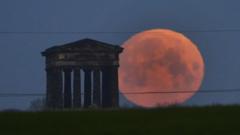
The Full Worm Moon is currently crossing the British night sky, marking the final celestial milestone before the spring equinox. While mainstream reports often treat these events as mere aesthetic curiosities, the appearance of this specific moon is a complex intersection of orbital mechanics, atmospheric optics, and a psychological trick of the mind that has baffled observers for centuries. This is not just a bright light in the sky. It is a predictable consequence of the Moon's elliptical orbit reaching a point where the geometry of the Earth-Moon-Sun system aligns to produce maximum illumination.
The Mechanics of the March Orbit
To understand why this moon looks the way it does, we have to look at the math of the lunar cycle. The Moon does not circle the Earth in a perfect ring. It moves in an ellipse. When the Moon reaches the point in its orbit closest to Earth, known as perigee, it appears significantly larger and brighter than when it is at its furthest point, or apogee. The March full moon often sits at a specific juncture where the tilt of the Earth’s axis begins to favor the Northern Hemisphere, changing the angle at which we perceive the lunar disc through our atmosphere.
The name "Worm Moon" is frequently attributed to Native American tribes, specifically referencing the time of year when the ground begins to thaw and earthworm casts reappear. However, there is a deeper historical layer. To many colonial settlers, it was known as the Lenten Moon, signaling the period of fasting and the approach of Easter. The timing is dictated by the Metonic cycle, a period of approximately 19 years after which the phases of the Moon recur on the same days of the year.
The Persistence of the Lunar Illusion
One of the most frequent claims during any full moon event in the UK is that the moon looks "massive" as it rises over the horizon. It is a lie told by your brain. If you were to take a photograph of the moon at the horizon and another when it is high in the sky using the same lens, the size of the lunar disc would be identical. This phenomenon is known as the Moon Illusion.
Scientists have debated the cause of this for decades. The most prominent theory is the Ponzo Illusion. When the moon is near the horizon, your brain sees it alongside familiar objects like trees, buildings, or distant hills. Because your mind knows those objects are far away, it compensates by "enlarging" the moon to make sense of the scale. When the moon is high in the empty sky, there are no reference points, and the brain perceives it as its actual, smaller size.
Another factor is atmospheric refraction. As lunar light passes through the thickest part of the Earth's atmosphere near the horizon, the light waves are bent. This can cause the moon to appear flattened or slightly distorted, and it often shifts the color palette toward deep oranges and reds. This happens because shorter blue wavelengths are scattered away, leaving only the longer red wavelengths to reach your eyes.
Watching from the British Isles
Observing the Full Worm Moon in the UK presents unique challenges compared to lower latitudes. The North Atlantic Drift creates a consistent layer of high-altitude moisture that can obscure the view or, in better conditions, create a lunar halo. This halo is a ring of light caused by the refraction of moonlight through hexagonal ice crystals in cirrus clouds.
For the best viewing experience, timing is everything. The moon reaches its peak illumination when it is 180 degrees opposite the Sun in geocentric longitude. For the UK, this often occurs during the early morning hours or late evening, depending on the exact day of the cycle.
- Avoid Light Pollution: The sheer brightness of a full moon can wash out the stars, but urban light pollution still degrades the contrast.
- The Horizon View: Find a location with a clear view of the eastern horizon at sunset. The "Moon Illusion" is strongest during the first twenty minutes of the moonrise.
- Equipment: While the naked eye is sufficient, a basic pair of 10x50 binoculars will reveal the Tycho Crater and the Maria (the dark basaltic plains formed by ancient volcanic eruptions).
The False Promise of the Supermoon Label
In recent years, the term "Supermoon" has been used with reckless abandon by digital media outlets to drive traffic. It is a term coined by an astrologer, not an astronomer. While the Full Worm Moon can coincide with perigee, the actual difference in perceived size is roughly 14%. To the average observer, this is almost impossible to distinguish without side-by-side photographic evidence.
The obsession with these labels often distracts from the genuine science of the event. We are looking at a celestial body that is 384,400 kilometers away, reflecting sunlight with an albedo of about 0.12. It is a dead, rocky world that dictates the tides of our oceans and, historically, the planting cycles of our ancestors.
Orbital Synchronization and the Equinox
The significance of the March full moon is also tied to the Vernal Equinox. In the Gregorian calendar, the first full moon following the equinox determines the date of Easter. Because the lunar year is roughly 11 days shorter than the solar year, the Full Worm Moon sometimes falls before the equinox and sometimes after. When it falls before, as it often does, it serves as the "warning" moon that winter is definitively ending.
The shift in the moon’s path across the sky is also notable. During the winter, the full moon tracks high in the sky, mimicking the path the sun takes in the summer. As we move toward spring, the moon's nightly arc begins to sit lower. This transition changes the shadows cast on the lunar surface, making the craters along the terminator line (the divide between light and dark) appear more pronounced during the waxing and waning phases surrounding the full moon.
Technical Details for Photography
If you are attempting to document the Full Worm Moon, you must fight the camera’s internal logic. Most smartphones will overexpose the moon, turning it into a white, featureless blob. The moon is a sunlit object; you should use settings similar to those you would use on a bright day on Earth.
$$f/11 \text{ stop at } 1/\text{ISO speed for the shutter speed}$$
This "Looney 11" rule is a standard starting point for manual photography. By keeping the aperture at $f/11$, you ensure enough depth and clarity to capture the geographic features of the lunar surface. Use a tripod. Even the slightest hand tremors at high focal lengths will blur the image and ruin the sharp edges of the lunar limb.
The atmosphere acts as a lens. On a cold, clear night in the UK, the air is more stable, leading to what astronomers call "good seeing." If the stars are twinkling violently, the air is turbulent, and your photos will likely be soft. If the stars are steady, the atmosphere is still, and you have a rare window for high-resolution imaging.
The Cultural Weight of the Lunar Cycle
Beyond the physics, the Full Worm Moon carries a heavy psychological weight. For centuries, the return of the moon in March was a signal for the resumption of travel and trade that had been frozen by winter. In the modern era, we have largely disconnected from these natural rhythms, replaced by artificial lighting and 24-hour digital cycles.
Reclaiming the act of observing the moon is a way to re-align with the physical reality of the planet. It is a reminder that despite our technological advancements, we are still tethered to the gravitational pull of a satellite and the tilt of a spinning globe. The Worm Moon is the final act of a cold season.
Step outside tonight and look East about thirty minutes after sunset.