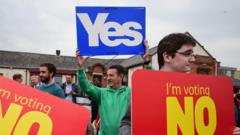
The Binary Trap
The British media loves a comfortable binary. For over a decade, the narrative surrounding Scottish politics has been frozen in 2014, a perpetual loop of "Yes" versus "No" that ignores the rotting floorboards of the actual house. If you read the standard analysis, you’re told that independence is the "defining line" because of deep-seated ideological rifts or a fundamental clash of identities.
That is a lazy consensus. It’s a convenient fiction maintained by a political class that has run out of ideas.
The constitutional divide isn't a sign of a vibrant, engaged electorate. It is a heat sink. It is where difficult questions about economic productivity, failing public services, and a demographic time bomb go to die. We aren’t divided by a dream of a new state or the preservation of an old one; we are paralyzed by a "constitutional hobbyism" that allows politicians on both sides of the border to avoid governing.
The Myth of the "Informed Voter"
Standard political commentary assumes the Scottish voter is weighing the macroeconomics of the GERS (Government Expenditure and Revenue Scotland) report against the abstract virtues of British Unionism.
I have spent fifteen years in the rooms where these strategies are built. Nobody believes the GERS data is being used for honest inquiry.
Unionists weaponize the multi-billion pound "fiscal transfer" as a threat—a "too poor, too small" cudgel. Nationalists dismiss it as an accounting trick designed by Westminster to hide Scotland’s true wealth. Both are wrong, and both know it.
The reality is that Scotland’s fiscal position is a symptom of a wider UK disease: a London-centric service economy that has systematically hollowed out industrial bases and failed to invest in high-growth infrastructure. Independence doesn't magically fix a 9.4% notional deficit, nor does the Union provide a "broad back" that isn't already buckling under its own weight.
Identity as a Management Tool
Why does the "independence line" persist if the economic arguments are a wash? Because identity is the cheapest form of political mobilization.
If you can convince a voter that their entire moral framework is tied to a flag—whether it's the Saltire or the Union Jack—you don't have to deliver on education. You don't have to fix the highest drug death rate in Europe. You don't have to explain why the "Scottish Mortgage" is becoming an oxymoron for the under-30s.
The Scottish National Party (SNP) and the Scottish Conservatives are two sides of the same coin. They are symbiotic organisms. The Tories need the threat of a "break-up of the UK" to scare their base into relevance. The SNP needs a "Westminster villain" to mask the fact that, after nearly two decades in power, their domestic record is a graveyard of missed targets.
The Demographic Delusion
While the press focuses on the "constitutional divide," the real divide is generational and existential.
Scotland is aging faster than the rest of the UK. We are looking at a future where the tax base shrinks while the cost of social care and healthcare explodes. Neither side of the independence debate has a credible plan for this.
- The Independence Argument: "We will attract high-skilled migrants and rejoin the EU." This ignores the reality that every other European nation is competing for that same pool of labor, and a new border at Gretna isn't exactly a magnet for global talent.
- The Unionist Argument: "We are stronger together within the UK's internal market." This ignores the fact that the UK's growth has been stagnant since 2008, and being tethered to a sinking ship isn't a "strength."
Imagine a scenario where the "border" isn't a line on a map, but a wall between the working-age population and an unsustainable pension liability. That is the crisis hitting Scotland in 2030, and "Constitution Talk" is the white noise used to drown out the sirens.
The Brexit Red Herring
The common refrain is that Brexit changed everything. It provided the "material change in circumstances."
Actually, Brexit did something far more damaging: it proved that breaking up a complex political and economic union is a logistical nightmare that yields almost zero immediate "sovereignty dividends." The Scottish public watched the Brexit fallout and, despite the polling showing a narrow preference for independence, developed a profound "change fatigue."
The divide remains because it is a stalemate of fear. The "No" side is afraid of the unknown risks of separation. The "Yes" side is afraid of a future where they remain trapped in a UK that feels increasingly alien.
Fear doesn't build a nation. It doesn't save a union. It just keeps the status quo on life support.
Devolved Impotence
We need to stop pretending the Scottish Parliament is a powerhouse of radical policy. It has become a glorified council.
The "independence divide" allows Holyrood to blame Westminster for every failure, and Westminster to blame Holyrood for every overspend. It is a circular firing squad where the only casualties are the citizens.
I’ve seen civil servants spend months drafting papers on "The Future of an Independent Scotland" while the current attainment gap in schools widens. That isn't governance; it's LARPing (Live Action Role Playing).
The Real Fiscal Reality
The debate we should be having is about the Laffer Curve—at what point does Scotland's divergent tax regime actually begin to shrink the tax base?
$$t = \frac{R}{B(t)}$$
Where $t$ is the tax rate, $R$ is revenue, and $B(t)$ is the tax base as a function of the rate. Currently, Scotland is testing the limits of $t$ without seeing a corresponding rise in $R$ that justifies the risk of capital flight to the south.
Stop Asking "Should Scotland Be Independent?"
It’s the wrong question. It’s a 20th-century question in a 21st-century world where power is increasingly held by transnational corporations and digital infrastructure rather than nation-states.
The real question is: "How do we make the Scottish economy productive enough to survive the next thirty years?"
The answer to that question doesn't care about the constitutional divide. It requires:
- Total planning reform to allow for massive energy and housing infrastructure.
- A radical overhaul of the education system that prioritizes technical competence over "soft" targets.
- A ruthless focus on the 'middle-income trap' that sees Scotland's brightest move to London or abroad because there is no ladder for them at home.
The independence debate is a luxury we can no longer afford. It is a hobby for a political class that prefers arguing about flags to the grueling work of economic reconstruction.
The "dividing line" isn't between those who love Scotland and those who love Britain. It’s between those who want to keep arguing about the 1707 Act of Union and those who realize the 2030s are going to bury us if we don't start building something real.
Put the flags away. The house is on fire.
Would you like me to analyze the specific economic growth data of the Scottish tech sector compared to the rest of the UK to see where the real "independence" might come from?