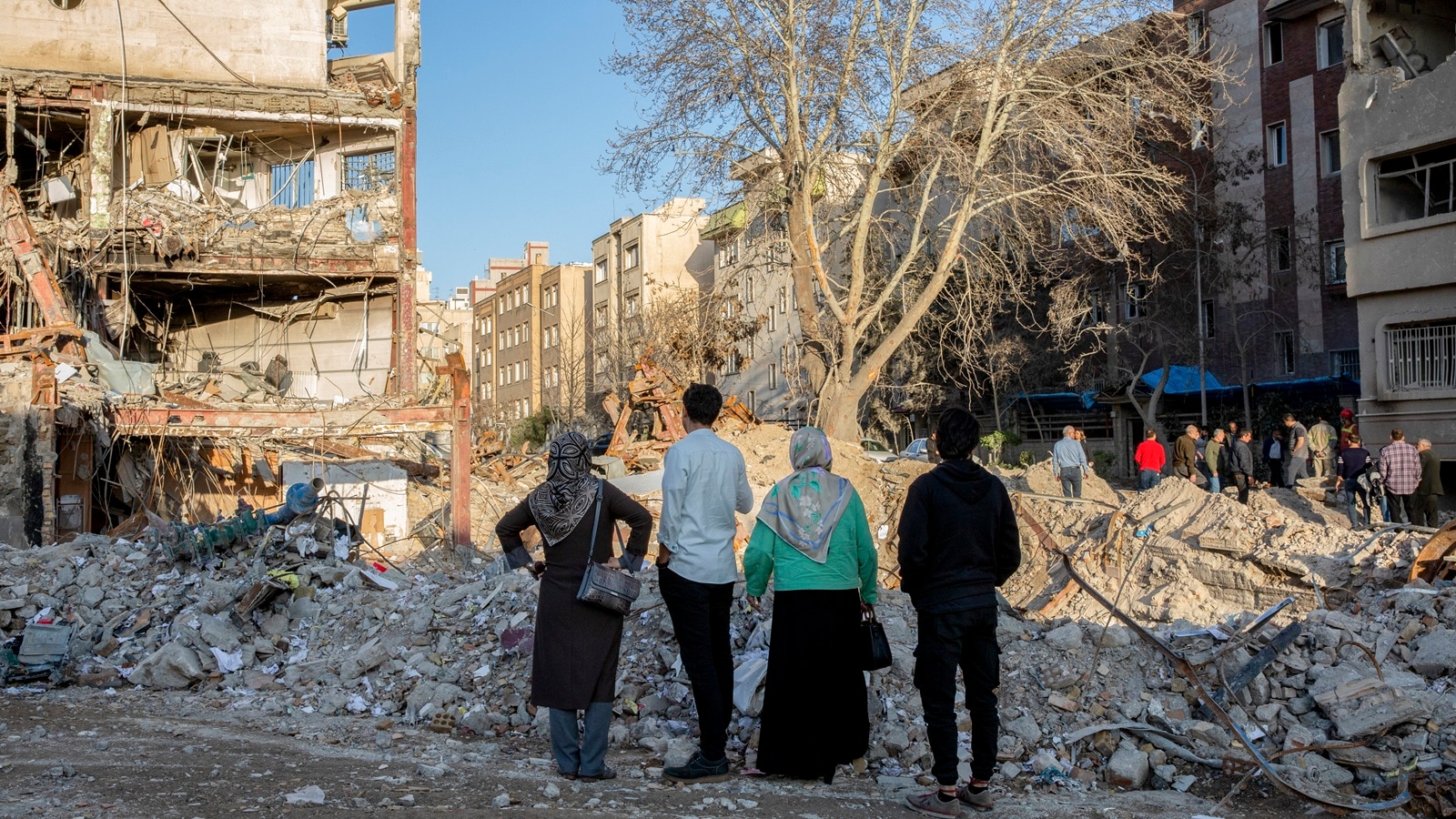
The headlines are screaming about a quagmire. They talk about Israel "getting stuck" in a new front, falling into an Iranian trap, and facing a "dangerous new ally" after a wave of 60 strikes in a single day. It makes for great clickbait. It also reveals a fundamental misunderstanding of 21st-century kinetic warfare.
Most analysts are still playing Risk on a cardboard map. They see more strikes and more actors as a sign of weakness or overextension. They are wrong. What we are witnessing isn't a country "getting stuck"—it is the intentional, violent dismantling of the "Ring of Fire" strategy that Iran spent thirty years and billions of dollars building.
If you think 60 strikes in 24 hours is a sign of desperation, you haven't been paying attention to the math of modern attrition.
The Myth of the "Sovereignty Trap"
The common narrative suggests that by striking a new country, Israel has widened the war to its own detriment. This assumes that borders still function as shields for proxy groups. They don't.
For decades, the Middle East operated under a "gentleman's agreement" of gray-zone warfare. Iran used proxies in Lebanon, Iraq, Yemen, and Syria to bleed Israel, while keeping its own hands clean and its territory safe. Israel, in turn, usually played defense or launched limited "mowing the grass" operations.
That era is dead.
By hitting targets across multiple borders simultaneously, Israel is signaling that the old rules of "proxy sanctuary" are over. The "trap" isn't for Israel; it’s for the host nations that allowed their soil to become Iranian launchpads. When you see 60 strikes in a day, you aren't seeing a military flailing. You are seeing a target list that has been curated for a decade being executed with terrifying efficiency.
The "New Ally" Delusion
The media loves a new villain. Every time a militia in Iraq or a faction in a neighboring state fires a drone, it’s framed as a "game-changing alliance."
Let’s be real: These aren't new allies. These are the same remnants of the Axis of Resistance that have been under Iranian command since the 2000s. Calling them a "new threat" is like calling a backup quarterback a "secret weapon" when the starter gets sacked.
The math of these "60 strikes" tells a different story:
- Volume vs. Velocity: 60 strikes in a day is high volume, but what was the impact? Most of these are low-cost, off-the-shelf drones or unguided rockets.
- Intercept Economics: Yes, it costs more to intercept a drone than to build one. But it costs infinitely more to rebuild a command-and-control center than it does to launch a swarm of plastic toys.
- Intelligence Superiority: You cannot hit 60 targets accurately in 24 hours without deep, structural penetration of your enemy's communication networks.
Israel isn't "trapped" by these new actors. It is using them as a live-fire laboratory to prove that the Iranian proxy model is fundamentally broken. When the proxy can no longer protect itself—let alone threaten the heart of the enemy—the proxy becomes a liability to Tehran, not an asset.
Attrition is the Point, Not the Problem
I’ve watched military budgets evaporate in real-time when leadership fails to understand attrition. The "lazy consensus" says that a long war favors the insurgency. That is usually true in counter-insurgency (COIN) operations where you are trying to win hearts and minds.
This isn't a COIN operation. This is a structural demolition.
Israel is betting that it can destroy Iranian infrastructure faster than Iran can replenish it. This is a bold, dangerous gamble. It requires a level of domestic endurance that most Western nations lack. But from a purely military standpoint, the "entrapment" narrative fails because it ignores the asymmetry of the damage.
Imagine a scenario where a boxer is being hit by ten different people. The crowd thinks the boxer is losing because he’s being attacked from all sides. But the boxer is the only one wearing gloves, and every time he swings, he breaks a jaw. The other ten are bare-knuckled and hitting his ribs. It hurts the boxer, sure. But his opponents are leaving the ring in ambulances.
The Intelligence Gap Nobody Talks About
Why were there 60 strikes? Because the target bank is finally being cleared.
In traditional warfare, you hold back. You save your best intelligence for the "big one." What we are seeing now is the realization that the "big one" is already here. Israel is burning through years of mossad-harvested data.
The risk isn't "getting stuck." The risk is intelligence exhaustion. Once you've hit every known warehouse, every hidden bunker, and every mid-level commander in a 500-mile radius, what do you do for an encore?
The competitor's article claims Iran found a "dangerous ally." The truth is more clinical: Iran found a way to stay in the news while its primary deterrent—Hezbollah's missile array—is being systematically picked apart.
The Economic Reality of the Long War
Critics point to Israel’s credit rating and the cost of mobilization as proof that the "strike" has backfired. This is the most "professional" argument, and it’s the one that carries the most weight. War is expensive.
However, the cost of not striking is higher. The "status quo" was an economy under constant threat of a massive, coordinated invasion from three sides. By shifting to a proactive, multi-front offensive, Israel is attempting to "reset" the regional cost of doing business.
They are telling the world: "We will accept a one-year recession to prevent a thirty-year decline."
It’s a brutal, cold-blooded calculation. It might not work. But calling it a "trap" implies Israel walked into this blindly. They didn't. They kicked the door down.
Stop Asking if They are "Stuck"
The question isn't whether Israel is "trapped" in another country. The question is whether any country in the region can actually stop them.
So far, the answer is a lot of noise, 60-plus low-impact strikes, and a lot of empty rhetoric from Tehran. Iran is playing a psychological game, trying to convince the West that Israel is failing. The West, eager for a return to "stability" (which is just a code word for the old, failing status quo), is buying it.
Don't buy it.
We are seeing the birth of a new doctrine: Hyper-Active Defense. It’s messy. It’s violent. It ignores international "concerns" in favor of cold, hard security reality.
If you want to understand what's happening, stop looking at the number of missiles fired. Start looking at the map of Iranian influence. It’s shrinking for the first time in three decades.
The 60 strikes aren't a sign of Israel's weakness. They are a funeral march for the Iranian proxy strategy.
Either you see the demolition for what it is, or you keep wondering why the "trapped" lion keeps winning the fights.
Pick one.