The coffee in the plastic cup had gone cold long before the first exit polls flickered onto the screen at the town hall. In Erfurt, the air didn't smell like revolution. It smelled like damp pavement, bratwurst grease, and the peculiar, electric tension that precedes a thunderstorm. For decades, this corner of eastern Germany had been a place where people spoke in whispers about the past and looked at the future with a squint, as if trying to protect their eyes from a sun that never quite rose.
Then came the numbers. Meanwhile, you can explore related developments here: The Cold Truth About Russias Crumbling Power Grid.
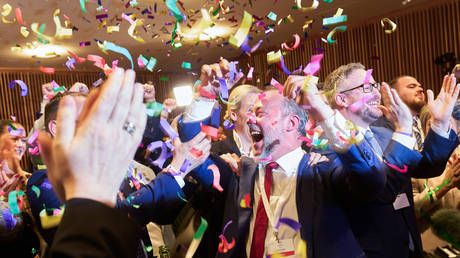
The Alternative for Germany (AfD) didn't just win a seat at the table. They kicked the door off the hinges. With roughly 32.8% of the vote in Thuringia, they became the first far-right party to win a state election in Germany since the dark days of the 1940s. In neighboring Saxony, they snapped at the heels of the conservatives, trailing by a fraction of a percentage point.
To the bureaucrats in Berlin, this is a data point. A "milestone." A crisis for the "firewall"—that invisible, political pact designed to keep the far-right out of power. But to understand why a third of a province decided to set the established order on fire, you have to look past the bar charts. You have to look at the hands that cast the ballots. To see the full picture, we recommend the excellent article by Reuters.
The Geography of Resentment
Imagine a man named Klaus. He is a hypothetical composite of the voters I spoke with in the weeks leading up to the vote—men and women who feel like ghosts in their own country. Klaus is fifty-five. He remembers the fall of the Wall not as a cinematic triumph of liberty, but as the moment his world became a bargain bin. His factory closed. His qualifications were suddenly worth less than the paper they were printed on.
For thirty years, Klaus was told to be patient. To "modernize." To wait for the "blossoming landscapes" promised by Western politicians. He watched the young people leave for Munich and Frankfurt. He watched the local grocery store turn into a betting shop. He watched the headlines focus on climate change and gender-neutral pronouns while his heating bill doubled and the nearest hospital moved thirty kilometers away.
The AfD didn't give Klaus a solution. They gave him a mirror. They told him his anger wasn't a personal failure; it was a righteous defense of a home that was being stolen by "outsiders" and "globalists."
The political establishment treats these voters like a collective fever that needs to be broken. They point to Björn Höcke, the AfD leader in Thuringia, a man a German court ruled could legally be called a "fascist." They point to the extremist rhetoric and the surveillance by domestic intelligence agencies. They expect the horror of history to act as a deterrent.
They are wrong. For many in the East, the "firewall" isn't a safety feature. It is a fence that keeps them out.
The Architecture of the New Right
The shift we are seeing is not a sudden flare-up. It is a slow-motion tectonic move. Historically, German politics relied on a broad, stable center. The Christian Democrats (CDU) and the Social Democrats (SPD) were the twin pillars of the federal republic. They offered a predictable, slightly dull stability.
That stability is dead.
In Thuringia, the SPD—the party of the sitting Chancellor, Olaf Scholz—plummeted to single digits. Think about that for a heartbeat. The party leading the national government is practically an endangered species in the East. The "traffic light" coalition in Berlin (named for the red, yellow, and green colors of the parties) is blinking a frantic, warning amber.
The AfD's strategy was surgical. They didn't bother with the polished, sterile debates of national television. They went where the people were. They mastered TikTok, flooding the feeds of young voters with high-energy, simplified messages about national pride and the "failure" of migration policy. While the established parties were arguing over the nuances of the "debt brake" in committee rooms, the AfD was in the village squares, handing out blue balloons and telling people their frustrations were valid.
It worked. The youth vote, once the stronghold of the Greens, shifted significantly toward the right. It turns out that if you grow up in a town with no cinema, no reliable internet, and a sense that the world is moving on without you, the promise of "disruption" sounds a lot more like hope than a threat.
The Invisible Stakes
What happens when the "unthinkable" becomes the "unavoidable"?
The immediate reality is a legislative gridlock. Because every other party has sworn never to govern with the AfD, forming a majority in Thuringia is now a mathematical nightmare. The CDU, which came in second, has to find a way to build a coalition that includes the far-left BSW (the Bündnis Sahra Wagenknecht).
The BSW is its own brand of political vertigo. Led by a charismatic former communist, it combines old-school socialist economics with a hardline stance on migration and a skeptical view of NATO. To watch the center-right CDU attempt to shake hands with the BSW just to keep the AfD at bay is to watch a political system trying to survive by swallowing its own tail.
But the real stakes aren't in the coalition agreements. They are in the atmosphere.
In the days following the vote, the "intellectuals" and the "elites" in Berlin spoke of a "dark day for democracy." But in the pubs of Gera and the workshops of Suhl, the feeling was different. It was a sense of relief. Not necessarily because people love every word that comes out of Björn Höcke’s mouth, but because they finally felt they had made the center of the world flinch.
They wanted to be heard. They used a sledgehammer to get attention.
The tragedy of the "firewall" is that it often prevents the very thing it is meant to protect: genuine engagement. By treating a third of the electorate as a radioactive mass, the mainstream parties have inadvertently validated the AfD's narrative of being the only "true" representatives of the people.
The Cost of Silence
I remember walking through a residential neighborhood in Erfurt just as the sun began to dip behind the brutalist apartment blocks. There was a woman sitting on a bench, watching her grandson play. I asked her how she felt about the result.
She didn't give me a political manifesto. She told me about the bakery that closed last year. She told me about the bus that only runs twice a day. She told me she was tired of being told she was "backward" by people who had never set foot in her town.
"I don't want to go back to the old days," she said, her voice dropping as a neighbor passed. "But I want to know that my grandson will have a reason to stay here. Right now, the only people talking about 'here' are the ones in blue."
That is the emotional core of the milestone. It isn't just about migration, though that is the loudest part of the debate. It is about the feeling of being an afterthought. The East has long felt like Germany's "second-best" half—a place of lower wages, fewer corporate headquarters, and a persistent, nagging sense of inferiority.
The AfD took that feeling and weaponized it. They transformed "second-best" into "the real Germany."
The Fraying Thread
The center-left coalition in Berlin is now staring at a void. With a federal election looming next year, the "Thuringia effect" is a terrifying omen. If they can't find a way to speak to the "Klauses" of the world—to offer them more than just lectures on morality and complex economic theories—the blue wave won't stop at the regional borders.
It is a mistake to view this result as a fluke or a temporary madness. It is a symptom of a deep, structural rot in the social contract. When people feel that the system no longer serves them, they will find someone who promises to break the system on their behalf.
The blue hour in the Thuringian forest is a time of transition. It is the moment when the light fails, and the shadows grow long enough to swallow everything. The politicians in Berlin are currently lighting candles and cursing the dark. But candles won't be enough. They need to figure out why the lights went out in the first place.
The ballot boxes have been emptied. The cold coffee has been thrown away. But the silence that has settled over the East isn't a peaceful one. It is the heavy, expectant silence of a room where someone has just said something that can never be taken back.
Germany is no longer the country it was yesterday. The "firewall" still stands, technically, but the heat on the other side is rising, and the wood is starting to char.
The walk back to the station was quiet. The stars were hidden by a thick blanket of clouds. In the distance, the lights of the city flickered—small, fragile, and suddenly very far apart.
Sometimes, a milestone isn't a sign that you've reached a destination. It’s just a marker showing how far you’ve drifted from home.