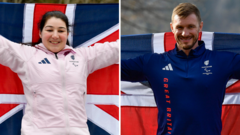
The metal pole is cold. It is a specific, biting chill that travels from the aluminum through a thin pair of racing gloves, settling deep into the marrow of the wrists. For most athletes, a flag is a ceremonial afterthought, a piece of fabric to be waved during a choreographed walk through a stadium. But for Menna Fitzpatrick and Neil Simpson, as they prepare to lead the British delegation into the teeth of the Winter Paralympics, that silk banner weighs more than the sum of its threads.
It weighs as much as every 5:00 AM alarm in a freezing Highland training camp. It weighs as much as the collective breath of a nation that only truly looks at the snow once every four years.
To understand why these two individuals were chosen to carry the Union Jack, you have to look past the medal counts and the podium finishes. You have to look at the geometry of trust.
The Invisible Tether
In the world of elite para-alpine skiing, the sport is a conversation. Menna Fitzpatrick is the most decorated Winter Paralympian in British history, a title that suggests a solitary climb to the summit. The reality is far more intimate. Menna, who has less than 5% vision, navigates a mountain at 65 miles per hour while following the voice of a guide.
Imagine standing at the top of a sheet of ice. Now, imagine closing your eyes and trusting a single voice to tell you when to turn, when to tuck, and when to brace for a jump that will launch you into a void.
This isn't just sport. It is a radical act of surrender.
Neil Simpson operates in a similar space, though his narrative is threaded with the complex bond of brotherhood. Guided by his brother, Andrew, the duo represents a biological synchronicity. When they move, they move as a single organism. The guide is the eyes; the athlete is the engine. If the communication breaks—if a single word is lost to the wind or a radio frequency flickers for a millisecond—the result isn't just a missed gate. It is a catastrophic collision with the physics of the mountain.
The Selection of Symbols
Choosing flagbearers is often a bureaucratic exercise in rewarding the "most likely to win." However, the selection of Fitzpatrick and Simpson for these Games signals a shift in the British narrative. It isn't just about the gold. It is about the specific brand of resilience required to thrive in an environment that is fundamentally hostile to the human body.
The Winter Paralympics are often treated as the "brave" sibling of the Olympics. This is a patronizing mistake. These athletes do not want your pity; they want your recognition of their technical mastery. Menna Fitzpatrick doesn't ski because she is "overcoming" her lack of sight. She skis because she is a faster, more aggressive, and more tactically sound skier than almost anyone else on the planet.
She carries the flag because she has mastered the art of the invisible.
Neil Simpson’s rise is equally telling. His inclusion as a flagbearer is a nod to the future. If Menna is the storied veteran, the keeper of the flame, Neil is the spark. He represents the evolution of the program—a young man who grew up watching the pioneers and decided that "good enough" was a slur.
The Physicality of the Moment
The opening ceremony is a sensory overload. The roar of the crowd, the flashing lights, the rhythmic thump of music designed to manufacture excitement. For a visually impaired athlete, this environment is a chaotic soup of data points.
When Menna and Neil grip that flag, they are anchoring themselves. The flag becomes a physical manifestation of their journey from the quiet, lonely slopes of their youth to the screaming intensity of the world stage.
Consider the mechanics of the march. They are walking into an arena where thousands of eyes are fixed on them, yet their focus is entirely on the sensation of the ground beneath their boots and the direction of the voice beside them. It is a microcosm of their entire careers: finding clarity in the noise.
There is a specific kind of silence that exists only on a mountain after a heavy snowfall. It is a muffling, heavy quiet that makes you feel like the only person left on earth. For years, this was the soundtrack to their lives. They trained in the shadows, away from the cameras, away from the sponsors, and away from the public consciousness.
Now, that silence is gone.
Why This Choice Matters Now
The British Winter Paralympic team has historically punched far above its weight class. While countries with vast, sprawling mountain ranges and year-round snow culture often dominate the medals, the British squad relies on a different kind of fuel. They are the outsiders. They are the ones who learned to ski on dry slopes and in indoor fridges in the North of England.
By naming Fitzpatrick and Simpson as the face of the team, the British Paralympic Association is doubling down on a message of technical excellence. They aren't just sending "representatives." They are sending masters of the craft.
Statistical analysis shows that the "flagbearer effect"—the idea that carrying the colors boosts an athlete's performance—is a mixed bag. Some find it a distraction; others find it a catalyst. For Menna and Neil, the pressure is already a constant companion. You cannot ski at those speeds with those limitations without having already made peace with the idea of extreme pressure.
The flag is just another element of the run. It is a piece of equipment they have to manage.
The Human Cost of the Gold
We like to talk about the glory, but we rarely talk about the knees. We don't talk about the concussions, the broken ribs, or the mental exhaustion of living in a perpetual state of "what if."
Every time Menna Fitzpatrick clicks into her bindings, she is making a gamble. She is betting her physical safety on the calibration of her guide’s voice. Every time Neil Simpson pushes out of the starting gate, he is carrying the expectations of a family and a nation on his shoulders.
The flag doesn't make those burdens lighter. It just makes them visible.
When the lights dim and the ceremony ends, the flags will be folded and put away. The pageantry will fade. What remains is the ice. The biting wind will return, and the crowds will disappear as the athletes head to the top of the mountain for their first competitive runs.
The real story isn't the moment they walked into the stadium. The real story is the moment they leave it, heading toward a mountain that doesn't care about their titles, their flags, or their vision. The mountain only cares about gravity.
And they are ready to dance with it.
The shadow of the flagbearer is long, stretching across the snow toward the finish line. It is a shadow cast by two people who spent their lives learning how to see in the dark, and who now find themselves standing in the brightest light of all. They are not just carrying a piece of fabric; they are carrying the proof that the most important things in life are the ones we cannot see, but only feel.
The pole is still cold. The wind is still rising. But as they step forward, the weight of the flag finally feels like wings.