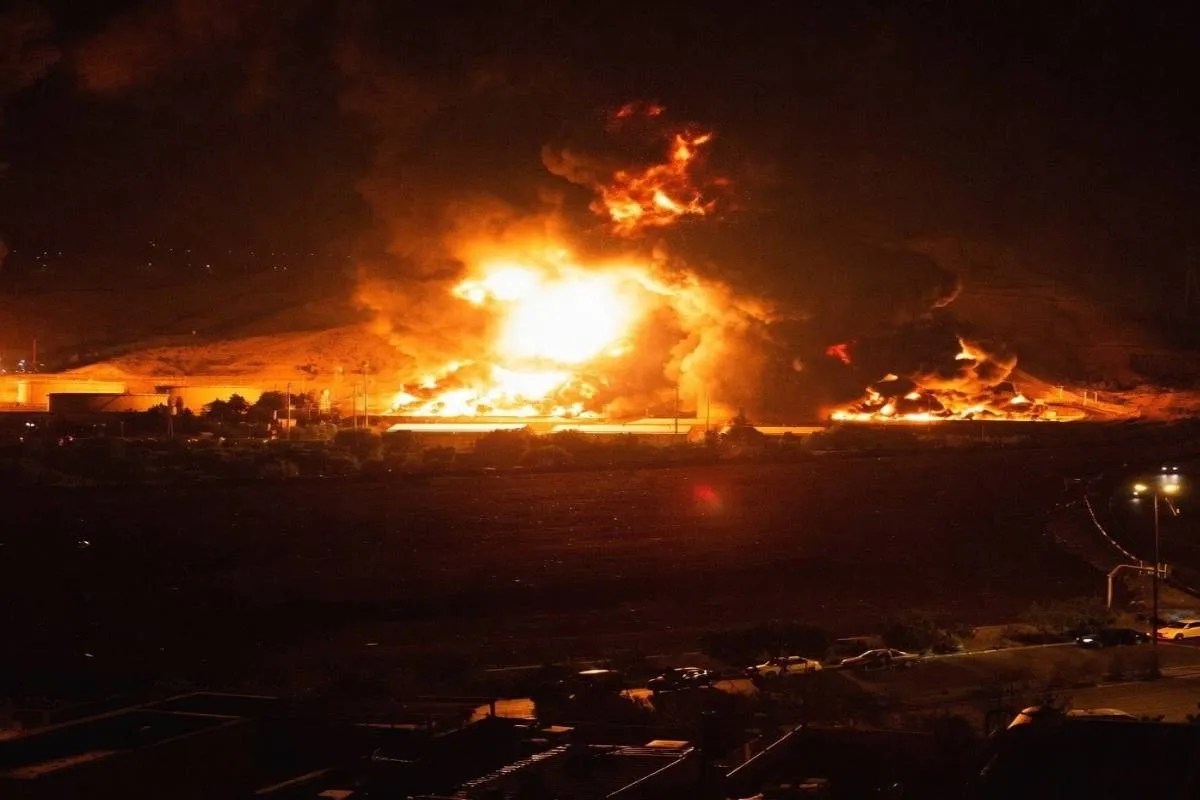
The recent kinetic engagement between Israel and Iran marks a fundamental transition from shadow warfare to a logic of overt structural degradation. While media reports often focus on the visceral imagery of "explosions in the sky," a strategic analysis must instead prioritize the operational objectives, defensive saturation points, and the signaling mechanisms inherent in such a large-scale aerial deployment. This engagement was not a randomized strike but a calculated calibration of force designed to test the limits of Integrated Air Defense Systems (IADS) while maintaining a specific rung on the escalation ladder.
The efficacy of these strikes depends on three primary variables: the suppression of enemy air defenses (SEAD), the precision-to-payload ratio of the munitions used, and the secondary psychological impact on the command-and-record infrastructure of the Iranian state.
The Triad of Target Acquisition
To understand the scope of the attacks across Tehran, Isfahan, and Shiraz, one must categorize the targets based on their functional utility rather than their geographic location. The mission profile suggests a tripartite division of labor:
- Anti-Access/Area Denial (A2/AD) Neutralization: The initial wave prioritized the "blinding" of the adversary. By targeting radar installations and S-300 battery nodes, the attacking force sought to create a corridor of impunity. Without active radar tracking, the subsequent waves can operate with a significantly lower risk-to-mission profile.
- Logistical and Manufacturing Bottlenecks: By focusing on sites associated with missile production and drone assembly—specifically those housing specialized carbon-fiber winding machines or solid-fuel mixers—the offensive aims to create a multi-year recovery timeline. This is "attrition by infrastructure," where the goal is not just to destroy current inventory but to dismantle the means of replacement.
- Command, Control, and Communication (C3) Nodes: Disrupting the flow of information between the central leadership in Tehran and regional military hubs serves to induce "strategic paralysis." When local commanders cannot receive real-time updates or authorization, the response becomes fragmented and reactive.
Calculating the Defensive Saturation Point
The Iranian response relies on a layered defense architecture, utilizing a mix of domestic systems (such as the Bavar-373) and aging Russian hardware. However, every defense system has a Saturation Point—the specific number of incoming projectiles that exceeds the system's ability to track, engage, and intercept simultaneously.
Israel’s tactical approach involves the use of "decoys" and "electronic warfare (EW) suites" to artificially inflate the number of targets on Iranian radar screens. This forces the defender to deplete expensive interceptor missiles on low-value targets. Once the magazine depth of the ground-based air defense is exhausted, the high-value assets (F-35I Adir or F-15I Ra'am) can deliver precision-guided munitions (PGMs) with near-total lethality.
The technical disparity here is not just in the aircraft but in the Kill Chain Latency. If the Israeli sensor-to-shooter loop is 90 seconds and the Iranian detection-to-engagement loop is 180 seconds, the defender is essentially fighting a ghost of the previous minute’s tactical reality.
The Physics of Precision: Why "Loud" Doesn't Always Mean "Large"
A common misconception in reporting kinetic strikes is equating the sound of an explosion with the scale of the damage. In modern urban warfare, the objective is often Surgical Decapitation of Capability.
- Thermobaric vs. Penetrative Warheads: For targets like underground bunkers or hardened missile silos in the mountains near Isfahan, the choice of munition is a matter of physics. Kinetic energy penetrators (bunker busters) use high-density alloys to pierce several meters of reinforced concrete before detonation.
- The CEP (Circular Error Probable) Variable: Modern PGMs used in this operation likely possess a CEP of less than 3 meters. This allows for the destruction of a specific wing of a building—perhaps the one housing the server racks or the centrifuges—while leaving the rest of the structure intact. This precision is a form of communication: it tells the adversary that nowhere is safe, but not everywhere is a target.
Regional Stability and the Economic Cost Function
The volatility in Tehran's markets following the strikes illustrates the Economic Cost Function of kinetic warfare. War is not merely fought with lead; it is fought with currency.
- Capital Flight: The immediate devaluation of the Rial reflects a loss of investor confidence in the state's ability to protect its industrial heartland.
- Resource Diversion: Every S-300 missile fired and every radar station rebuilt represents a diversion of capital from an already strained civilian economy. This creates internal friction points that the Iranian leadership must manage alongside the external military threat.
- Insurance and Maritime Risk: If the strikes extend or threaten the periphery of the Persian Gulf, the "War Risk Premium" for oil tankers increases. This creates a global feedback loop where the cost of the conflict is felt in energy markets in London and New York, potentially triggering diplomatic pressure on both combatants to de-escalate.
Limitations of Aerial Supremacy
While the Israeli Air Force (IAF) maintains a qualitative edge, aerial campaigns have inherent limitations that a data-driven analysis must acknowledge.
- The Reconstitution Rate: Physical structures can be rebuilt. Unless the strikes are followed by sustained interdiction or diplomatic isolation, the "degradation" is temporary.
- Mobile Launcher Resiliency: While fixed sites are easy to map and destroy, mobile Transporter Erector Launchers (TELs) are notoriously difficult to track in real-time. If Iran retains a significant portion of its mobile ballistic inventory, the deterrent threat remains active regardless of how many fixed warehouses are leveled.
- The "Rally Round the Flag" Effect: Kinetic strikes on sovereign soil often bridge internal political divides. The tactical success of destroying a drone factory may be offset by the strategic failure of hardening the civilian population's resolve against the perceived external aggressor.
The Logic of Pre-Emption vs. Retaliation
The shift from "shadow" to "light" marks the end of the era of plausible deniability. When missiles fall on three major cities simultaneously, the ambiguity is stripped away. This is an exercise in Escalation Dominance. The goal is to prove to the opponent that for every action they take, the response will be an order of magnitude higher in cost and sophistication.
By hitting Tehran, the heart of the political apparatus, and Isfahan, the center of the nuclear and military-industrial complex, the attacker is mapping out the "Red Lines" in real-time. If the Iranian response is muted, the new status quo favors the aggressor. If the Iranian response is massive, it triggers a "Full-Scale Conflict" logic for which the Israeli side has already prepared the defensive posture (Iron Dome, David's Sling, and Arrow systems).
The current trajectory indicates a move toward High-Frequency, Low-Duration Engagements. Rather than a prolonged 20th-century style war, we are seeing "pulsed" military operations. These pulses are designed to achieve specific diplomatic or technical setbacks for the opponent before retreating into a period of assessment and diplomatic maneuvering.
The critical bottleneck for Iran now is not just the loss of hardware, but the loss of Specialized Human Capital. If the strikes targeted technical personnel or military research facilities, the "brain drain" caused by physical elimination is far harder to rectify than the replacement of a radar dish.
The strategic play moving forward is the observation of the "re-arm" cycle. If Israel detects the movement of replacement components from North Korea or Russia into the targeted zones, a second "mop-up" pulse is statistically probable within a 14-to-21-day window. The objective is now total denial of the adversary's long-range strike capability.