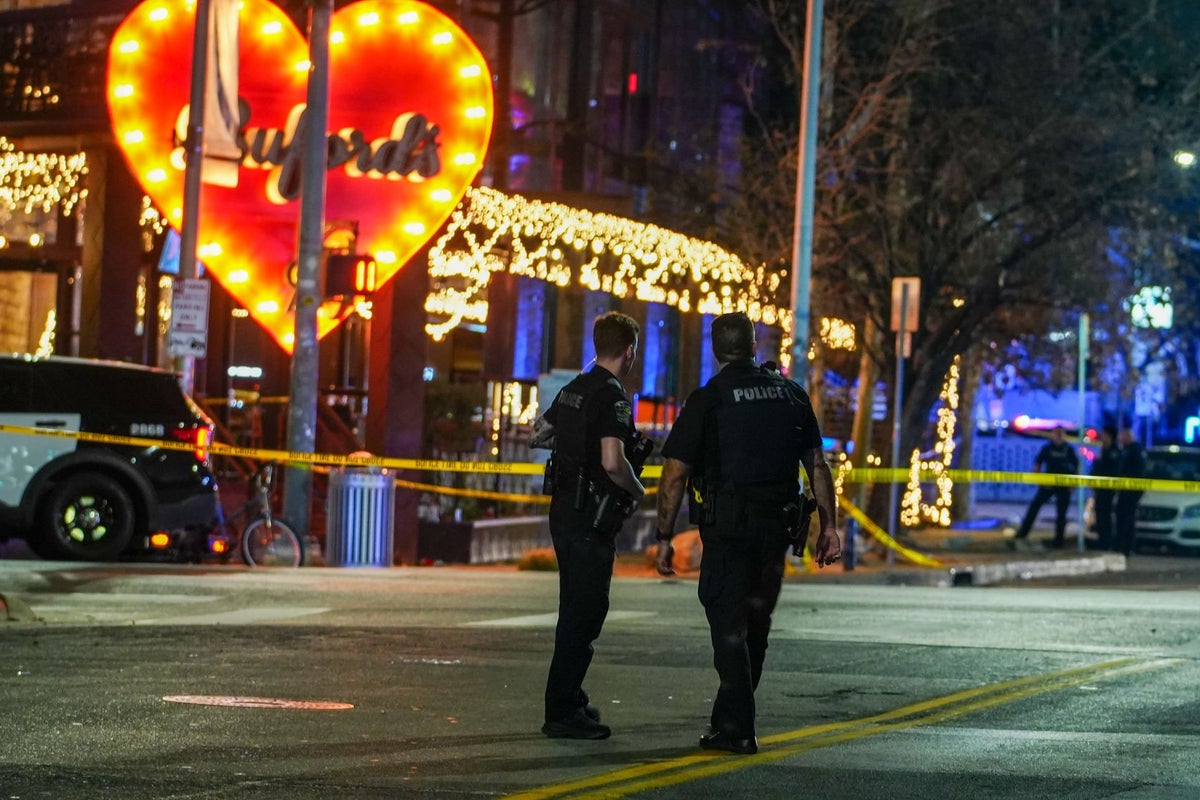
The transition from a standard criminal investigation to a counter-terrorism operation depends on the identification of specific ideological signaling rather than the scale of the violence itself. In the wake of the Austin bar shooting—which resulted in two fatalities and 14 injuries—the presence of "indicators" found on the gunman shifts the analytical framework from localized kinetic violence to a state-level security incident. To understand the trajectory of this investigation, one must deconstruct the variables that define domestic terrorism and the evidentiary thresholds required by federal agencies.
The Triad of Terror Classification
The determination of "terrorism" is not a qualitative judgment based on the horror of the act; it is a legal and operational classification based on three distinct pillars. If the Austin evidence does not satisfy all three, the case remains a mass shooting under the purview of state homicide laws rather than a federal national security case.
- The Kinetic Act: This is the baseline. It involves the use of force or violence against persons or property to intimidate or coerce. The Austin event, with 16 total casualties, clearly meets the threshold of a mass casualty event.
- The Target Selection: In this instance, a crowded nightlife venue. Security analysts look for "symbolic resonance." Was the bar chosen because of its specific clientele (e.g., a specific minority group, political affiliation, or religious identity)? If the target selection was random or based on personal grievance, the terrorism label typically fails.
- The Ideological Objective: This is the "indicator" mentioned by law enforcement. To classify this as terrorism, investigators must prove the gunman intended to "further ideological goals stemming from domestic influences, such as those of a political, religious, social, racial, or environmental nature."
Evidence Mapping and the Digital Fingerprint
The "indicators" found on the gunman likely fall into three categories of evidence that law enforcement prioritizes during the first 48 hours of a post-attack forensic sweep.
Manifestos and Declarations
The most direct indicator is a written document or a recorded video detailing a specific grievance or a call to action. These documents serve as the "logical architecture" of the attack. They provide the intent necessary to bridge the gap between "mass murderer" and "terrorist." If the Austin gunman left a manifesto, the investigation immediately pivots to identifying the network of radicalization that produced that document.
Technical Signaling and Search History
Modern radicalization leaves a data trail. Analysts examine the gunman’s hardware for:
- Accessing encrypted communication channels (Signal, Telegram) linked to known extremist groups.
- Persistent consumption of propaganda specifically designed to incite "lone wolf" or "stochastic" violence.
- Search queries related to soft-target vulnerabilities or previous attackers who are venerated in specific subcultures.
Hardware and Logistics
The methodology of the attack often reveals the level of sophistication. The use of specific modifications to firearms, the presence of secondary explosive devices, or the wearing of tactical gear with specific iconography (patches, runes, or symbols) provides immediate visual indicators of a broader ideological alignment.
The Mechanics of Stochastic Terrorism
The Austin shooting highlights a growing difficulty in modern threat assessment: the rise of stochastic terrorism. Unlike traditional terrorist cells with a hierarchical command structure, stochastic actors are "triggered" by a decentralized environment of inflammatory rhetoric.
- The Probability Function: In this model, the "leader" does not give a direct order. Instead, they broadcast a message to a massive audience, knowing that the probability of at least one individual acting on that message is high, even if the specific actor and timing remain unpredictable.
- The Validation Loop: When an individual like the Austin gunman sees their grievances echoed in mainstream or fringe digital spaces, it validates their violent impulses. The "indicators" found on the body are often the artifacts of this validation—printed memes, specific slogans, or references to online "saints" of previous massacres.
The Jurisdictional Shift
When "indicators" of terrorism are confirmed, the resource allocation for the investigation changes fundamentally.
The FBI Joint Terrorism Task Force (JTTF) assumes a lead or heavy secondary role. This triggers the use of the National Security Entry (NSE) protocols, allowing for broader surveillance of the gunman’s known associates and digital footprint. The primary objective moves from "who did this?" to "who else is planning this?"
The Resource Tiering:
- Level 1 (Local): Austin Police Department manages the crime scene, victim identification, and immediate public safety.
- Level 2 (State): Texas Department of Public Safety (DPS) provides forensic support and regional intelligence.
- Level 3 (Federal): FBI and Department of Homeland Security (DHS) analyze the "indicators" to determine if this is part of a wider domestic violent extremist (DVE) trend.
The Cost of Categorization
Labeling an event as "terrorism" is not merely semantic; it has significant socio-economic and legal implications.
- Legal Enhancement: If the gunman survived, federal terrorism charges carry significantly harsher sentencing and different detention protocols (e.g., Special Administrative Measures).
- Insurance and Liability: Under the Terrorism Risk Insurance Act (TRIA), certain insurance payouts for businesses are only triggered if the Secretary of the Treasury, in consultation with the Attorney General, officially "certifies" the event as an act of terrorism. This can affect the recovery speed for the venue and the surrounding Austin district.
- Public Perception and Copycat Risk: The "terrorism" label increases the media saturation of the event. While necessary for public awareness, this saturation can inadvertently provide the "heroic" narrative that future stochastic actors seek, creating a self-perpetuating cycle of violence.
The Logic of Precedent
To forecast the outcome of the Austin investigation, one must look at the "indicators" through the lens of previous Texas incidents, such as the 2019 El Paso shooting. In that case, the manifesto provided the definitive link to white nationalist ideology, allowing for a federal hate crime and domestic terrorism prosecution. If the Austin gunman’s indicators are less explicit—perhaps more aligned with "incel" subcultures or generalized anti-government sentiment—the federal government may be more hesitant to use the "terrorism" label publicly, opting instead for "violent extremism."
The distinction matters because "terrorism" implies a threat to the state or the social order, whereas "violent extremism" is often treated as a psychological or sociological failure.
Intelligence Bottlenecks
The investigation faces two primary bottlenecks in the coming days. First is the "Decryption Wall." If the gunman used end-to-end encryption for his primary communications, the "indicators" may be trapped behind hardware that requires weeks of forensic bypassing. Second is the "Noise-to-Signal Ratio." In the hours after a mass shooting, digital platforms are flooded with false flags, hoaxes, and "trolling" by users claiming the gunman belonged to various opposing groups. Sifting through this digital debris to find the actual motive requires a level of data hygiene that can slow the release of public information.
The strategic priority now is the mapping of the gunman's "radicalization trajectory." By identifying the specific point in time where the gunman moved from digital consumption to physical preparation, intelligence agencies can refine their predictive models for other high-risk individuals currently in the "consumption" phase.
Strategic Operational Forecast
Expect the following developments based on the current investigative trajectory:
- Subpoena Wave: Federal investigators will issue a massive round of subpoenas to social media platforms (X, Discord, Telegram) to reconstruct the gunman's social graph.
- Targeted Hardening: Austin nightlife districts will see a temporary but significant increase in visible law enforcement presence, shifting from standard patrol to "high-visibility deterrence" to prevent a secondary "cluster" attack.
- Ideological Classification: Within 7 to 10 days, the FBI will likely issue a formal statement classifying the gunman's ideology. This will define the political and social discourse surrounding the event for the remainder of the year.
Analyze the digital footprint of the gunman for "out-group" derogation patterns. If the data shows a consistent trend of dehumanizing a specific demographic, the transition from a homicide investigation to a federal hate crime and domestic terrorism case is a mathematical certainty. Monitor the Department of Justice's filings for the invocation of 18 U.S.C. § 2331, which will signal the official federal adoption of the terrorism framework.