The ice in the glass didn’t just clink; it rattled.
It was a Saturday night in Dubai, a city that usually feels like a fortress of glass and high-speed dreams. In the rooftop lounges of Downtown and the beach clubs of the Palm, the air was thick with the usual humidity and the scent of expensive oud. Then, the phones started chirping. Not the rhythmic ping of a WhatsApp message or the chime of a food delivery app. This was the jagged, persistent pulse of news alerts.
Iran had launched a massive wave of drones and missiles toward Israel.
Suddenly, the geography of the Middle East—a thing most residents here treat as a distant backdrop to their tax-free lives—shrank. The sky, which usually belongs to the glowing logos of Emirates and Etihad, was now a corridor for projectiles. To understand the mood in Dubai that night, you have to understand the specific type of silence that follows a loud party. It is a vacuum. It is the sound of thousands of people collectively holding their breath while looking at their balconies, wondering if the horizon is about to change shape.
The Mirage of Immunity
Living in Dubai often feels like living inside a very beautiful, very expensive simulation. You are shielded from the grit of the world by marble lobbies and the sheer logistical brilliance of a city built on sand. But when regional tensions boil over, the simulation glitches.
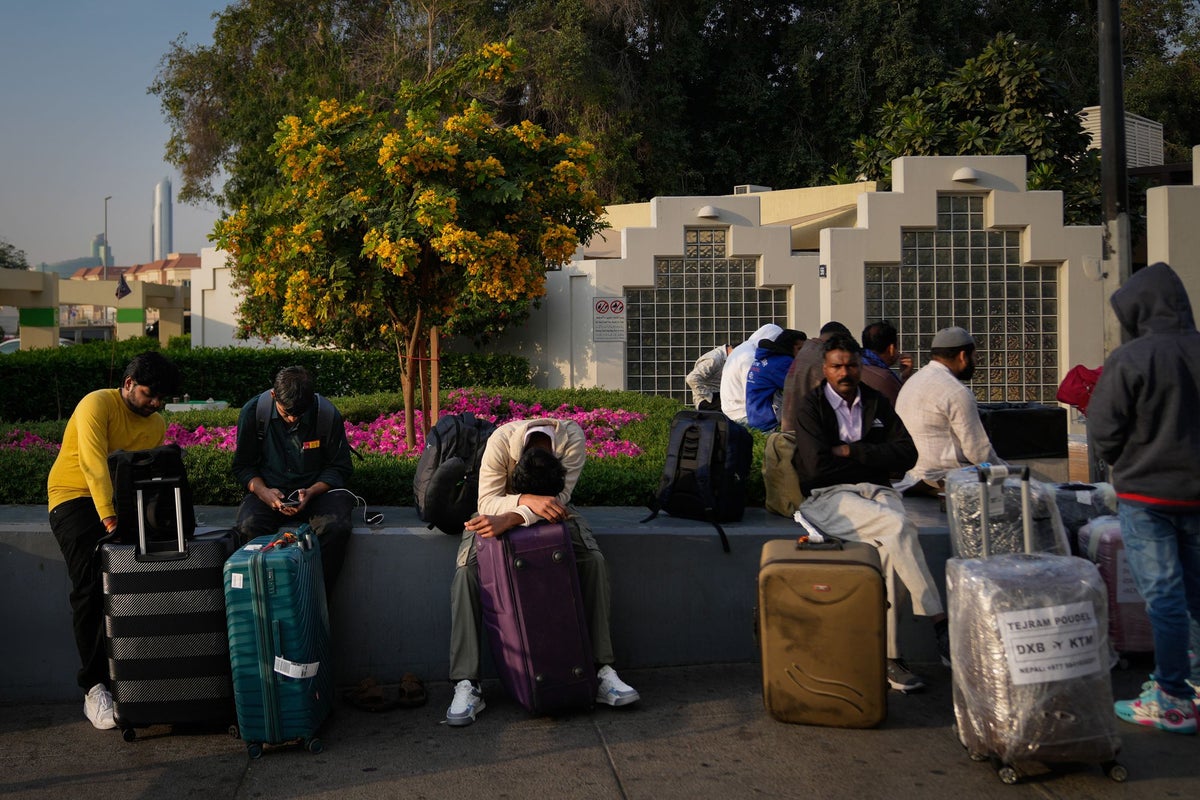
The "panic and uncertainty" described by news tickers wasn’t a screaming-in-the-streets kind of chaos. It was more clinical. It was the sound of suitcases being zipped shut by tourists who had arrived only forty-eight hours prior. It was the frantic scrolling of FlightRadar24.
Consider a hypothetical traveler named Elena. She represents thousands that night. She had saved for a year to spend a week at a resort in Jumeirah. As the news broke, she found herself standing in a gold-leafed elevator, clutching a beach bag, surrounded by people in evening wear who were all staring at their screens with the same pale, reflected light on their faces. The question wasn't "Are we safe?" but rather "How do we get out if the airspace closes?"
Airspace is the lifeblood of this desert hub. When Jordan, Iraq, and Lebanon slammed their aerial borders shut, the giant map of the world’s flight paths suddenly had a jagged hole in its center.
The Logistics of Fear
The math of a missile strike is terrifyingly simple, yet for those on the ground, the variables felt infinite. Iran is not far. The Persian Gulf is a narrow strip of blue. While the targets were hundreds of miles away, the path to those targets felt uncomfortably intimate.
Reliable reports confirmed that over 300 projectiles—a mix of "suicide" drones, cruise missiles, and ballistic missiles—were in the air. For a resident in a Burj Khalifa apartment, looking out at the dark expanse of the sea, every distant light of a commercial plane looked, for a split second, like something else.
This is where the psychological toll resides. In a city built on the promise of the future, a sudden reminder of historical animosities feels like an affront to the "Dubai Way."
The uncertainty manifested in the grocery stores. In the 24-hour markets of Al Barsha and Dubai Marina, the late-night crowds weren't buying party supplies. They were buying water. Gallons of it. They were buying bread and batteries. There is a specific kind of dread that comes from buying canned goods in a city that prides itself on having every luxury available within a thirty-minute delivery window.
The Invisible Stakes
Why does it matter if a city that wasn't the target felt the tremor?
Because Dubai is the world’s waiting room. It is where the global elite, the wandering workforce, and the hopeful dreamers converge. When that waiting room feels insecure, the ripples move through the global economy.
The stakes weren't just about the physical safety of the residents. They were about the fragility of the "Global City" concept. If a drone can cross a border, it can cross a narrative. The narrative of Dubai as a safe haven, a Switzerland with palm trees, was being tested by the sheer physics of regional conflict.
The drones—slow-moving, buzzing machines—took hours to reach their destination. That "slow-motion" nature of the attack was a unique form of torture. It wasn't a sudden explosion; it was a scheduled catastrophe. You could watch it happen in real-time on social media. You could see the trajectories. You could see the interceptions over distant cities, and then look up at your own quiet, starry sky and wait for the "what if."
The Morning After the Amber Glow
By the time the sun rose over the Hajar Mountains, the immediate fever had broken. The majority of the drones and missiles had been intercepted. The "barrage" was over, but the "uncertainty" remained like a layer of fine desert dust on every surface.
People went back to the malls. The fountains at the base of the Burj Dubai continued their choreographed dance to Whitney Houston. But the conversations over coffee were different. They were about "exit strategies" and "residency back-ups."
The reality of living in a hyper-connected hub is that you are never truly disconnected from the friction of the world. You can build the tallest building, the largest mall, and the most efficient airline, but you cannot build a wall high enough to keep out the anxiety of a neighborhood in flux.
We often think of war as something that happens "over there." But in the modern age, "there" is only a two-hour flight away. The night the sky turned amber wasn't just a news event; it was a reminder that even in the most glittering oasis, the desert is always just outside the door.
The tourists stayed, mostly. The flights resumed, eventually. But the clink of the ice in those glasses on the rooftops felt a little less steady, a little more fragile, as if everyone had finally realized they were living on a very beautiful, very thin sheet of glass.
The lights of the city stayed on, but for one long, terrifying night, everyone knew exactly where the shadows were.