Kim Jong Un isn’t bluffing anymore. For years, the Western world treated North Korean missile tests like a repetitive cry for attention or a bizarre theatrical performance. That era is over. The reality we face in 2026 is that Pyongyang has successfully developed a nuclear arsenal that can reach the United States mainland. This isn't just about regional tension in East Asia. It’s a fundamental shift in how Washington has to think about protecting its own cities.
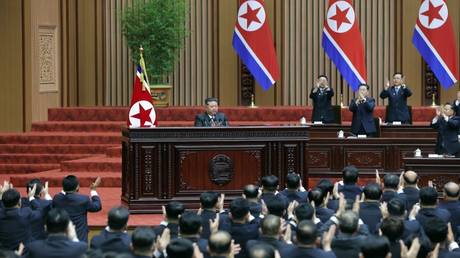
When Kim Jong Un states that his nuclear forces are a "powerful deterrent" capable of "annihilating" enemies, he's speaking to a domestic audience, sure. But he's also stating a technical fact that the Pentagon acknowledges behind closed doors. The days of hoping for "denuclearization" are likely dead. We’re now in a period of permanent nuclear coexistence with one of the most unpredictable regimes on earth. Learn more on a connected topic: this related article.
The technical leap that caught everyone off guard
It’s easy to mock the grainy footage and the oversized military parades. Don't fall for that trap. The North Korean missile program has shown a level of resilience and rapid iteration that surprised even seasoned intelligence analysts. They moved from liquid-fueled rockets that took hours to prep—making them easy targets—to solid-fuel technology.
Solid fuel is a massive deal. It means missiles can be stored, moved on mobile launchers, and fired in minutes. If you can’t see the launch coming, you can’t stop it. The Hwasong-18 intercontinental ballistic missile (ICBM) is the centerpiece of this threat. It’s designed specifically to overwhelm U.S. missile defense systems by using multiple reentry vehicles. Basically, they want to throw more targets at us than our interceptors can handle. Further reporting by NBC News highlights similar views on the subject.
Why Kim feels he needs to threaten the US
To understand the threat, you have to understand the logic behind it. Kim Jong Un watched what happened to leaders like Muammar Gaddafi in Libya. Gaddafi gave up his nuclear ambitions for a seat at the international table and ended up dead in a ditch a few years later. Kim has zero intention of following that script.
For the Kim dynasty, nukes are the ultimate life insurance policy. They believe that as long as they can hold a city like Los Angeles or Chicago hostage, the U.S. will never attempt a regime-change operation. It’s a brutal, cold calculation. They aren't looking for a war they know they’d lose. They’re looking for a way to make sure the U.S. never starts one.
The crumbling of the Sanctions Wall
We've been told for decades that sanctions would starve the program of resources. That hasn't worked. North Korea has become a master of "gray zone" economics. They use sophisticated cyberattacks to steal billions in cryptocurrency. They engage in ship-to-ship transfers of oil in the middle of the ocean to bypass maritime blocks.
More importantly, the geopolitical split between the U.S., Russia, and China has given Kim a massive opening. Moscow, in particular, has grown much closer to Pyongyang lately. With Russia providing a diplomatic shield at the UN Security Council, the era of unified international pressure is essentially over. Kim knows he can keep building his "nuclear sword" because his neighbors are too busy fighting each other to stop him.
What this means for American cities
Let’s be direct. If a conflict breaks out on the Korean Peninsula, the risk of a nuclear strike on the U.S. mainland is no longer zero. It’s a low-probability, high-consequence scenario. Our primary defense is the Ground-based Midcourse Defense (GMD) system located in Alaska and California. It’s designed to hit an incoming warhead in space.
However, no defense system is perfect. In testing, these interceptors have a mixed record. If North Korea launches a volley of five or ten missiles at once, the math gets terrifying very quickly. This is why the conversation in Washington is shifting from "how do we get them to stop" to "how do we manage the risk."
The South Korean dilemma
Our allies in Seoul are watching this closely. They see Kim’s ability to hit the U.S. and they start to wonder: "Would Washington really sacrifice San Francisco to save Seoul?" This is the "decoupling" fear. If South Korea loses faith in the U.S. nuclear umbrella, they might decide to build their own nukes.
That would trigger a nuclear arms race across Asia that nobody wants. We’re at a point where the North Korean nuclear threat isn't just about the missiles themselves, but about the collapse of the entire international order that has kept the peace since 1945.
Stop waiting for a diplomatic miracle
There is no "Grand Bargain" coming. Kim Jong Un has written North Korea’s status as a nuclear power into their constitution. They won't trade their nukes for food or economic aid. Any policy based on that hope is destined to fail.
We need to focus on enhanced deterrence and realistic arms control. That means better intelligence, more robust missile defenses, and a clear-eyed understanding that the North Korean nuclear threat is a permanent fixture of the 21st century.
The next step for any concerned citizen or policy watcher is to move past the headlines of "crazy" dictators. Start looking at the hardware. Watch the delivery systems. The threat is technical, it's growing, and it's parked right on our doorstep. Pay attention to the frequency of solid-fuel tests in the coming months. Those tests are the clearest signal of how much time we have left before the window for containment closes for good.