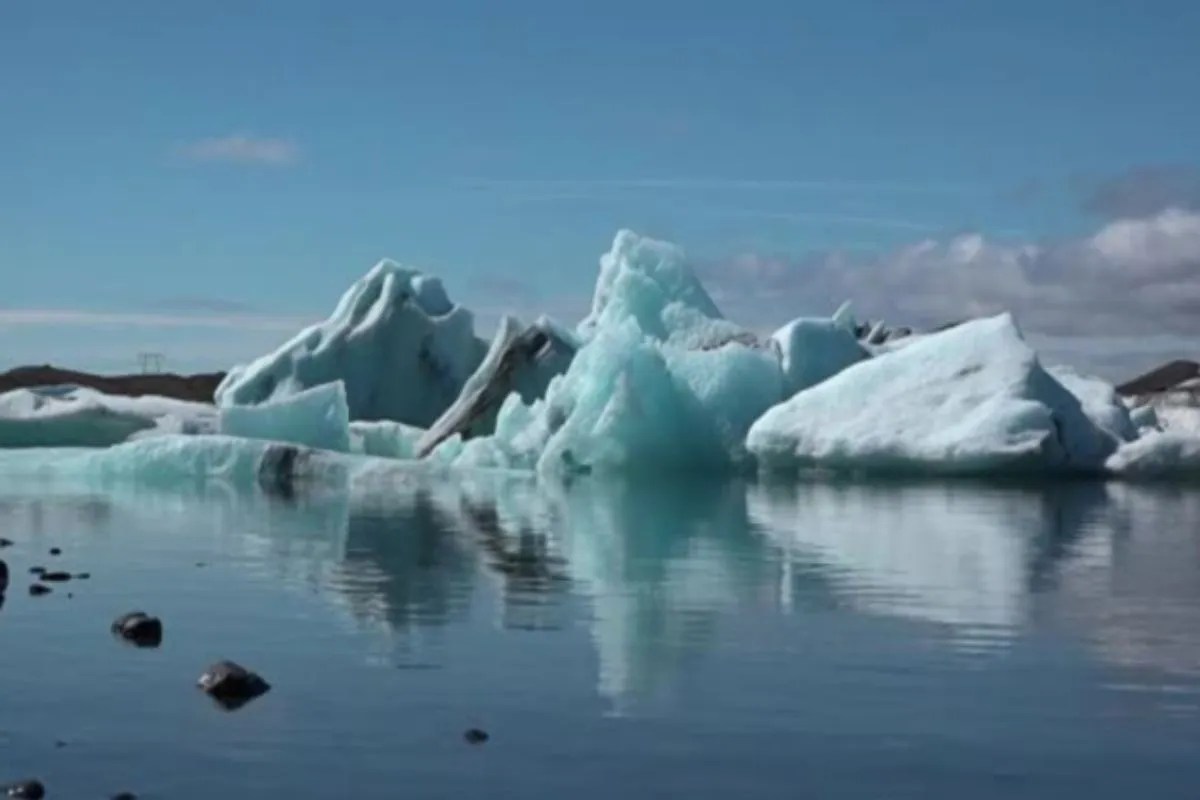
Humans have officially altered the clockwork of the solar system. For decades, the conversation around climate change focused on rising tides, scorching heatwaves, and the slow death of biodiversity. But a more profound, almost invisible transformation is occurring beneath our feet and above our heads. The massive melting of polar ice is shifting the very rotation of the Earth, stretching the length of our days in a way not seen in millions of years. This isn't just a metaphor for a changing world. It is a literal physical drag on the planet's spin.
The physics is straightforward but the scale is terrifying. As ice sheets in Greenland and Antarctica vanish, that weight—once pinned to the poles—is redistributed toward the equator. Because Earth is a spinning sphere, moving mass away from its axis of rotation slows it down. Think of a figure skater. When they pull their arms in, they spin faster. When they stretch them out, they slow down. By melting the ice, we are forcing the planet to "stretch its arms out." Recent satellite data and geodetic measurements confirm that this redistribution of mass is now the dominant factor in the lengthening of the day, overtaking the natural tidal friction caused by the moon. In other updates, take a look at: The Sabotage of the Sultans.
The Breakdown of Planetary Time
For the better part of three million years, the Earth’s rotation was governed by a predictable tug-of-war between the moon and the planet’s internal molten core. The moon's gravity creates tides, which gradually dissipate energy and slow the spin by about 2.4 milliseconds per century. However, the surge in meltwater has accelerated this process.
Since 1900, the day has lengthened by about 0.8 milliseconds due to ice melt alone. While a millisecond sounds like a rounding error, it represents a massive shift in angular momentum. We are seeing a rate of change that hasn't occurred since the Pliocene epoch. The geological record shows that Earth usually takes tens of thousands of years to adjust its spin. We have triggered a similar shift in just over a century. This isn't a natural cycle. It is an industrial intervention in celestial mechanics. USA Today has provided coverage on this critical topic in great detail.
Why Your GPS Might Fail
The average person doesn't feel a millisecond. Your computer does. Modern civilization is built on a foundation of hyper-precise timekeeping. High-frequency trading, Global Positioning Systems (GPS), and the synchronization of power grids rely on atomic clocks that are accurate to a billionth of a second. These clocks are consistent, but the Earth is not. To keep our digital world aligned with the planet's physical rotation, scientists use "leap seconds."
If the Earth continues to slow at this pace, the traditional methods of time correction will become obsolete. In fact, we were approaching a moment where we might have needed a "negative leap second"—removing a second to stay in sync. But the melting ice has delayed that necessity by acting as a brake. It has masked the internal changes of the Earth's core. This creates a nightmare for software engineers and network architects. A negative leap second has never been tested in a live environment. The last time we messed with global time standards, we faced the Y2K scare. This time, the glitch isn't in the code. It's in the planet.
The Hidden Shift in the Earth Core
While the ice melt acts on the surface, something equally strange is happening thousands of miles below. The Earth’s liquid outer core is also changing its flow patterns. Historically, the core's movement tended to speed up the planet's rotation, countering the moon's slowing effect. But the sheer volume of water moving from the poles to the equator is starting to influence the "oblateness" of the Earth.
The planet is getting fatter at the middle. This change in shape doesn't just affect time; it affects gravity. As the Earth becomes more "squashed" at the poles and bulged at the center, the gravitational pull in different regions fluctuates. This has long-term implications for satellite orbits. We are essentially changing the flight path of every piece of technology currently circling the globe.
Geopolitical Friction in a Slower World
The redistribution of water isn't uniform. The ocean isn't a bathtub where the level rises equally everywhere. Because of the Earth's rotation and gravitational shifts, the water piling up at the equator creates regional sea-level rises that far exceed the global average. This leads to a terrifying realization for coastal infrastructure.
Most sea-level rise models focus on the volume of water. They rarely account for the "rotational feedback." As the spin slows and the mass moves, the water is physically pushed toward the tropics. This places an undue burden on nations near the equator, many of which are already economically vulnerable. We are witnessing a physical transfer of wealth and safety driven by the conservation of angular momentum.
The Limits of Adaptation
Some skeptics argue that a few milliseconds won't change the price of bread. They are wrong. The lengthening of the day is a symptom of a total system failure. It indicates that the mass of the planet is no longer where it is supposed to be. When the Earth's weight shifts, it puts new stresses on the tectonic plates. There is emerging research suggesting that these changes in rotation can trigger seismic activity. The Earth is a precision-tuned machine. When you move the weights on a spinning wheel, the whole machine starts to vibrate.
We are currently adding about 1.33 milliseconds to the day every century due to climate-driven mass shifts alone. If carbon emissions continue on their current trajectory, that rate will double. By the year 2100, we could be looking at a world where the primary driver of time itself is no longer the stars or the moon, but the byproduct of our tailpipes and factories.
The Unintended Legacy
We have spent the last century worrying about how we are changing the atmosphere. Then we started worrying about how we were changing the oceans. Now, we have to grapple with the fact that we have changed the fundamental motion of the Earth in space. This is no longer just a "climate" issue. It is a geodynamic crisis.
The shift in the Earth’s axis—known as polar drift—has also moved by about 10 meters in the last century because of ice loss. The North Pole is literally migrating toward a new coordinate. Navigation systems that were calibrated twenty years ago are already finding discrepancies. We are losing our grip on the very measurements we use to define our reality.
The time for abstract debate has passed. The planet is physically telling us that the balance has broken. Every millisecond added to the day is a reminder that the Earth is a finite system with physical limits. We are currently testing those limits to the point of structural failure. The clocks are ticking, and for the first time in human history, they are ticking slower because of us.
Every engineer and physicist responsible for the satellites overhead is now forced to factor human behavior into their orbital calculations. We have moved from being inhabitants of a world to being the primary drivers of its physical orientation. This is the ultimate testament to our impact. We haven't just changed the weather. We have changed the day.
The next time you look at your watch, remember that the duration of that second is being rewritten by the melting ice in the Arctic. We are living on a planet that is literally losing its pace. If we do not stabilize the ice, we will eventually find ourselves out of sync with the universe.
Adjust your clocks accordingly.