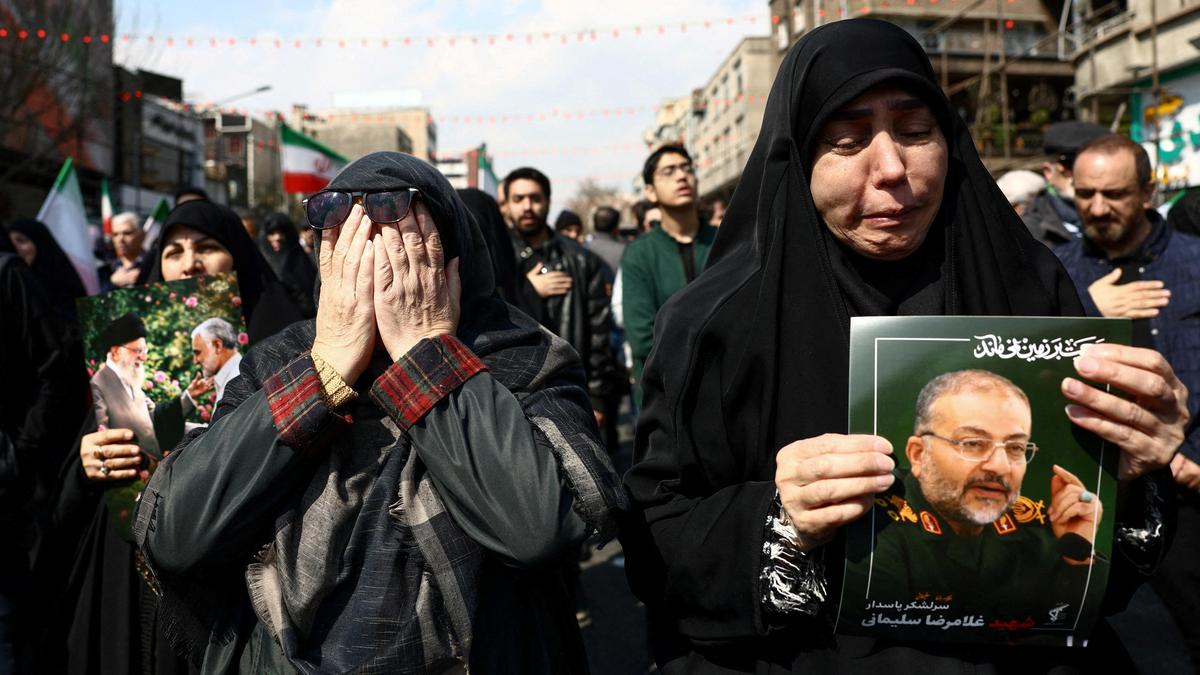
Western intelligence agencies often mistake Iran’s fixation on martyrdom for mere religious fervor. This is a strategic error. In Tehran, the concept of the "witness" or martyr—the shahid—is not just a theological pillar; it is a sophisticated tool of asymmetric warfare and internal security. By elevating death on the battlefield to the highest form of political expression, the Islamic Republic has built a defense mechanism that traditional military math cannot solve. This is how a mid-tier regional power balances the scales against superpowers. They don't need to win every dogfight if they can convince their population that losing is actually a spiritual victory.
The Engineering of Sacrifice
The Iranian state does not leave martyrdom to chance. It is a manufactured resource. Since the 1979 Revolution, and specifically during the meat-grinder years of the Iran-Iraq War, the regime perfected the "Foundation of the Martyrs." This isn't just a charity. It is a massive economic conglomerate that manages billions in assets, providing pensions, housing, and education to the families of the fallen. Recently making news in this space: The Kinetic Deficit Dynamics of Pakistan Afghanistan Cross Border Conflict.
When a Basij volunteer or a Revolutionary Guard officer dies in Syria or Yemen, the state immediately kicks into gear. They provide a financial safety net that ensures the survivor's loyalty. This creates a self-sustaining loop. The "culture of sacrifice" is subsidized by the state's vast holdings in telecommunications, construction, and mining. Martyrdom is a line item on a balance sheet.
The Basij and the Human Shield Doctrine
To understand how this translates to the modern battlefield, look at the Basij paramilitary. These are not elite commandos. They are often young men from rural provinces or aging veterans. Their primary function is mass. During the "Sacred Defense" against Iraq, these units were sent to clear minefields with their bodies. Additional details on this are covered by NBC News.
Today, that same logic applies to cyber warfare and urban suppression. The regime uses the promise of martyrdom to recruit "cyber-Basij" who view digital sabotage as a holy act. It lowers the cost of entry for state service. You don't need to pay a mercenary a high wage if you can convince him that his death earns him eternal prestige and his family a free apartment in Karaj.
The Psychological Front Line
Martyrdom serves a dual purpose. Externally, it acts as a deterrent. It tells the United States and Israel that conventional "shock and awe" tactics will fail because the target doesn't fear the end. If your opponent views a drone strike not as a defeat but as a promotion to sainthood, your leverage disappears.
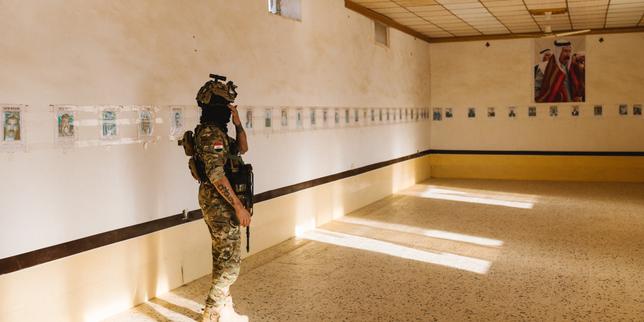
Internally, it is a tool of social control. The streets of Tehran are an open-air gallery of the dead. Murals of fallen soldiers stare down at commuters from every skyscraper. This constant visual reinforcement makes dissent feel like a betrayal of those who "gave everything." When Gen. Qasem Soleimani was assassinated in 2020, the regime didn't just mourn a general. They weaponized his image to bridge the gap between hardliners and the disillusioned middle class.
The Limits of the Myth
There is a growing crack in this foundation. The Generation Z Iranians—the "born-digital" cohort—are increasingly resistant to the martyrdom narrative. For a twenty-year-old in Isfahan, the promise of a pension for their parents after they die in a proxy war has lost its luster. They want high-speed internet, global travel, and a functional economy now.
The state is responding by modernizing the "brand." They are using high-production-value music videos and social media influencers to repackage martyrdom for a TikTok audience. They call them "Defenders of the Shrine." It is the same old product in a shiny new box.
Asymmetric Escalation and the Nuclear Shadow
The most dangerous application of the martyrdom doctrine is in the nuclear realm. Rational Actor Theory assumes that every state wants to avoid total destruction. But what if a faction within the leadership believes that a cataclysmic confrontation is a necessary precursor to the return of the Hidden Imam?
This is where the "politics of martyrdom" shifts from a domestic control tactic to an existential global threat. While the pragmatic wing of the Iranian government—the technocrats and career diplomats—treats the nuclear program as a bargaining chip, the ideological wing sees it as a shield for their "martyrdom-ready" proxies.
The Proxy Network as a Force Multiplier
Hezbollah in Lebanon and the Houthis in Yemen have fully adopted the Iranian model. They don't just use Iranian missiles; they use Iranian sociology. By fostering a culture where death is celebrated, these groups can sustain casualties that would collapse a Western democracy.
The Houthis, for instance, have turned the Red Sea into a shooting gallery. They aren't worried about the retaliatory strikes from the U.S. Navy because every sailor they lose becomes a martyr used to recruit ten more. It is a mathematical certainty that Western precision munitions will eventually run out before the supply of willing martyrs does.
The Economic Engine of the Dead
The Bonyad Shahid (Martyr Foundation) is one of the least understood players in the Iranian economy. It operates outside the oversight of the Iranian Parliament. It answers only to the Supreme Leader. This gives the regime a "black budget" to fund operations abroad.
By tying the welfare of millions of citizens to the continued existence of the martyrdom cult, the regime has made itself "too big to fail." If the Islamic Republic falls, the pensions for the families of hundreds of thousands of war dead vanish. This creates a massive, built-in constituency for the status quo.
Even the most secular Iranian family might hesitate to support a revolution if it means their elderly mother loses her state-provided medical care because her son died in the 1980s. The regime has successfully collateralized the grief of the nation.
The Technological Pivot
As we move further into the 2020s, the "martyr" is being digitized. The IRGC is using AI-driven facial recognition to identify protesters and then comparing those faces against the databases of "loyalist" families. If a child of a martyr is caught protesting, the family's benefits are threatened. This is the ultimate evolution of the system: the dead are used to police the living.
The West continues to focus on centrifuges and missile ranges. They are looking at the hardware. But the software—the deep-seated, state-sponsored cult of the shahid—is what actually drives the machine. Without understanding that martyrdom is a cold, calculated administrative policy, any attempt to "normalize" relations with Tehran is doomed to fail.
The regime has spent forty years teaching its people that the world of the living is secondary. You cannot bargain with a government that views your greatest threat—death—as its greatest reward.
The pressure is mounting. Sanctions have hollowed out the middle class, and the ideological fervor of the 1970s is a distant memory for most. Yet, the murals remain. The pensions are still paid. The state continues to gamble that the iron logic of the martyr will hold the cracks together for one more decade. They are betting that the memory of the dead is more powerful than the hunger of the living. It is a grim calculation, but so far, it has kept the house standing.