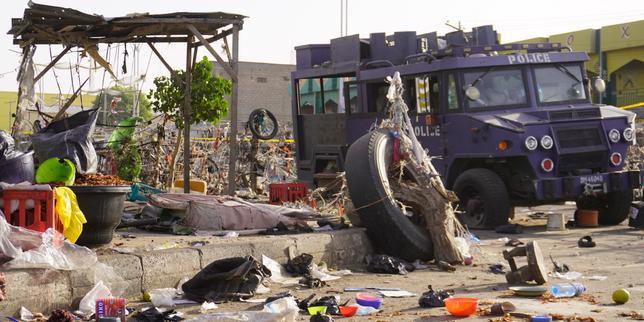
The wind in Borno State does not just carry heat. It carries a fine, rhythmic grit that finds its way into the seams of your clothes, the back of your throat, and the very mechanics of how you stay alive. For a decade and a half, the people of northeastern Nigeria have learned to read this wind. They look for the dust clouds kicked up by a convoy of technicals—pickup trucks with heavy machine guns welded to the flatbeds—long before they hear the engines.
Lately, the dust hasn't stopped rising.
While the rest of the world looked toward high-tech trenches in Eastern Europe or the urban ruins of the Levant, a familiar shadow began to lengthen again across the Lake Chad Basin. The headlines call it a "renewed offensive." The people living in places like Kukawa and Malam Fatori call it the return of a nightmare they were told had been put to bed.
The Geography of a Ghost Town
Imagine a marketplace. It isn't just a place to buy yams or salt; it is the heartbeat of a community. In the Far North, these markets are the only thing standing between a family and starvation. When the insurgents—the fractured remnants of Boko Haram and the more tactically disciplined Islamic State West Africa Province (ISWAP)—decide to move, the market is the first thing to die.
They don't always come with fire and lead anymore. Sometimes, they come with tax receipts. This is the "invisible" stake of the current conflict. ISWAP has moved beyond simple scorched-earth tactics. They are practicing a brutal form of statecraft. They provide a perverse kind of "security" for fishermen and farmers, provided those people pay a tithe. It is a protection racket on a sub-continental scale.
But the Nigerian military has responded with a strategy of "Super Camps." They have pulled their forces into heavily fortified garrisons, leaving the vast, rolling scrubland in between to the wolves. For a farmer in a village ten miles outside a garrison town, the government is a distant memory. The insurgents are the daily reality.
The Choice No One Should Make
Consider a man named Abba. He is a hypothetical composite of the dozens of displaced people currently huddling in the camps of Maiduguri. Abba has three choices, and all of them lead to ruin.
He can stay in the government-controlled camp, where the food rations are dwindling because international aid budgets have been cannibalized by newer, shinier wars elsewhere. He can watch his children grow thin while staring at a barbed-wire fence.
He can return to his ancestral lands to plant crops, knowing that he will likely be approached by men with rifles who will demand half his harvest.
Or, he can be caught in the middle. If the military finds him paying taxes to the insurgents, he is labeled a collaborator. If the insurgents find him talking to the military, he is labeled a spy.
The "offensive" isn't just about territory on a map. It is about the total erosion of the space where a normal human life can exist. When we talk about "security updates," we are actually talking about the death of the middle ground.
The Lake That Disappears
The conflict is inextricably tied to the water. Lake Chad was once one of the largest water bodies in Africa. Now, it is a fractured mosaic of marshes and islands.
This receding shoreline has created a tactical labyrinth. The insurgents use the tall grasses and the shifting sandbanks as a natural fortress. Even the most sophisticated aerial surveillance struggles to track a motorized boat hidden under a canopy of papyrus.
When the militants launched their recent wave of attacks, they used this geography to their advantage. They struck hard at fishing communities, seizing the trade routes that once fed millions. By controlling the fish, they control the currency of the region. They aren't just fighting for an ideology; they are fighting for the calories.
The Illusion of the Final Defeat
There is a dangerous cycle in how we process news from this region. A military spokesperson announces that the "terrorists have been technically defeated." A few months of relative silence follow. The world moves on. Then, a surge in kidnappings or a bold raid on a military outpost shocks the system.
The reality is that these groups are masters of hibernation. They don't need to win every battle. They only need to outlast the attention span of the international community and the budget of the Nigerian state.
Current data suggests that the insurgents have shifted their focus toward "soft targets" again. This isn't a sign of weakness; it’s a calculated move to prove that the state cannot protect its citizens. Every time a highway is closed due to the threat of ambush, the insurgents win. They don't need to occupy the road. They just need to make you afraid to drive on it.
The Cost of the Quiet
We often measure the cost of war in body counts. We should measure it in missed school years. In the northeast, an entire generation is being raised in the "Super Camps." They know the sound of a fighter jet better than the sound of a school bell.
The psychological toll is a debt that Nigeria will be paying for decades. When the "offensive" resumes, it doesn't just break buildings; it breaks the social contract. If you are a young man in a village where the state is invisible and the insurgents offer a weapon and a sense of power, the choice becomes a matter of survival, not radicalization.
The stakes are not abstract. This is not a "local" problem. The instability in the Lake Chad Basin ripples outward, fueling migration patterns that reach the Mediterranean and providing a blueprint for extremist groups across the Sahel.
The Weight of the Horizon
As evening falls over the plains of Borno, the sky turns a bruised purple. The heat finally begins to lift, but the tension remains. The soldiers behind the berms of the Super Camps check their magazines. The families in the camps huddle closer together.
The "offensive" isn't a single event. It is a persistent, grinding pressure. It is the realization that the peace everyone was promised was just a temporary pause in the wind.
The world might have stopped looking, but the dust hasn't stopped rising. It coats the eyes of the children who have never known a day without the threat of the convoy. It settles on the abandoned plows and the empty fishing nets. It is a reminder that in this part of the world, silence isn't peace. It's just the moment before the engines start again.
The trucks are moving. You can see it in the horizon, a thin line of brown blurring the sky, moving toward the next town, the next market, the next life.
Would you like me to analyze the specific socio-economic factors that have allowed ISWAP to establish their "taxation" system in the Lake Chad region?