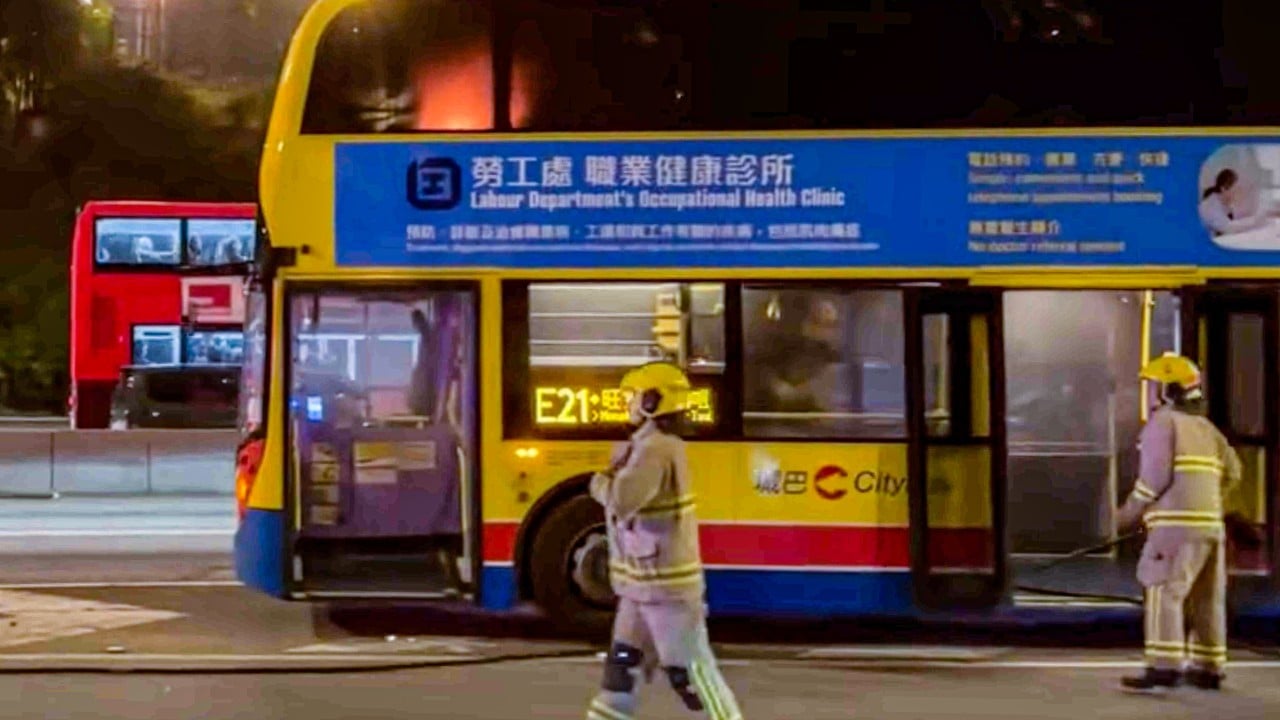
The upper deck of a Hong Kong KMB bus is usually a sanctuary of mundane transit. It is a place of rhythmic vibrations, the soft hum of the air conditioning fighting the subtropical humidity, and the synchronized glowing rectangles of fifty different lives being lived through five-inch screens. On a Tuesday afternoon in late February, that sanctuary dissolved into a pressurized chamber of white smoke and acrid heat.
A 27-year-old man, whose name will likely remain a footnote in a police ledger, was sitting near the back. He wasn’t doing anything extraordinary. He wasn’t a bomb technician or a thrill-seeker. He was a commuter with a spare battery. Then, the air changed.
The smell hits you first. It is not the scent of a campfire or a blown fuse. It is a sharp, metallic chemical stench that feels like it’s scraping the inside of your throat. Within seconds, the "power bank"—that ubiquitous plastic slab we all carry to stave off the anxiety of a low battery—had transformed from a convenience into a thermal runaway event.
The physics of this are terrifyingly simple. Inside that sleek casing, lithium ions are dancing between electrodes. When a separator fails—perhaps due to a microscopic manufacturing flaw, a previous drop onto a sidewalk, or the sheer ambient heat of a crowded bus—those ions stop dancing and start a riot. Energy that was meant to be trickled out over eight hours of web browsing is instead released in eight seconds.
The Anatomy of a Second
Panic has a specific sound on public transport. It is the frantic scraping of shoe rubber against floorboards and the collective intake of breath. As the smoke billowed from the man's bag, the bus became a trap.
He tried to deal with it. Humans have a stubborn, often dangerous instinct to save their belongings. He reached for the source of the heat, and that is when the energy became tactile. Lithium fires burn at temperatures exceeding 500 degrees Celsius. To touch it is to understand, in a visceral and agonizing flash, exactly how much power we keep pressed against our thighs and tucked into our backpacks.
By the time the driver pulled the massive vehicle to a halt near the Tsim Sha Tsui intersection, the damage was done. The man’s hands were no longer just skin and bone; they were a map of second-degree burns. He was rushed to Queen Elizabeth Hospital, leaving behind a charred seat and a busload of witnesses who will never look at a charging cable the same way again.
The Invisible Compact
We have made a silent, collective pact with modern chemistry. We demand thinner phones, longer-lasting laptops, and headphones that can play music for forty hours straight. To get those things, we have accepted the presence of high-energy density cells in every corner of our lives.
We sleep with them under our pillows. We strap them to our wrists to track our heart rates. We let our children hold them inches from their faces.
Most of the time, the chemistry holds. The stabilizers do their job. The internal circuitry acts as a vigilant gatekeeper, shutting down the flow if things get too hot. But these safety measures are operating at the edge of what is possible. When you realize that a lithium-ion battery is essentially a controlled explosion that we’ve convinced to happen very, very slowly, the miracle isn't that they occasionally fail. The miracle is that they don't fail every single day.
Consider the life of that specific power bank. It was likely bought for a few dozen dollars, perhaps from a reputable brand, perhaps from a discount bin. It lived in dark bags, was tossed onto tables, and sat in the sun. It was charged and discharged hundreds of times. Each cycle caused the internal materials to expand and contract, a microscopic breathing that slowly wears down the paper-thin walls separating the volatile components.
The Regulatory Shadow
Hong Kong is a city built on density. When something goes wrong here, it happens in close quarters. The Fire Services Department and the Electrical and Mechanical Services Department (EMSD) are constantly chasing the tail of a global supply chain that floods the market with cheap, uncertified energy storage.
The problem is that a "good" battery and a "bad" battery look identical to the naked eye. They both have a USB port. They both have a little blue light that says "100%." But underneath the plastic, one has a robust management system and flame-retardant separators, while the other is a ticking clock of cost-cutting measures.
We are currently living through a transition period in human history. We are moving from the age of internal combustion to the age of electrification, but our safety literacy hasn't caught up to our consumption. We know not to smoke while pumping gas. We know not to leave a candle burning near a curtain. Yet, we buy unbranded replacement batteries for our e-bikes and leave them charging overnight in the hallway, blocking our only exit.
The Cost of Convenience
The man on the KMB bus will heal. The blisters will fade, and the skin will graft. But the psychological residue is harder to wash away. For the other passengers, the next time they smell something slightly off—a heavy friction on the brakes, a hot motor—their hearts will skip.
They saw how quickly the mundane becomes the medicinal.
We often talk about "the future" as something that will be powered by clean, safe energy. We forget that energy, by its very definition, is the capacity to do work—and if it can do work, it can do damage. There is no such thing as a completely inert fuel source. Whether it is a tank of pressurized hydrogen, a gallon of gasoline, or a pocket-sized block of lithium, we are carrying the sun in our pockets.
The next time you reach for your charger, look at the device. Feel the warmth. That heat is the friction of a thousand chemical reactions keeping your digital life breathing. It is a tiny, contained tempest.
We navigate our world by trusting the objects around us. We trust the bridge to hold, the elevator to stop, and the battery to stay quiet. But every so often, the chemistry reminds us that it never signed the contract we thought it did. It just waits for the separator to thin, for the heat to rise, and for the sanctuary of a Tuesday afternoon to vanish in a cloud of white, suffocating smoke.
The bus continues its route. The charred seat is replaced. The rectangles keep glowing. We keep scrolling, eyes fixed on the screen, while the volatile heart of the machine beats inches from our palms.