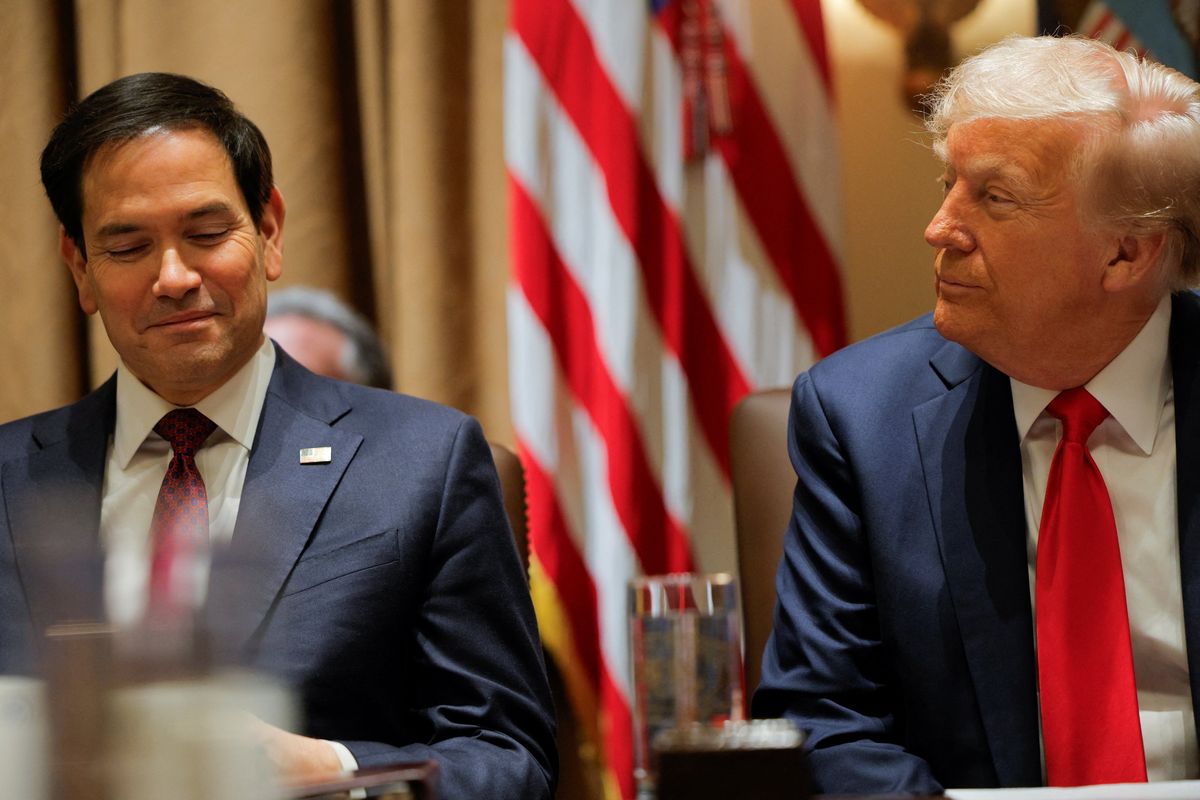
The smoke hasn't even cleared from the first wave of strikes in Operation Epic Fury, and the White House already can't keep its story straight. If you've been following the news over the last 48 hours, you've seen a bizarre public disconnect between President Donald Trump and his Secretary of State, Marco Rubio. They aren't just disagreeing on the small stuff. They're fundamentally contradicting each other on the most important question of all. Did Israel force America’s hand, or did Trump pull the trigger on his own?
Rubio went on the record Monday with a pretty explosive claim. He told reporters that the U.S. launched these strikes because Israel was already committed to attacking Iran. According to Rubio, the U.S. knew an Israeli strike was coming, knew that Iran would retaliate against American troops in the region, and decided to go first to "preempt" the chaos. In his version, Israel was the engine and the U.S. was basically forced to jump in the driver’s seat to keep the car from crashing.
Then came Trump.
While meeting with German Chancellor Friedrich Merz on Tuesday, the President flat-out rejected that narrative. He didn't just nudge Rubio’s comments aside; he stomped on them. Trump insisted that Israel didn't pressure him at all. In fact, he flipped the script, suggesting that he was the one who might have forced Israel’s hand. "I think they were going to attack first, and I didn't want that to happen," Trump said. It's a classic Trump move: claiming total dominance and refusing to look like he's taking orders from anyone, even a close ally like Benjamin Netanyahu.
The logic behind the Rubio slip up
Why would Marco Rubio—a seasoned politician who’s usually very careful with his words—basically blame an ally for a U.S. military operation? To understand this, you have to look at the political pressure cooking in Washington right now. This war is not exactly a smash hit with the public. We’re looking at a massive bombing campaign, hundreds of casualties, and an open-ended timeline.
By framing the war as something "Israel was going to do anyway," Rubio was trying to give the administration an out. It’s a way of saying, "Don't blame us for starting this; blame the situation we inherited." It shifts the responsibility of the "war of choice" tag onto Netanyahu. But for Trump, that framing is a disaster. It makes him look like a follower.
Why the imminent threat narrative is crumbling
The administration has been leaning hard on the idea of an "imminent threat" to justify skipping Congressional approval. They’ve pointed to everything from the 1979 hostage crisis to recent drone movements. But Democrats aren't buying it.
- Pramila Jayapal noted that the briefings provided no actual evidence of an immediate attack.
- Mark Warner pointed out that a threat to Israel isn't legally the same as an "imminent threat" to the United States.
- Tim Kaine is already calling out a "troubling pattern" of launching wars without the consent of Congress, citing recent moves in Venezuela and Nigeria.
If the threat wasn't actually imminent, and if the U.S. only attacked because it thought Israel might, the legal foundation for the war becomes incredibly shaky. It turns into a war of "anticipatory retaliation," which is a fancy way of saying we started a fight because we were worried about what might happen if someone else started one.
What the military reality tells us
While the politicians argue in D.C., the situation on the ground in Iran is getting ugly fast. The Iranian Red Crescent Society is reporting nearly 800 dead, but independent human rights groups like Hengaw say the real number is closer to 1,500. This isn't just a surgical strike on a few labs. We're talking about strikes across 153 cities.
Trump claims we’ve "knocked out everything." He’s bragging that the U.S. has a "virtually unlimited supply" of munitions and can fight "forever." But his own military brass seems to disagree. Reports suggest that General Dan Caine, Chairman of the Joint Chiefs, warned the White House that interceptor stocks are actually running low. Those $4 million missiles don't grow on trees, and the Pentagon is burning through them at a rate that has some Gulf allies worried they won't have anything left for their own defense.
The friction with allies
It’s not just the domestic side that's messy. Trump is already picking fights with European leaders who aren't showing enough "courage."
- United Kingdom: Trump called Keir Starmer "not Winston Churchill" because the UK didn't join the bombing, despite letting the U.S. use British bases.
- Spain: After Spain refused to let U.S. planes use their bases for these missions, Trump threatened to cut off all trade. "Spain has been terrible," he said.
This "with us or against us" rhetoric is a throwback to the 2003 Iraq war, but it’s happening at 10x the speed.
The real cost of the confusion
When the President and the Secretary of State can't agree on why we're at war, it creates a massive vacuum for conspiracy theories and propaganda. Iran’s Foreign Minister, Abbas Araghchi, jumped on Rubio’s comments immediately, claiming the U.S. admitted to fighting a "war of choice on behalf of Israel."
That’s a dangerous line. It fuels the narrative that American soldiers are being put in harm's way for another country’s interests. We’ve already seen six American service members killed, and a "friendly fire" incident where Kuwaiti air defenses accidentally downed three U.S. F-15s. Every time a new body bag comes home, the question of "Why are we doing this?" is going to get louder.
Trump’s four stated goals are:
- Destroying Iran's ballistic missile program.
- Wiping out the Iranian Navy.
- Permanently stopping nuclear development.
- Cutting off funding for regional proxies.
Those are huge, multi-year objectives. Yet, Trump is telling the public this will only take four to five weeks. It doesn't add up. You can't dismantle a country's entire military infrastructure in a month without a full-scale invasion, and even then, history says it takes a lot longer.
If you’re trying to make sense of this, stop looking for a unified strategy. There isn't one. You have a Secretary of State trying to manage the diplomatic fallout by spreading the blame, and a President who wants to take all the credit for being the "tough guy."
Watch the War Powers Resolution vote in the House this week. That’s where the real rubber meets the road. If the administration can't produce a single, coherent reason for this war, they might find their "unlimited" munitions budget getting cut off a lot sooner than four weeks. You should contact your representative now if you want to see the actual intelligence they're claiming justifies this. Don't wait for the "forever" war to actually start living up to its name.


