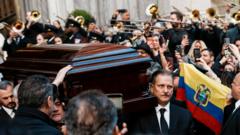
The air in East Harlem didn't just carry the scent of sofrito and the hum of city traffic that afternoon. It carried the weight of a brass revolution. When a pioneering salsa musician passes away, you don't just get a moment of silence. You get a wall of sound. Watching dozens of trombonists line up to play a final tribute isn't just a spectacle for tourists or a viral video clip. It's a visceral reminder that salsa was built on the bones of the trombone.
Most people think of salsa as a swirl of trumpets and piano. They're wrong. The "New York Sound" that defined the 1970s was gritty, heavy, and bottom-heavy. It was the sound of the urban jungle, and the trombone was its roar. When the community gathers to blow those slides one last time for a fallen giant, they aren't just playing notes. They're reclaiming a history that started in the basement clubs of the Bronx. Recently making news lately: Why Point Break is the Only Action Movie That Actually Matters.
The Trombone as the Soul of the Barrio
If you want to understand why fifty trombones showed up to a funeral, you have to understand the instrument's role in the Fania Records era. Before the glitz, salsa was the music of the marginalized. Trumpets were expensive and associated with the "clean" big band sounds of the 1950s. The trombone was different. It was loud. It was a bit clumsy. It was rebellious.
Willie Colón famously used a two-trombone setup that changed everything. It created a raw, aggressive texture that matched the reality of Nuyorican life. This wasn't ballroom music. It was street music. The "asfalto" sound. When these musicians gather today, they're honoring the fact that this specific instrument gave a voice to a generation that felt invisible. You can hear the struggle in the slide. You can hear the joy in the blast. Additional information on this are detailed by Deadline.
Why This Viral Funeral Tribute Actually Matters
We see "musical tributes" all the time, but this one hits differently. It’s about the lineage. In the world of Latin music, the relationship between a bandleader and their community is sacred. The musicians who showed up weren't all famous. Some were session players, some were students, and some were legends who hadn't touched their horns in years.
They played "El Cantante." They played "Aguanile." These aren't just songs. They are anthems of survival.
- The technical difficulty of playing in unison outdoors is immense, yet they sounded like a single machine.
- The choice of the trombone specifically honors the "Jibaro" influence mixed with urban jazz.
- It represents a passing of the torch to younger players who are keeping the "Salsa Dura" movement alive in 2026.
I’ve spent years watching how genres evolve, and salsa is one of the few that maintains this level of fierce loyalty. You don't see forty oboes showing up for a classical conductor. There's a brotherhood in the brass section that defies the logic of the modern music industry. It's communal. It's loud. It's unapologetic.
The Technical Brilliance of the New York Salsa Sound
People underestimate the complexity of these arrangements. Salsa isn't just "fast music." It's a mathematical puzzle of polyrhythms. The trombone sections in the 70s had to balance the Clave—the five-beat pattern that is the heartbeat of the genre—while providing melodic hooks that stayed in your head for days.
The "pioneering musician" honored in these videos understood that the trombone could play the role of a vocalist. It could moan, it could shout, and it could weep. When you hear that mass of brass playing in the street, you're hearing the "Moña." That's the improvised or semi-arranged section where the horns just take over. It’s a controlled chaos that requires incredible discipline.
The funeral wasn't a somber affair in the traditional sense. It was a "descarga"—a jam session. In Caribbean culture, you celebrate the life by making sure the music never stops. If the music stops, the memory fades. The trombones ensure the memory is deafening.
Preserving the Raw Edge of Latin Jazz
The music industry keeps trying to sanitize salsa. They want it to be "Pop-Salsa" with programmed drums and soft synths. It’s boring. It has no teeth. The reason this funeral footage resonates so much is that it reminds us what real music feels like. It’s physical. You can feel the vibration of the air in your chest.
We need more of this. Not just at funerals, but in our schools and community centers. The trombone is a difficult instrument to master. It requires lung capacity, precise slide positioning, and an ear for microtones. By showing up in such numbers, these musicians are making a political statement: "We are still here, and our culture cannot be compressed into an MP3."
If you’re a fan of the genre, don't just watch the video and move on. Dig into the discography. Listen to the early 70s records where the trombones are mixed so loud they almost distort. That’s where the magic is. That’s the "Pura Salsa" that these men and women were celebrating on the sidewalk.
Go find a local Latin jazz jam session this weekend. Buy a record from an independent artist who still uses a live horn section. Support the venues that allow these "descargas" to happen. The best way to honor a pioneer isn't by crying at a funeral—it's by making sure the next generation knows how to hold the slide.