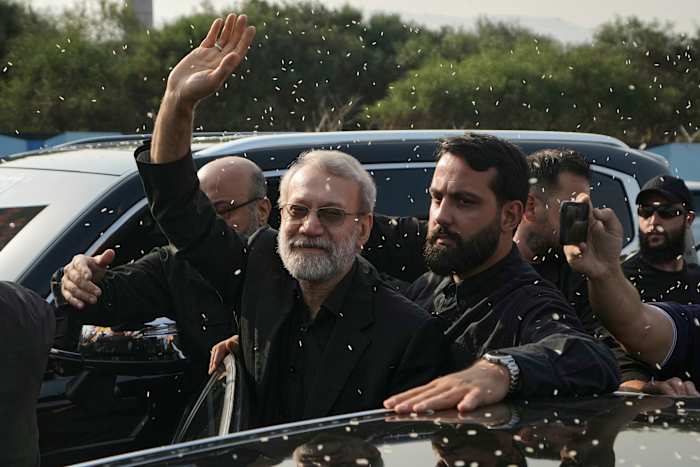
The air in Tehran has a specific weight when the regional equilibrium shifts. It is not a sound, but a sudden absence of it. On a Thursday that began like any other—thick with the smell of diesel exhaust and saffron—the news of Ali Larijani’s death didn't just break; it detonated.
For decades, Larijani was more than a name on a security dossier. He was the architect of shadows. As a pillar of Iran’s strategic apparatus and a frequent face of its diplomatic defiance, his presence suggested a certain level of Iranian permanence. When the Israeli Defense Forces (IDF) confirmed they had targeted and killed him during a precise operation, that sense of permanence evaporated. In its place, a cold, sharp reality took hold. The long-range chess match between Jerusalem and Tehran had just lost one of its most calculated players.
The strike was not a random act of aggression. It was a surgical removal. Intelligence suggests the operation targeted a command hub where Larijani was coordinating with regional proxies—the "Ring of Fire" that has increasingly tightened around Israel’s borders. For the soldiers in the IDF control rooms, this was a mission of data points, satellite thermals, and high-altitude precision. But for the streets of the Middle East, this was a message written in fire.
The Ghost in the Machine
To understand why this matters, one must look past the military hardware. We often treat these geopolitical assassinations like scores in a game. One side up, one side down. That is a mistake. To know Larijani was to know the connective tissue of the Iranian Revolution's global reach. He was the man who translated the Supreme Leader’s ideological vision into the gritty, logistical language of IRGC operations.
Imagine a bridge. Not one made of steel, but of influence, money, and shared resentment. Larijani was the master mason of that bridge, ensuring that supplies moved from Tehran through Iraq and into the hands of those waiting in Lebanon and Syria. When a bridge like that is cut, the parties on either side don't just stop; they stumble.
Israel’s intelligence community, often referred to as a "black box" of intentional ambiguity, chose to be uncharacteristically loud about this success. By claiming the kill, they weren't just checking a box on a hit list. They were signaling a total collapse of the "red lines" that used to govern this shadow war. The message was simple: No one is unreachable. No office is thick enough. No security detail is tight enough.
The Human Cost of Strategic Hubris
There is a tendency in newsrooms to speak of "targets" and "assets." It sanitizes the violence. But if you were a shopkeeper in the Dahieh district of Beirut or a student in North Tel Aviv today, the vocabulary is different. It is the language of "what happens tonight?"
Every action in this theater demands an equal and opposite reaction. This is the kinetic law of the Levant. When the IDF pulls the trigger on a figure as high-ranking as Larijani, they are betting that the resulting chaos within the Iranian command structure will outweigh the ferocity of the inevitable retaliation. It is a gamble of breathtaking proportions.
Consider the mid-level officer in the Quds Force who woke up this morning to find his mentor gone. He is not thinking about "holistic security frameworks." He is thinking about his own survival and the immediate need to prove his worth through a counter-strike. This is how cycles of violence become self-sustaining engines. The death of a leader often births a dozen martyrs, each one more desperate and less predictable than the man they replaced.
The Invisible Stakes
Why should a person sitting in London, New York, or Sydney care about a strike on a security chief they had never heard of until this morning?
The answer lies in the price of oil, the stability of global shipping, and the terrifyingly short distance between a regional skirmish and a global conflagration. The Middle East is the world’s nervous system. When Tehran feels a sharp pain, the rest of the world develops a fever.
Larijani represented the "Old Guard" of Iranian strategy—men who, while radical, were deeply rational actors. They knew how far to push without triggering a total war that would end their regime. With his removal, the vacuum may be filled by younger, more ideological commanders who have spent their entire lives in the crucible of sanctions and proxy battles. These are men who may not share Larijani’s appreciation for the "managed" escalation.
The map of the region is shifting in real-time. We are seeing a transition from a war of attrition to a war of decapitation. Israel is no longer content to trim the branches of the Iranian influence tree; they are swinging for the trunk.
The Sound of the Next Move
As night falls over the Mediterranean, the silence returns, but it is heavier than before.
In Tel Aviv, the cafes are full, but the eyes are turned toward the sky. In Tehran, the funerals are being prepared, and the rhetoric is being sharpened into something lethal. The death of Ali Larijani is a milestone in a conflict that has no exit ramps. It is a reminder that in the world of high-stakes espionage and regional dominance, the only thing more dangerous than a powerful enemy is an enemy who feels they have nothing left to lose.
The drones are still in the air. The satellites are still watching. The next move isn't a matter of "if," but of "where." And as the world waits for the dust to settle on this specific rubble, the underlying reality remains unchanged: the most expensive thing in the Middle East isn't the missiles or the oil. It is the peace that keeps slipping through the fingers of those who claim to be protecting it.
The sirens will eventually wail again. This time, they will be louder.
Would you like me to analyze the historical parallels between this event and the 2020 assassination of Qasem Soleimani?