A single grain of sand on a digital beach. That is all it takes to shift the trajectory of a carrier strike group.
On a Tuesday afternoon, a young intelligence analyst in a windowless room in Virginia stares at a high-resolution satellite feed of the Persian Gulf. She is looking for the "glint"—that specific, metallic reflection that identifies a Kh-47M2 Kinzhal missile sitting on a deck. She finds it. The image is crisp, the shadows of the gantry cranes in the Iranian port of Bandar Abbas stretch long and thin in the afternoon sun. Within minutes, the image is on a secure server. Within an hour, it is on the desk of a decision-maker whose hand is hovering over a red telephone.
There is just one problem. The gantry cranes do not exist. Neither does the missile. The entire port facility is a ghost, a fever dream of a generative adversarial network (GAN) that has learned exactly how to fool the human eye and the algorithmic sensor alike.
This is not a scene from a Tom Clancy novel. It is the new, terrifying baseline of modern geopolitics. We have entered an era where the primary weapon of war isn't a kinetic projectile, but a manipulated pixel. When we talk about "disinformation," we usually think of a weirdly worded tweet or a grainy deepfake of a politician. We don't think about the structural reality of the earth being rewritten from space.
But that is exactly what happened during the recent spikes in tension between the United States and Iran. Fake satellite imagery, polished to a mirror sheen by artificial intelligence, began circulating in private intelligence circles and across social media. It didn't just suggest a threat; it provided the "proof."
The Architecture of the Lie
To understand why this is so dangerous, you have to understand how we used to trust. For sixty years, satellite imagery was the "Gold Standard" of truth. If a plane was on a runway in a photo taken from 300 miles up, the plane was there. Period. Shadows followed the laws of physics. The atmospheric haze was consistent with the local weather data.
AI has broken that physics.
Consider a hypothetical developer named Elias. Elias doesn't work for a government; he’s a hobbyist with a high-end GPU and a chip on his shoulder. He feeds an AI model thousands of images of the Iranian coastline. Then, he feeds it "masks"—simple shapes representing destroyers, missile batteries, and fuel depots. The AI learns the "style" of a satellite photo: the specific grainy texture of a Maxar feed, the way sunlight hits saltwater, the way concrete reflects heat.
Elias clicks a button. The AI "paints" a fleet of Iranian fast-attack boats swarming a US tanker.
It looks perfect. Even to the experts.
This is the "AI-to-War pipeline." When these images hit the internet, they don't just fool civilians. They create "intelligence friction." If a commander receives a report of a threat, and then sees a "leaked" satellite photo on a reputable-looking OSINT (Open Source Intelligence) account that confirms the threat, the pressure to act becomes a physical weight. Delaying for 24 hours to verify the image's metadata could mean the difference between a successful defense and a sunk ship.
Speed is the enemy of truth. And AI is the king of speed.
The Invisible Stakes of a Blurry Border
We often assume that "high tech" means "high clarity." The opposite is true in the world of satellite deception. The most effective fakes are the ones that are slightly obscured—a little bit of cloud cover, a touch of motion blur.
In the high-stakes chess match between Washington and Tehran, these blurred images act as a Rorschach test for hawks on both sides. If you are already looking for a reason to escalate, the AI will give you exactly what you want to see.
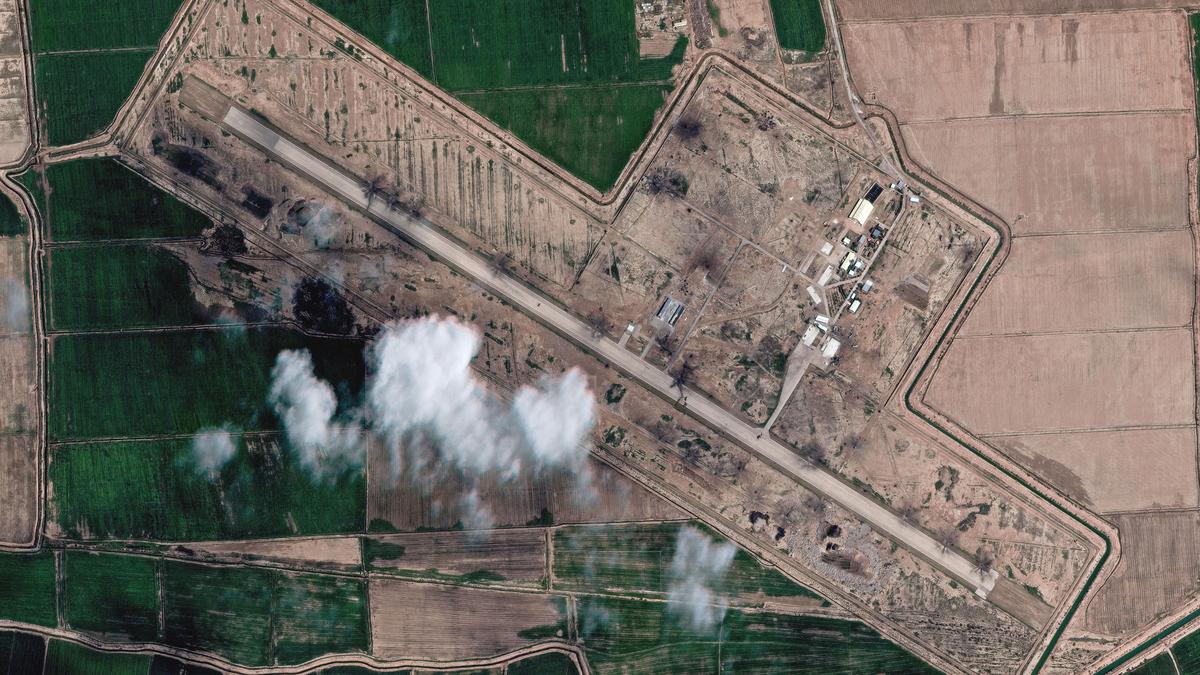
Imagine a Senator in a closed-door briefing. He is shown a series of slides. One of them shows a "newly constructed" enrichment facility in the Iranian desert. The shadows are consistent. The tire tracks leading to the entrance look heavy, suggesting the transport of lead-shielded materials.
"Is this confirmed?" he asks.
"It matches the patterns we've seen before," the briefer says.
They don't say it's real. They say it matches the pattern. That is the linguistic loophole that AI exploits. It doesn't create new realities; it mimics the patterns of existing ones so perfectly that the human brain fills in the gaps.
But the desert in that photo is actually a stretch of empty sand three hundred miles away from any military installation. The "facility" is a digital graft. If the US launches a "pre-emptive" strike based on that image, they aren't just hitting empty sand—they are hitting the tripwire of a global conflict.
The emotional core of this isn't about technology. It's about the erosion of the ground beneath our feet. When we can no longer trust the view from the sky, we lose our perspective on the earth.
Why the Old Guards are Failing
We used to rely on "Verification." We looked at metadata. We looked at sun angles. We cross-referenced with ground-level "stringers" who could confirm if a building was actually there.
But AI can now forge metadata. It can calculate the exact sun angle for any coordinate on earth at any time of day and adjust the shadows in the fake image to match. It can even create "multi-temporal" fakes—a series of images over weeks showing a fake building being "constructed" day by day.
The sheer volume of data is the second problem.
Satellites are currently dumping petabytes of data onto earth every single day. No human can look at all of it. We use AI to sort the satellite data. So, we have AI (the filter) looking at AI (the fake). This creates a "hallucination loop." If the filtering AI has a bias toward detecting "hostile intent," and the faking AI provides "hostile" imagery, the system reinforces the lie until it becomes an actionable fact.
It’s a digital house of mirrors where the walls are made of code and the floor is a trapdoor.
The Human Cost of the Digital Mirage
Think about the sailors on a destroyer in the Strait of Hormuz. They are 19, 20, 21 years old. They live in a state of constant, high-alert boredom. Their reality is mediated through screens. When a "verified" image of an imminent threat flashes across the command-and-control center, their lives shift instantly.
Adrenaline spikes. Safeties come off.
If that image is a lie, those young men and women are being put in a kill-or-be-killed scenario by a software script running in a basement in a different time zone. The "invisible stakes" are the lives of people who don't even know what a GAN is.
We have spent decades worrying about nuclear proliferation. We should be worrying about reality proliferation.
When anyone with a laptop can manufacture a casus belli—a cause for war—from thin air, the very concept of "sovereignty" begins to dissolve. Iran can claim a US drone violated their airspace and provide "photographic proof." The US can claim Iran is moving mid-range missiles to the border and provide "photographic proof."
Both can be lying. Both can be telling the truth. And the terrifying part? Neither side might actually know for sure.
The Death of the "Smoking Gun"
In 1962, during the Cuban Missile Crisis, the United States stood before the UN and showed grainy, black-and-white photos of Soviet missiles in Cuba. Those photos changed the world. They were the "smoking gun" that forced a resolution.
If the Cuban Missile Crisis happened today, those photos would be dismissed as "AI garbage" by one half of the world and used as a call for nuclear war by the other.
The "smoking gun" is dead. AI killed it.
We are left in a world where evidence is an aesthetic choice. This isn't just a technical hurdle for intelligence agencies to overcome; it's a fundamental shift in how human beings process conflict. We are moving from an evidence-based world to a vibe-based world.
If the "vibe" is that Iran is aggressive, any image—no matter how fake—that supports that vibe will be accepted.
The defense against this isn't just "better AI." You can't fight fire with fire when the fire is burning down the concept of truth itself. The defense is a radical, almost painful return to human skepticism. It requires us to slow down. It requires us to demand "provenance"—a chain of custody for an image that is as rigorous as the chain of custody for a piece of physical evidence in a murder trial.
But slowing down is the one thing the modern world refuses to do.
We want the update. We want the alert. We want the confirmation that our enemies are as evil as we suspected.
As you read this, a server somewhere is rendering a new patch of desert. It’s adding a few trucks. It’s adjusting the shadows to account for the hazy morning air over the Gulf. It’s making sure the resolution is just low enough to be believable, but high enough to be terrifying.
The image is almost ready. It’s about to be sent. And when it arrives, it won't just be a picture on a screen. It will be a heartbeat. A finger on a trigger. A world held in the balance of a few million pixels that don't actually exist.
The scariest thing about the fake satellite photo isn't that it's a lie. It's that, in the heat of a crisis, the truth simply doesn't matter anymore.
Only the glint of the fake missile does.
The screen flickers. The analyst blinks. The red phone begins to ring.
Would you like me to look into the specific technical methods currently being developed to "watermark" satellite data at the point of capture?