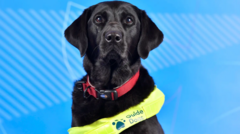
Pickle isn't just a dog. He's a four-legged morale booster who officially became the 26th member of the ParalympicsGB squad for the Paris 2024 Games. While most athletes were obsessing over marginal gains and carbon-fiber tech, this Norwich Terrier was busy winning the hearts of the entire delegation. It’s a move that sounds like a PR stunt, but if you've ever felt the crushing weight of high-stakes competition, you know it's actually a stroke of genius.
The British Paralympic Association didn't just pick a random pet. Pickle belongs to Penny Briscoe, the Chef de Mission for ParalympicsGB. He’s been a fixture at their headquarters for years. He isn't there to compete in the T11 100m sprint. He’s there because elite sport is a pressure cooker that can break even the toughest humans. Sometimes, the only thing that can lower a world-class athlete's heart rate isn't a breathing exercise or a sports psychologist—it's a wagging tail.
The logic behind the fluff
Why does a national sports team need a dog? It's about mental health. We talk a big game about supporting athletes, but the reality of a Paralympic Village is intense. It’s loud. It’s crowded. The stakes are literally life-altering. Research consistently shows that interacting with dogs reduces cortisol levels and spikes oxytocin. For an athlete who’s been away from home for weeks, maybe months, seeing a familiar face like Pickle provides a sense of normalcy that's hard to find in a clinical, high-performance environment.
Pickle’s role was never meant to be a mascot. He was a teammate. During the build-up to Paris, he spent his days at the team's prep camp, acting as a grounding force. You'd see him trot around the athletes' village, oblivious to the fact that he was surrounded by gold medalists. That’s the point. He doesn't care about world records or whether you missed your personal best by a millisecond. He just wants a head scratch.
Why this isn't just a British thing
Other countries are catching on to the value of animal therapy in sport. The U.S. Olympic and Paralympic Committee brought in emotional support animals for the first time during the Tokyo Games, and the trend is only growing. It’s a shift away from the old-school "grit and grind" mentality. It acknowledges that athletes are humans first and performers second. If a small terrier can be the difference between a mental breakdown and a focused performance, why wouldn't you bring him along?
I’ve seen how these dynamics play out in training camps. It's often the small, unofficial moments that define a team's spirit. The collective laugh when Pickle decides to nap on a piece of high-tech equipment or the way the mood shifts when he enters a room for a team briefing. It’s hard to stay stressed when a Norwich Terrier is demanding your attention.
What Pickle teaches us about high performance
There's a lesson here for corporate leaders and coaches alike. We spend millions on data analytics and physiological monitoring. We track sleep cycles and macronutrient intake. But how much do we invest in the emotional environment of the team?
The inclusion of Pickle as the 26th member of the ParalympicsGB squad was a public statement. It said that the British Paralympic Association values the well-being of its people as much as the weight of the medals they bring home. It’s about creating a culture of care.
The Norwich Terrier advantage
You might wonder why a Norwich Terrier was the breed of choice. These dogs are hardy, compact, and famously spirited. They're small enough to travel easily but have enough personality to hold their own in a room full of world-class athletes. Pickle fits that mold perfectly. He’s not a fragile lapdog; he’s a working breed with a massive heart.
For the athletes, Pickle was a constant. Coaches come and go. Teammates change. But the dog in the office is always there, always happy to see you. That kind of consistency is priceless when you're preparing for the biggest moment of your career.
Making the case for more team dogs
I'm not saying every office or sports team needs a dog. Not everyone likes them, and some people are allergic. But the "Pickle Effect" is real. It’s about breaking down barriers. It’s hard to be a stoic, unapproachable coach when you’re down on the floor playing with a dog. It humanizes everyone.
If you're running a high-pressure team, look at what ParalympicsGB did. They didn't just hire another consultant. They brought in a furry ball of love. It worked for them in Paris, and it’s a model more organizations should consider.
Take a hard look at your team's stress levels. If everyone is on edge, maybe it's time to stop looking at spreadsheets and start looking at the culture you've built. Sometimes, the most effective tool for success isn't a new piece of software—it's a dog with a badge and a job to do.
Check the local regulations for your training facility or office. Look into the specific requirements for service or emotional support animals. Talk to your team about what actually helps them decompress. Don't just assume more training is the answer. Sometimes, the best thing you can do for your team's performance is to let them take a five-minute break to play with a terrier.