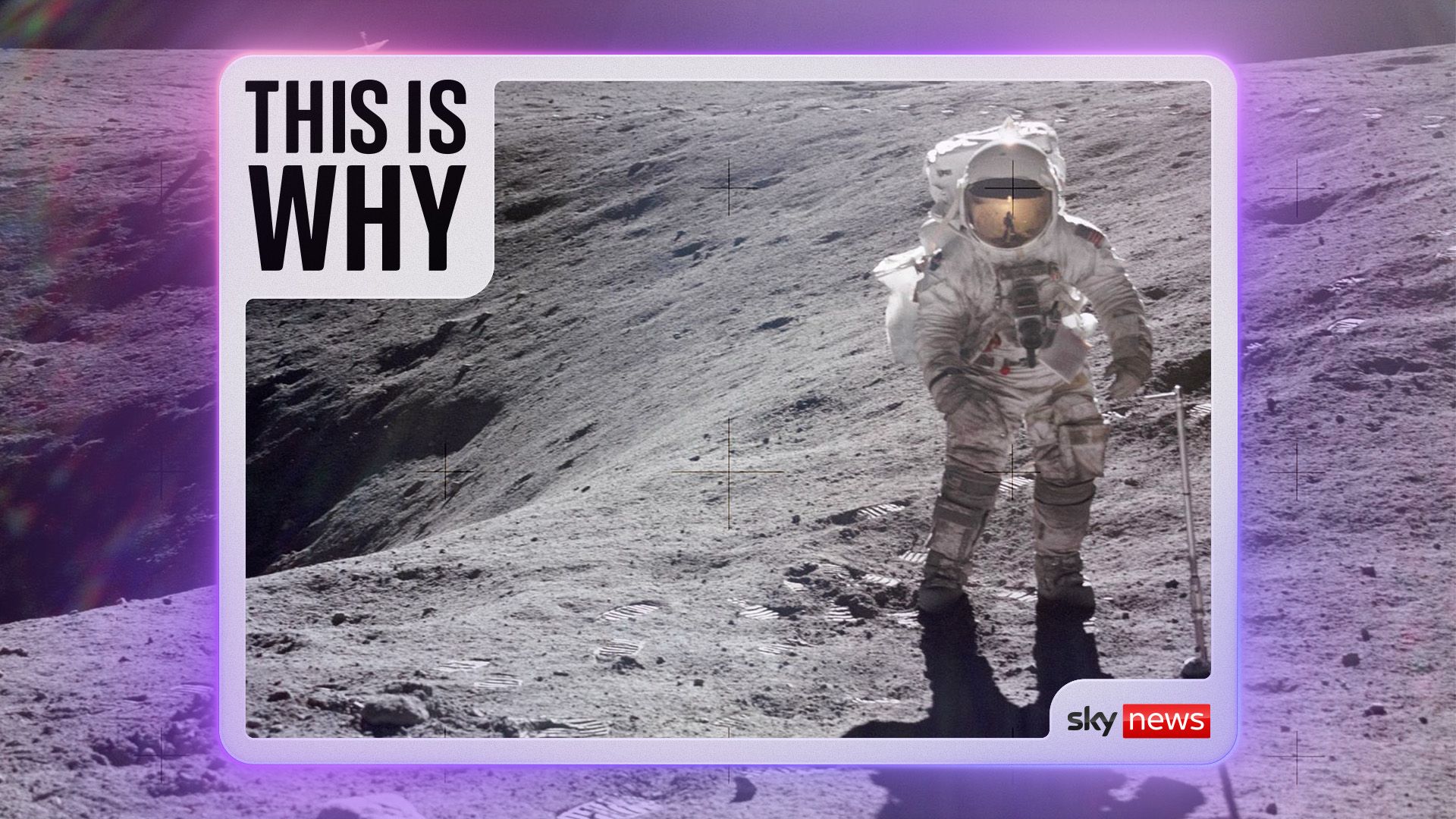
The return to the lunar surface is not a repetitive historical loop; it is a capital-intensive infrastructure project designed to solve the physical and economic bottlenecks of deep space exploration. While the Apollo era functioned as a geopolitical signaling mechanism, the Artemis program operates on the logic of resource acquisition, gravity-well optimization, and long-term risk mitigation. Understanding why NASA is returning to the moon requires moving past the romanticism of "exploration" and analyzing the specific physics-based constraints that currently make Mars and asteroid mining mathematically improbable from a terrestrial launch point.
The Gravity Well Constraint and the Delta-v Tax
The fundamental barrier to space industrialization is the cost of escaping Earth’s gravity. Launching a kilogram of mass into Low Earth Orbit (LEO) requires a specific change in velocity, known as $\Delta v$. Escaping Earth’s deep gravity well consumes the vast majority of a rocket's propellant before it even reaches vacuum.
The moon occupies a strategic position as the first "filling station" in the inner solar system. Because the moon’s gravity is approximately one-sixth that of Earth, the energy required to launch from the lunar surface is exponentially lower. Developing a lunar industrial base creates a "Lunar Arbitrage" scenario: if fuel can be manufactured on the moon, the cost of reaching Mars or the asteroid belt drops by orders of magnitude. We are shifting from a Linear Launch Model (Earth to Destination) to a Hub-and-Spoke Model (Earth to LEO, LEO to Moon, Moon to Deep Space).
The Three Pillars of Lunar Strategic Value
The Artemis architecture is built upon three distinct functional requirements that the current International Space Station (ISS) environment cannot satisfy.
1. In-Situ Resource Utilization (ISRU)
The discovery of water ice in the Permanently Shadowed Regions (PSRs) of the lunar south pole changed the calculus of space flight. Water is more than a life-support consumable; it is a chemical feedstock.
- Propellant Production: Through electrolysis, $H_2O$ is split into Liquid Hydrogen ($LH_2$) and Liquid Oxygen ($LOX$).
- Regolith Processing: The lunar soil, or regolith, contains high concentrations of oxygen and metals. Processing this material on-site allows for the 3D printing of radiation-shielded habitats, eliminating the need to haul heavy shielding material from Earth.
2. The Deep Space Radiation Laboratory
Low Earth Orbit is protected by the Van Allen belts, which shield the ISS from the harshest solar and cosmic radiation. Long-duration missions to Mars will expose crews to Galactic Cosmic Rays (GCRs) and Solar Particle Events (SPEs) that cannot be fully simulated in LEO. The moon provides a high-radiation environment with a stable geological surface, allowing NASA to test biological resilience and hardware durability under "true" space conditions.
3. Cislunar Geopolitics and Legal Precedence
The Artemis Accords represent a strategic effort to establish the "rules of the road" for space-based resource extraction. By establishing a permanent presence, the United States and its partners are defining the operational reality of "Safety Zones" and "Non-Interference," effectively setting the standard for how the 1967 Outer Space Treaty is interpreted in a commercial context.
The Gateway Architecture: Decoupling the Ascent and Transit Phases
A critical failure in public understanding of Artemis is the role of the Lunar Gateway. Unlike Apollo, where the Command Module and Lunar Module traveled together, Artemis utilizes a modular station in a Near-Rectilinear Halo Orbit (NRHO).
This orbit is a gravitational "sweet spot" that stays in constant view of Earth and provides easy access to the lunar south pole. The Gateway serves as a high-altitude dry dock. By decoupling the vehicle that lands on the moon from the vehicle that travels back to Earth, NASA can reuse components. The Human Landing System (HLS), currently being developed by SpaceX as a variant of Starship, is designed to remain in the lunar vicinity, shuttling between the surface and the Gateway, while the Orion capsule handles the high-stress Earth atmospheric reentry. This division of labor reduces the total mass required for each mission leg.
Quantifying the Economic Moat of the South Pole
The selection of the lunar south pole as the landing site is a tactical decision driven by "Peaks of Eternal Light" and "Craters of Eternal Darkness."
- Energy Density: High-elevation rims at the south pole receive nearly constant sunlight. This allows for near-continuous solar power generation, avoiding the 14-day lunar night that killed previous robotic missions.
- Cryogenic Storage: The craters nearby are the coldest known places in the solar system. These thermal gradients—intense sun adjacent to extreme cold—are ideal for maintaining the cryogenic temperatures needed for $LH_2$ storage and for harvesting the volatiles trapped in the ice.
The Logistics Bottleneck: The SLS and Starship Integration
The primary risk to this strategy lies in the integration of two vastly different launch philosophies. The Space Launch System (SLS) is a traditional, expendable, high-reliability heavy-lift vehicle. SpaceX’s Starship is a disruptive, fully reusable system that requires multiple orbital refilling launches to reach the moon.
The strategic vulnerability here is the Fuel Transfer Gap. For Artemis III to succeed, SpaceX must demonstrate the ability to transfer hundreds of tons of cryogenic propellant in LEO. If orbital refueling fails to scale, the entire Hub-and-Spoke model collapses, reverting NASA to a "flags and footprints" approach that lacks the payload capacity for permanent habitation.
The Mars Horizon: The Moon as a Technical Proxy
Mars is a minimum of six months away. The moon is three days away. Any failure in life support, power generation, or transit on a Mars mission is a death sentence because there is no "abort to Earth" capability once the Trans-Mars Injection burn is complete.
The moon serves as a Failure Mode Analysis platform.
- Dust Mitigation: Lunar dust is electrostatically charged and abrasive. It destroys seals and clogs machinery. Solving this on the moon is a prerequisite for any Martian surface operation.
- Autonomous Operations: Due to the light-speed delay (up to 20 minutes each way for Mars), crews must operate with high autonomy. The 1.3-second delay to the moon allows for a "training wheels" approach to autonomous command.
- Psychological Isolation: Testing team dynamics in a truly hostile environment where the "blue marble" of Earth is a small dot in the sky (or, in the case of the south pole, hovering on the horizon) provides data on crew mental health that the ISS cannot replicate.
Strategic Forecast: The Shift from Exploration to Occupation
The next decade will see the transition of cislunar space from a scientific frontier to a contested economic zone. The success of the Artemis program will be measured not by the number of boots on the moon, but by the cost per ton of delivered payload to the lunar surface.
The strategic play for any entity involved in this sector—be it a government or a private contractor—must be the perfection of autonomous mining and robotic assembly. Human presence is currently the most expensive and high-risk variable in the equation. Reducing the "Human-to-Robot Ratio" on the lunar surface while increasing the "In-Situ-to-Terrestrial Resource Ratio" is the only viable path to making the lunar economy self-sustaining. Entities that master cryogenic fluid management in zero-G and the robotic processing of silicates will control the logistics of the inner solar system for the next fifty years.