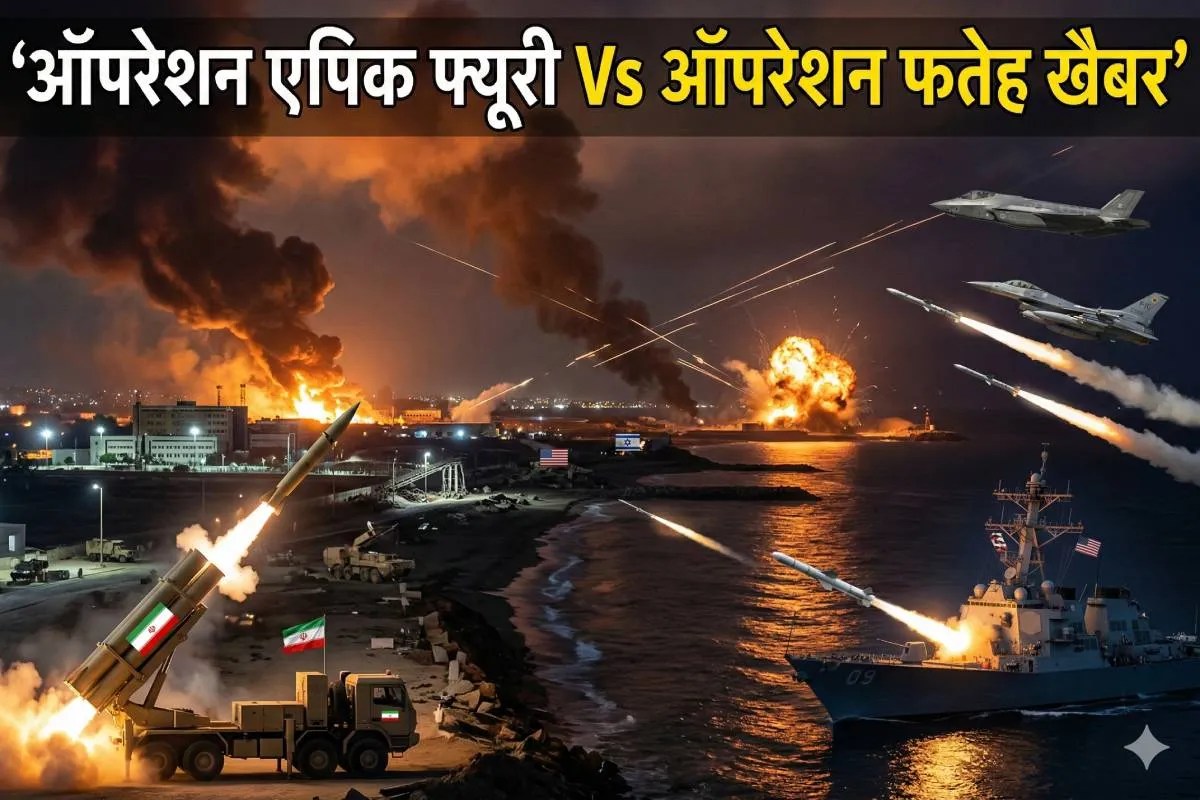
The recent escalation in the Middle East has moved past mere border skirmishes into a high-stakes laboratory for ballistic missile warfare. While local media often focuses on the immediate "fury" of the strikes or the symbolic names of the weaponry—like the Epic Fury or Fateh Khyber—the technical reality on the ground in Tehran and across the Levant reveals a much more dangerous shift in regional power dynamics. We are no longer looking at the unguided rockets of the past. The current conflict centers on high-precision, solid-fuel ballistic missiles capable of hitting specific hangars or power grids from a thousand miles away.
The smoke over Tehran isn't just a sign of localized explosions. It is the physical manifestation of a failed containment strategy. For years, the international community focused on preventing nuclear enrichment while overlooking the rapid maturation of delivery systems. That oversight has now come due. Iran’s missile program, specifically the development of the Fateh family of missiles, has reached a point where "saturation" is a viable military strategy against even the most sophisticated defense umbrellas.
The Engineering of the Fateh Khyber
To understand why these explosions are rocking the region, one must look at the transition from liquid to solid fuel. The Fateh Khyber (also known as the Fateh-110 or its longer-range derivatives) represents a leap in readiness. Liquid-fueled missiles are temperamental. They require a lengthy fueling process before launch, a window of time where they are sitting ducks for satellite detection and preemptive strikes.
Solid-fuel missiles are different. They are essentially "instant-on" weapons. They can be stored in underground "missile cities," driven out on a transporter-erector-launcher (TEL), and fired within minutes. This mobility makes them incredibly difficult to track and neutralize before they leave the ground.
The "Khyber" variant specifically claims a range of approximately 1,500 kilometers. More importantly, it features a maneuverable reentry vehicle (MaRV). In plain English, this means the warhead doesn't just fall in a predictable arc. It can shift its path as it nears the target, making it a nightmare for interceptors like the Arrow 3 or Patriot systems to calculate an intercept point. When you hear reports of explosions in Tehran or surrounding military complexes, you are often hearing the result of these high-velocity impacts or the kinetic energy of interceptors trying to catch a moving target.
The Shield vs the Sword
The defense against such an onslaught relies on a multi-tiered architecture. It starts with space-based infrared sensors that detect the heat bloom of a launch. Then, ground-based radar takes over. But the sheer math of a mass launch favors the attacker. If an adversary fires 100 missiles and the defense system has a 90% success rate—which is remarkably high in real-world conditions—10 warheads still get through.
If those 10 warheads are directed at high-value infrastructure, the economic and psychological damage is total. This is the "Epic Fury" often cited in regional reports—not just the fire, but the overwhelming volume of incoming steel.
The technical struggle is also an economic one. An interceptor missile can cost between $2 million and $4 million. The attacking missile might cost a fraction of that, perhaps $300,000 to $500,000. The defender is essentially being bled dry, spending millions to stop thousands. This lopsided math is what drives the current intensity of the strikes; it is an attempt to break the defender’s bank as much as their spirit.
Logistics of the Underground Cities
Tehran’s survival strategy relies on what they call "missile cities"—vast networks of tunnels carved into the mountains. These are not just storage lockers. They are fully integrated launch facilities.
- Vulnerability: While these tunnels protect against conventional airstrikes, they create a bottleneck. There are only so many exit points.
- Intelligence: The "explosions" reported inside Tehran aren't always incoming missiles. Sometimes, they are the result of industrial accidents or targeted sabotage within these sensitive logistics chains.
- Production: Iranian engineers have moved toward indigenous production, meaning they are no longer strictly reliant on North Korean or Russian blueprints. They have refined the guidance sets to include GPS and GLONASS integration, alongside inertial navigation that functions even if satellite signals are jammed.
The Overlooked Factor of Electronic Warfare
In the chaos of the "Great War" narratives, the silent battle of the electromagnetic spectrum is often ignored. Every time a Fateh Khyber is launched, a massive "electronic handshake" occurs. The missile is trying to find its way, while the defender's electronic warfare (EW) suites are trying to "blind" it or feed it false coordinates (spoofing).
The fires seen in the streets of Tehran are occasionally the result of missiles that have been successfully diverted. A missile that loses its "brain" doesn't just disappear; it falls somewhere. Often, it falls on civilian infrastructure far from the intended military target. This creates a secondary crisis: the political fallout of "collateral damage" caused by successful defense measures.
Hard Truths of the Regional Balance
The hard truth is that there is no perfect defense. The "Iron Dome" is designed for short-range, low-velocity rockets. Against the Fateh series, the region relies on much more expensive and complex systems that are currently being tested to their absolute limits. We are witnessing the first large-scale war where high-speed ballistic missiles are the primary tool of diplomacy.
The rhetoric of "fury" and "destruction" used by regional outlets masks a more calculated reality. Each side is probing for gaps. They are looking for the exact number of missiles required to overwhelm a specific radar battery. They are testing how quickly a population can be pushed to the brink of panic by the sound of atmospheric entries.
The explosions in the Middle East aren't a series of isolated events. They are part of a massive, live-fire exercise in modern attrition. The side that wins won't necessarily be the one with the "best" missile, but the one that can sustain production and launch cycles long after the other side has run out of interceptors.
Check the flight tracking data for the region over the next 48 hours to see which corridors remain closed to civilian traffic, as that is the only honest indicator of where the next "fury" is expected to land.