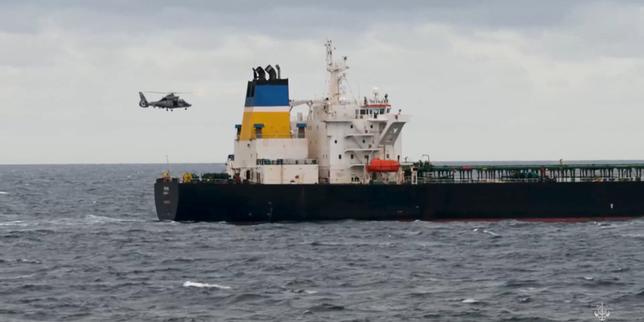
The seizure of the oil tanker Deyna by French naval forces in the Mediterranean marks a significant escalation in the quiet, grinding war of attrition against Russian maritime logistics. While the Russian Embassy in Paris maintains a calculated posture of ignorance—claiming they have no information regarding the crew or the vessel’s status—the reality on the water suggests a much more sophisticated game of cat and mouse. This is not a simple bureaucratic oversight. It is a symptom of a crumbling facade in the global shipping industry.
France’s decision to intercept the vessel under the framework of European Union sanctions indicates a high level of intelligence coordination. The French Navy does not board tankers on a whim. They act when the paper trail vanishes or when the AIS (Automatic Identification System) data begins to flicker in ways that suggest "spoofing." The Deyna represents the physical manifestation of the Ghost Fleet, a collection of aging, under-insured, and obscurely owned vessels designed to bypass the $60 price cap and logistical blockades imposed after the invasion of Ukraine.
The Calculated Silence of the Russian Embassy
Diplomatic "no comment" is a weapon. By claiming they have no data on the crew, the Russian mission achieves two goals. First, it distances the Kremlin from the legal liability of the vessel’s potential environmental or safety violations. Second, it leaves the crew—often composed of non-Russian nationals hired through third-party agencies in Dubai or Hong Kong—in a legal limbo that complicates French judicial proceedings.
If the embassy acknowledges the crew, they acknowledge the mission. If they remain silent, the Deyna remains a "stateless" problem in the eyes of international maritime law, even if it flies a flag of convenience like Cameroon or Palau. This tactic is a direct mirror of the "Little Green Men" strategy used in Crimea, now applied to the high seas. The ships are Russian in interest but anonymous in identity.
Logistics of the Mediterranean Chokepoint
The Mediterranean has become a primary theater for these shadow operations because it serves as the gateway between Baltic ports and the thirsty markets of Asia and the Middle East. To understand why the Deyna was stopped, one must look at the mechanics of Ship-to-Ship (STS) transfers.
Russian tankers often meet secondary vessels in international waters, away from the prying eyes of port authorities. They pump millions of barrels of crude from one hull to another, blending the oil with "neutral" grades to mask its origin. This process is inherently dangerous. These ships are frequently past their scrap date. They lack the rigorous P&I (Protection and Indemnity) insurance required by major global hubs. A single engine failure or a hull breach during an STS transfer in the Mediterranean would result in an environmental catastrophe that no one—not the Russian state, and certainly not the shell company in the Seychelles—would pay to clean up.
French authorities are increasingly unwilling to stomach this risk. The interception of the Deyna is a message to the owners of these ghost ships: the Mediterranean is no longer a lawless transit zone.
The Paper Trail to Nowhere
When investigators peel back the layers of ownership for a vessel like the Deyna, they find a recursive loop of offshore entities. The ship’s owner of record is likely a company that owns exactly one asset: the ship itself. These companies have no physical offices and no employees.
- Front Companies: Often based in jurisdictions with minimal oversight.
- Flag Hopping: Changing the vessel's registration frequently to avoid tracking.
- Shadow Insurance: Using non-Western insurers that lack the capital to cover a major spill.
This structure is designed to be brittle. It is meant to break as soon as a lawyer asks a question. By the time the French Navy boards the ship, the "owner" has already dissolved the company or transferred the ship’s title to another entity. This makes the French task of "freezing" the asset a nightmare of international litigation.
Why the Price Cap is Forcing Riskier Moves
The G7 price cap was intended to keep Russian oil flowing while starving the Kremlin of record profits. It worked, but only to a point. It forced Russia to build its own parallel infrastructure. Because they cannot use Western tankers or Western insurance for oil sold above the cap, they must rely on the bottom of the barrel.
The Deyna is the result of this forced evolution. It is a vessel operating outside the "White Market" of global shipping. When a ship operates in the gray or black market, it ignores standard safety protocols. It turns off its transponders. It takes longer, more dangerous routes to avoid NATO patrols. The French interception proves that the "dark" part of this fleet is becoming visible through sheer necessity. They are running out of places to hide.
The Human Cost of Maritime Scapegoating
Lost in the geopolitical chess match are the mariners themselves. Crews on ghost tankers are often recruited with the promise of high wages, only to find themselves on vessels with questionable maintenance and no legal protection. If a ship is seized, the owners vanish. The embassy remains silent. The crew is left to rot in a foreign port, often facing criminal charges for sanctions evasion that they were barely aware they were committing.
This is a deliberate feature of the system. The crew is a disposable component. By refusing to provide information, the Russian government is essentially telling these sailors they are on their own. It is a ruthless form of deniability that ensures the state is never directly tied to the breach of international law.
Western Resolve and the Legal Vacuum
The seizure of the Deyna tests the limits of what the French Navy can legally do. Under the UN Convention on the Law of the Sea (UNCLOS), seizing a merchant vessel in international waters is a high-bar maneuver. However, if the ship enters territorial waters or if there is "reasonable doubt" about its registry, the rules change.
France is betting that the Russian government will not fight too hard for a single tanker if doing so requires revealing the inner workings of their shipping network. It is a bluff. The French are calling it. By holding the ship, they are forcing the shadow owners to either step into the light to claim their property—thereby exposing themselves to sanctions—or abandon the vessel and its multi-million dollar cargo entirely.
Most choose to abandon.
The Future of Maritime Enforcement
We are entering an era where maritime law is being rewritten by the realities of economic warfare. The Deyna incident will not be the last. As the Ghost Fleet grows to compensate for tightening sanctions, the frequency of these high-seas confrontations will increase.
The strategy for European powers is now clear. They will target the weakest links in the chain—the vessels with the shadiest paperwork and the most compromised safety records. By making the Mediterranean a "high-friction" zone for Russian oil, they drive up the cost of doing business. Every day a tanker sits in a French port under guard is a day the Kremlin loses revenue.
The silence from the Russian Embassy is not a sign of confusion. It is the sound of a system that has been caught and is now trying to chew off its own limb to escape.
Monitor the movement of the Deyna’s sister ships currently idling off the coast of Greece; their next moves will reveal if this seizure has truly spooked the shadow operators or if they simply view it as the cost of doing business.