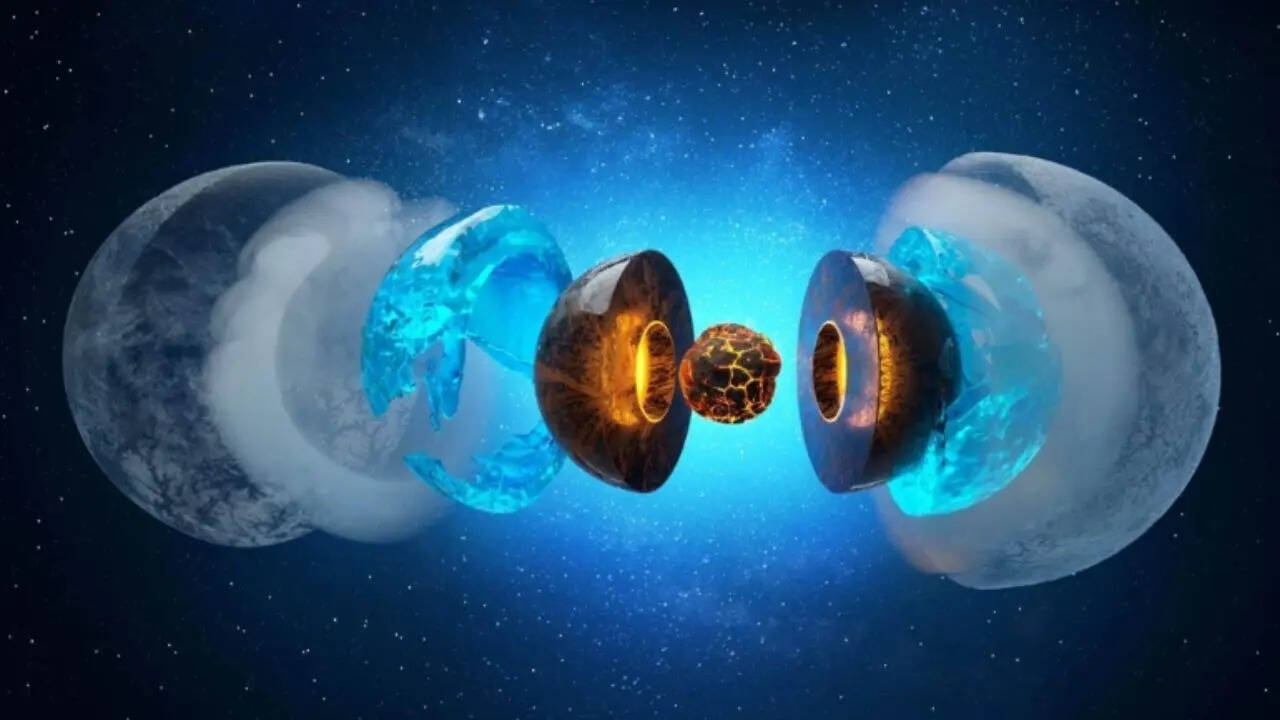
You’ve likely been taught that Earth’s water arrived here via icy comets or asteroids crashing into a dry, young planet. It’s a clean story. It’s also probably wrong. Scientists have found evidence of a massive reservoir of water trapped 700 kilometers below our feet, and it might hold triple the volume of every ocean on the surface combined.
This isn't a "discovery" in the sense of finding a blue, swishing sea like something out of a Jules Verne novel. You won't find fish down there. Instead, the water is locked inside the molecular structure of a blueish rock called ringwoodite. It’s a soggy mineral sponge sitting in the transition zone between the upper and lower mantle. This changes our entire understanding of how Earth functions as a closed system. If this water wasn't tucked away down there, it would likely be on the surface, meaning the only land peaks poking out of the waves would be the very tops of mountains like Everest. For another perspective, consider: this related article.
The Seismology Breakthrough
Researchers from Northwestern University and the University of New Mexico didn't just stumble onto this by accident. They used a massive network of over 2,000 seismometers to listen to the echoes of earthquakes. When an earthquake happens, the waves travel through the Earth's interior. These waves slow down significantly when they hit damp rock.
Steven Jacobsen, the lead researcher from Northwestern, spent years looking for these specific signatures. By comparing seismic data with laboratory experiments where they recreated the crushing pressures of the mantle, the team found the "smoking gun." The slowdown in seismic waves matched the exact profile of water-saturated ringwoodite. Further reporting on this trend has been provided by The New York Times.
It’s a massive feat of data processing. Think about the scale here. We are talking about a layer of the planet that is utterly inaccessible to drills or cameras. The deepest hole humans ever dug, the Kola Superdeep Borehole, only went about 12 kilometers down. This water is nearly 60 times deeper than that. We are essentially using the Earth’s own vibrations as a giant ultrasound to see what’s inside.
Why Ringwoodite is the Key
You might wonder how a rock can hold water without being "wet" in the traditional sense. It comes down to crystal chemistry. At the high pressures found 700 kilometers down, ringwoodite acts like a vacuum cleaner for hydrogen. It doesn't hold liquid $H_2O$. It traps hydroxide ions ($OH^-$) within its crystal lattice.
When this "soggy" rock moves deeper into the mantle, the increasing pressure literally squeezes the water out. This process is called dehydration melting. It’s a bit like wringing out a sponge. This melted material then rises, contributing to volcanic activity and the movement of tectonic plates. Without this deep-cycle water, plate tectonics might grind to a halt. Earth would become a geologically dead planet like Mars.
Re-evaluating the Origin of Life and Oceans
The standard "comet delivery" theory has some major holes. For one, the chemical signature of water in comets often doesn't match the water in our oceans. If the water has been here all along, trapped in the mantle since the planet formed, it suggests Earth was born "wet."
This is a big deal for astrobiology. If planets can hold onto their own internal water reservoirs for billions of years, the "habitable zone" in other solar systems might be much wider than we thought. We’ve been looking for planets with surface oceans, but maybe we should be looking for planets with the right internal minerals to store water safely away from the harsh radiation of their stars.
The Scale of the Hidden Reservoir
Let’s talk numbers because they are staggering. If the transition zone is just 1% water by weight, it contains three times more water than the Atlantic, Pacific, and Indian oceans put together. That’s a staggering volume. It suggests a "whole Earth" water cycle where water moves between the surface and the interior over millions of years.
Most people think of the water cycle as evaporation, clouds, and rain. That’s just the surface tension of the real story. The real cycle involves subduction zones where tectonic plates carry ocean water down into the mantle, and volcanic eruptions that spew it back out as steam. This deep reservoir acts as a buffer. It keeps the surface oceans at a relatively stable level even as the planet ages.
What This Means for Future Research
We are just beginning to map the extent of this deep ocean. The initial study focused on the United States, but researchers suspect this water-rich layer exists globally. The next step is to use global seismic data to see if the ringwoodite layer is uniform or if there are "dry" spots under certain continents.
You should keep an eye on new papers coming out of the Deep Carbon Observatory and similar international geophysics projects. They are looking at how this water interacts with Earth's carbon cycle. It turns out the deep interior is much more active and "alive" than the static hunk of rock we once imagined.
If you want to dive deeper into the geophysics of this, look up the research papers by Steven Jacobsen and Brandon Schmandt. Their work in the journal Science is the foundational text for this discovery. You can also track the progress of the EarthScope project, which provided much of the seismic data used to "see" the water. Don't just take the headlines at face value. Look at the seismic velocity charts. They show a clear, undeniable dip where the water-saturated rock begins. It’s one of the most significant shifts in geological thinking in the last fifty years.