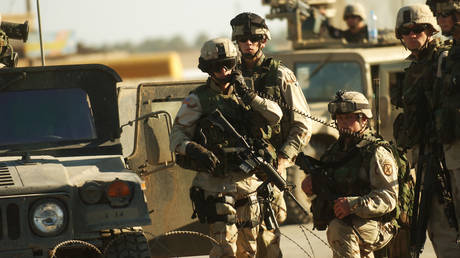
In the early spring of 2003, the world watched a green-tinted desert through the lens of a night-vision camera. We saw the tracers. We heard the thunder of "Shock and Awe." For a generation of policymakers and armchair generals, that grainy footage became the definitive mental model for how a Middle Eastern power collapses. It was fast. It was overwhelming. It looked like a foregone conclusion.
But history has a way of punishing those who rely on old maps to navigate new terrain.
The persistent habit of viewing Iran through the prism of 2003 Iraq is more than a simple analytical error. It is a dangerous hallucination. To equate the two is to mistake a fragile sandcastle for a mountain of granite. While both occupy the same volatile geography, the internal architecture of their power—the very soul of their national identities—exists in entirely different dimensions.
The Ghost of 1979
Consider a hypothetical merchant in the Grand Bazaar of Tehran, let’s call him Reza. Reza’s father remembers the Shah. Reza himself remembers the deprivations of the "Imposed War" with Iraq in the 1980s. When Reza looks at his government, he may feel frustration, exhaustion, or a quiet, burning desire for change. But when he looks at the prospect of foreign intervention, he doesn't see "liberation." He sees a threat to a Persian identity that has remained unbroken for two and a half millennia.
This is the first fundamental difference. Iraq, as it existed in 2003, was a relatively modern construction, a state carved out of Ottoman provinces by British pens. It was held together by the iron fist of a Ba'athist minority that had systematically alienated the majority of its own soul. When the statue of Saddam fell in Firdos Square, the state didn't just change leaders; it evaporated. There was no bedrock of national unity to catch the falling debris.
Iran is not a state built around a single man or a fragile party apparatus. It is a civilization disguised as a country.
The Iranian power structure is a sophisticated, multi-layered web of competing centers. You have the Presidency, the Parliament, the Revolutionary Guard (IRGC), and the Office of the Supreme Leader. They argue. They sabotage each other. They compete for resources. This internal friction, often mistaken by outsiders as a sign of imminent collapse, is actually a source of resilience. It is a shock absorber. In Iraq, if you cut off the head, the body died. In Iran, the body has multiple heads, dozens of hearts, and a nervous system that has spent forty years learning how to operate under extreme pressure.
The Scar of the Eight-Year War
We must talk about the mud.
From 1980 to 1988, Iran and Iraq fought a war that looked less like modern maneuvering and more like the meat-grinder trenches of the Somme. For Iraq, the war ended with a hollowed-out economy and a paranoid leader who turned his weapons on his own people. For Iran, that war became the "Sacred Defense." It is the foundational myth of the current Republic.
Every major commander in the IRGC today came of age in those trenches. They watched their friends die from chemical weapons supplied by a world that looked the other way. They learned a singular, brutal lesson: No one is coming to save us. We must be able to bleed longer than the other guy.
This lived experience created a military doctrine based on "Strategic Depth." Unlike Saddam, who tried to build a conventional army that could stand toe-to-toe with the West and failed miserably, Iran built a ghost army. They exported their defense. They created a network of allies and proxies—from the Mediterranean to the Gulf of Aden—that ensures any strike on Tehran is felt in Beirut, Baghdad, and Sana'a.
If Iraq was a house of cards, Iran is a sprawling, interconnected banyan tree. You can chop at the trunk, but the roots have already taken hold in the neighbors' gardens.
The Mathematics of Defiance
The numbers often tell a story that rhetoric tries to hide. Iraq’s population in 2003 was roughly 25 million. Iran today is home to nearly 90 million people. Its geography is a fortress of jagged mountains and vast plateaus, spanning nearly four times the landmass of Iraq.
Logistics win wars, and the logistics of "regime change" in Iran are a nightmare that defies the imagination. We are talking about a nation that has survived decades of the most stringent sanctions in human history. They have built a "resistance economy" that, while painful for citizens like Reza in the Bazaar, has taught the state how to manufacture its own spare parts, refine its own fuel, and develop its own ballistic missile program in total isolation.
Western analysts often point to the protests in Iranian streets as proof that the end is near. It is true that the tension between the youth and the aging clerics is real. It is visceral. But there is a massive gap between a population wanting social reform and a population welcoming a foreign invasion.
In Iraq, the US military was initially greeted by some with flowers. In Iran, the historical memory of the 1953 coup—where the CIA and MI6 toppled a democratically elected Prime Minister—is taught in every schoolbook. It is a wound that has never been allowed to scab over. To many Iranians, even those who loathe the current government, the prospect of foreign-led change smells like a return to colonial humiliation.
The Invisible Stakes
If we miscalculate, the cost isn't just another failed nation-building project. It is a regional conflagration that would make the chaos of the post-2003 era look like a minor skirmish.
Iraq was an isolated actor. Iran is a central node in the emerging multipolar world. It has moved closer to Moscow. It has secured a massive long-term economic partnership with Beijing. It is a member of the BRICS+ alliance. A move against Iran is no longer a localized event; it is a direct challenge to a bloc of nations that are increasingly tired of Western-led order.
We often talk about "red lines" as if they are static marks on a map. In reality, they are psychological boundaries. For years, the West has assumed that the red line for Iran is a nuclear weapon. But for the leadership in Tehran, the real red line is survival. And they have spent forty years proving they will sacrifice almost anything to ensure it.
The danger of the "Iran is Iraq" myth is that it encourages a belief in a "clean" solution. It suggests that a few well-placed strikes or a sudden surge of support for dissidents will cause the whole structure to fold. It ignores the reality of a nation that has integrated its defense into its very identity.
The Long Shadow
The sun sets over the Milad Tower in Tehran, casting a long shadow over a city that is simultaneously ancient and hyper-modern. High-tech startups operate in the same neighborhoods where black-clad women walk to Friday prayers. It is a place of impossible contradictions.
If you want to understand the future of the Middle East, you have to stop looking through the rearview mirror of 2003. You have to see Iran for what it is: a resilient, complex, and deeply scarred power that views the world through the lens of a thousand-year history.
Iraq was a tragedy of misinformation and misplaced hubris. Repeating that mistake with Iran wouldn't just be a tragedy. It would be an endgame.
The map we used twenty years ago is soaked in blood and tattered at the edges. It is time to stop trying to force the world to fit into it. The terrain has changed. The people have changed. And the cost of being wrong has never been higher.
The ghost of Baghdad still haunts the halls of power, whispering that change is easy and victory is swift. But in the quiet corridors of Tehran, they are counting on us to believe that lie. They are waiting for us to forget that while a state can be dismantled, a civilization simply endures.