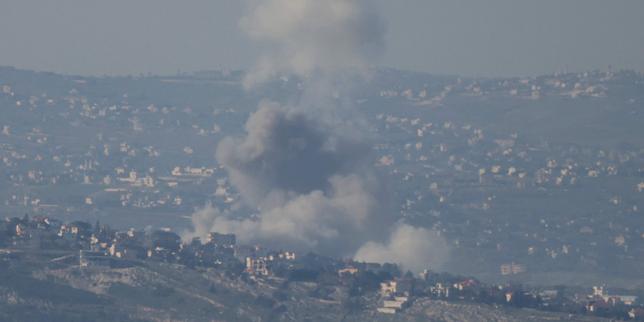
The explosions that ripped through Beirut’s southern suburbs at 3:00 a.m. this Monday were not just another entry in the ledger of Middle Eastern attrition. They were a funeral for a decade of strategic ambiguity. By the time the sun rose over the charred husks of buildings in Dahieh and the decimated valleys of the south, the casualty count had climbed to 31 dead and nearly 150 wounded. This was the immediate price of Hezbollah’s decision to launch a retaliatory rocket barrage against a missile defense site south of Haifa—a move triggered by the death of Iranian Supreme Leader Ali Khamenei just 24 hours prior.
For the average observer, this looks like the usual cycle of violence. It is not. This is a deliberate, high-stakes dismantling of the "proxy" shield that has protected Tehran for forty years. By striking Beirut with such ferocity in response to Hezbollah's first major violation of the 2024 ceasefire, Israel is signaling that the old rules—where a proxy could strike, and the sponsor could hide—have been permanently erased.
The Haifa Gambit and the 3 A.M. Response
The sequence of events began shortly after midnight on March 2. Hezbollah launched a sophisticated barrage of missiles and drones, targeting the Mishmar al-Karmel missile defense facility. In a statement released through their usual channels, the group called it a "legitimate defensive response" to the killing of Khamenei. They framed it as a duty of honor, a blood debt to their fallen patron.
Israel’s response was not a measured escalation. It was a massive, multipronged air campaign that hit more than 70 targets in a single wave. The Israeli Air Force struck the Dahieh district of Beirut, the Bekaa Valley, and 55 separate towns across southern Lebanon. This was not a warning shot. It was a decapitation attempt on Hezbollah’s intelligence apparatus. By the afternoon, the Israel Defense Forces (IDF) announced the death of Hussein Makled, the head of Hezbollah’s intelligence headquarters, killed in the overnight strikes in Beirut.
The precision of these strikes suggests a level of intelligence penetration that should terrify any remaining Hezbollah leadership. To hit an intelligence chief in the heart of a densely populated urban stronghold hours after a rocket launch requires more than just satellite imagery. It requires a live, breathing human network that the group clearly failed to purge after the 2024 conflict.
A Nation Under the Litani Shadow
The tragedy for the Lebanese people is that they are once again the collateral in a war they did not vote for. Prime Minister Nawaf Salam’s reaction was uncharacteristically blunt. Within hours, he condemned Hezbollah’s rocket fire as "irresponsible acts" that provide Israel with the "pretexts to continue its aggression." This is not the language of a government that still fears its domestic paramilitary. It is the language of a state that sees an opportunity to finally reclaim its sovereignty.
In an emergency cabinet meeting, Salam announced a total ban on all military activities by Hezbollah. He demanded the group surrender its weapons to the state. This is a tall order, bordering on the impossible, but it reflects a shifting tide in Lebanese politics. For the first time since the 2024 ceasefire, the Lebanese Armed Forces (LAF) are under intense pressure to do more than just monitor the border. They are being told to arrest those involved in launching rockets.
The Civilian Cost of a 20-Minute Evacuation
The human reality on the ground is a frantic, northbound exodus. When the IDF issued evacuation orders for 55 villages, the highway from Tyre to Sidon became a parking lot. Families piled onto scooters and into cars, driving over the rubble of buildings that were standing just hours before.
The "knock on the roof" or the 20-minute warning message has become a standard feature of modern warfare, but its utility is shrinking. When 50 villages are told to leave simultaneously, the infrastructure simply cannot handle the load. At least 31 people are dead, and that number is expected to rise as search and rescue teams—often Hezbollah-affiliated civil defense units—dig through the concrete remains of Haret Hreik.
The Strategic Miscalculation
Why did Hezbollah strike now? From a military perspective, it was a disaster. Their rockets were largely intercepted, and their retaliatory value was dwarfed by the loss of senior command staff and critical infrastructure.
The answer lies in the crumbling of the Iranian command structure. With Khamenei gone and Tehran under direct attack from a joint U.S.-Israeli campaign, the "Axis of Resistance" is suffering from a massive coordination failure. Hezbollah’s secretary-general, Naim Qassem, is now a "marked target for elimination," according to Israeli Defense Minister Israel Katz. The group is fighting for its relevance, and perhaps its survival, in a regional war that has moved past the era of containment.
The strategy of "Unity of Fields"—the idea that an attack on one Iranian ally would trigger a synchronized response from all—has failed to materialize in a way that actually deters the IDF. Instead, it has given Israel the justification to conduct what they call "Operation Epic Fury," a systematic dismantling of the Iranian-aligned military network.
The Logistics of the Bekaa Valley
While the world watches the smoke over Beirut, the real military work is happening in the Bekaa Valley. This is Hezbollah’s logistical spine. The IDF’s recent strikes there have targeted:
- Weapons production facilities and underground storage shafts.
- Engineering equipment, specifically bulldozers and excavators used to rebuild military sites.
- Illegal border crossings with Syria used for arms smuggling.
By targeting the equipment used for reconstruction, Israel is moving toward a policy of "permanent degradation." They aren't just blowing up a building; they are destroying the tools needed to build it back. This is a war of attrition where the goal is to ensure the enemy never reaches a baseline level of operational capability.
The End of the Proxy Era
The Middle East is currently witnessing the collapse of the proxy model. For decades, Iran projected power through groups like Hezbollah, the Houthis, and various Iraqi militias, assuming that the cost of a direct war with Tehran was too high for any Western power to pay.
That assumption was proven wrong on February 28, 2026.
When the United States and Israel launched their joint strike campaign against Iran, they didn't just target nuclear sites; they targeted the leadership. With the supreme leader dead and the regime in Tehran scrambling to form a "triumvirate" or a new leadership structure, the proxies are adrift. They are no longer the forward-deployed tip of an Iranian spear; they are isolated cells fighting a far more powerful and technically superior enemy.
Hezbollah’s current predicament is the "Lebanon Trap." If they don't fight, they lose their reason for existence and their support from what’s left of the IRGC. If they do fight, they invite a level of destruction that might finally turn the entire Lebanese population—including their own support base—against them.
The next few days will determine if this remains a series of devastating air raids or if the 100,000 Israeli reservists currently massed on the border will cross the Litani once again. If they do, the 2024 ceasefire will be remembered as a brief, 15-month intermission in a war that has no clear ending, only a series of increasingly violent chapters.


