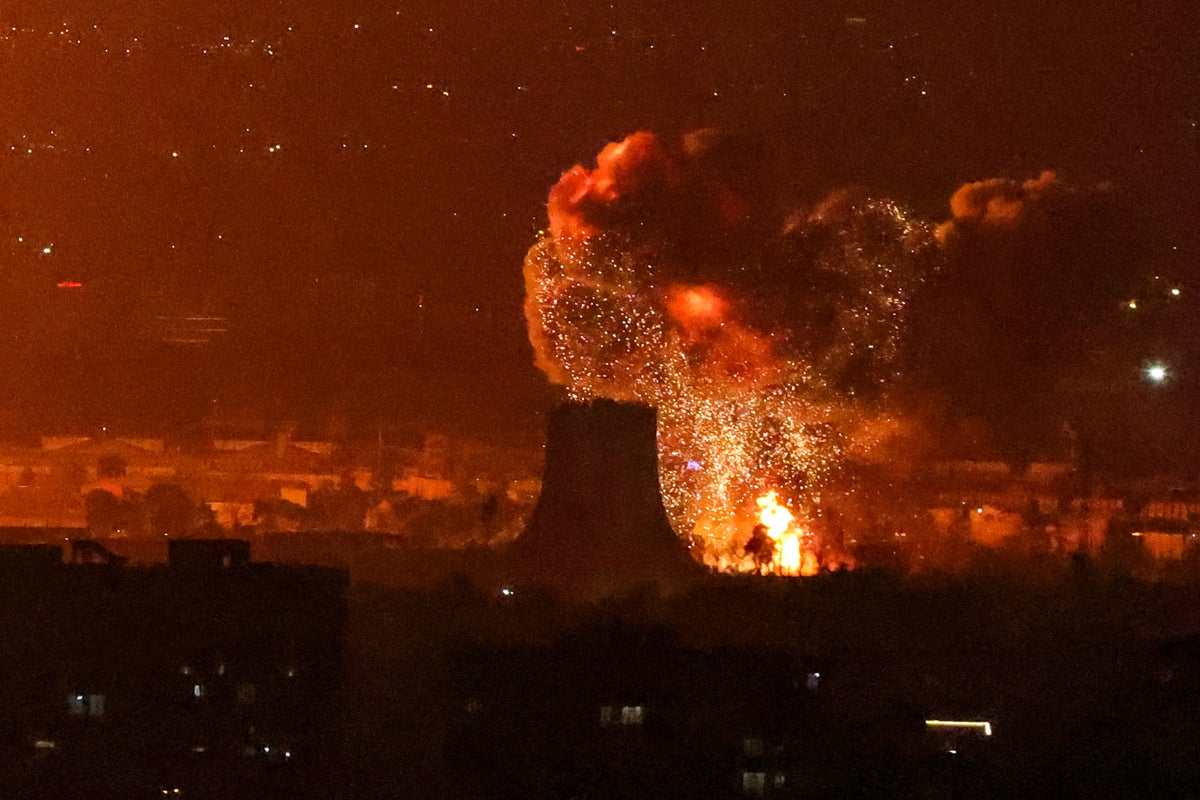
The degradation of a hardened nuclear facility through external kinetic action is not a matter of simple explosive yield but a function of structural resonance, geological coupling, and the disruption of ultra-high-speed rotational equilibrium. When analyzing reports of a significant strike on Iranian nuclear assets—specifically the Natanz enrichment plant or the Isfahan conversion facility—the primary metric of success is not the collapse of surface structures, but the permanent misalignment of the centrifuge cascades housed hundreds of feet below the surface. A successful strike must overcome the "overburden bottleneck," where the physical mass of the Earth acts as a low-pass filter for blast energy, necessitating the use of specialized penetrator geometry or high-precision temporal sequencing of impacts.
The Triad of Subterranean Vulnerability
To evaluate the claim of "severe damage" to an Iranian nuclear site, one must deconstruct the facility into three distinct operational layers. Damage to any single layer can halt production, but only the third ensures long-term strategic denial.
1. The Power and Cooling Lifecycle
Centrifuge enrichment is an energy-intensive process requiring absolute thermal stability. IR-2m and IR-6 centrifuges operate at tens of thousands of revolutions per minute; any fluctuation in power frequency or a failure in the cooling jackets leads to immediate "crash" scenarios where the rotor assemblies disintegrate. Kinetic strikes often target the electrical substations or the heat exchange manifolds located near the surface. While these are "soft" targets, they represent a critical dependency. If the cooling cycles are interrupted for even a short duration, the resulting thermal expansion in the vacuum chambers can seize the bearings of the entire cascade.
2. The Atmospheric and Gas Management System
The movement of Uranium Hexafluoride ($UF_6$) gas through the cascades relies on a delicate pressure differential managed by a complex network of valves and pipes. A missile strike that creates a pressure wave—even if it doesn't penetrate the main hall—can cause "transient pressure spikes" within the piping. Because $UF_6$ is highly corrosive and reacts violently with atmospheric moisture to form hydrofluoric acid, a breach in the gas management system leads to chemical fouling of the entire facility, rendering the remaining hardware unreachable without extensive decontamination.
3. The Kinetic Displacement of the Foundation
This is the most sophisticated form of interdiction. By using multiple tandem-charge warheads striking the same entry point (the "drilling effect"), an attacker can transmit a shockwave directly into the bedrock.
The objective here is not to crush the centrifuges but to achieve "Seismic Misalignment." If the floor of the enrichment hall shifts by even a few millimeters, the gyroscopic stability of the IR-6 rotors is compromised. At high speeds, the carbon-fiber rotors will touch the casing walls, leading to a chain-reaction "shrapnel event" that destroys the entire hall from the inside out.
Quantifying the Hardened Target Defenses
The Natanz Fuel Enrichment Plant (FEP) is designed to withstand standard aerial bombardment through a combination of depth and material density. The facility utilizes a layered defense-in-depth architecture:
- Sacrificial Overburden: Layers of soil and rock intended to dissipate the initial kinetic energy of a penetrator.
- Reinforced Concrete Bursters: Slabs of high-strength concrete (often exceeding 10,000 psi compressive strength) designed to trigger the fuse of a bomb prematurely.
- Air Gaps: Integrated voids between concrete layers that cause the shockwave to lose intensity as it transitions between different medium densities (impedance mismatch).
Structural analysis suggests that to reach the main enrichment halls, a weapon must possess a high sectional density—essentially a long, thin shape made of depleted uranium or tungsten—to maintain velocity through these layers. If reports of "severe damage" are accurate, it implies the use of munitions capable of maintaining structural integrity through at least 30 meters of earth and reinforced stone.
The Logic of the Sequential Strike
Military strategists utilize a "Functional Defeat" framework rather than a "Structural Destruction" framework when dealing with sites like Isfahan. Structural destruction is often impossible with conventional payloads, but functional defeat is achievable through the following causal chain:
- Suppression of Active Defense: The initial phase involves the neutralization of S-300 or Khordad-15 surface-to-air missile batteries. Without the removal of these "sensor nodes," high-precision loitering or sequential impacts are impossible.
- Portal and Vent Interdiction: Instead of hitting the rock, missiles target the elevator shafts and ventilation intake towers. This traps the workforce and prevents the exhaust of toxic gases, effectively turning the facility into a sealed tomb for the equipment.
- Seismic Coupling: The final phase uses heavy penetrators to hit the surrounding bedrock. This creates a "Ground Shock" environment.
$E_s = k \cdot \frac{\sqrt{W}}{D^n}$
In this relationship, the seismic energy ($E_s$) delivered to the centrifuges is a function of the weight of the explosive ($W$) and the distance from the hall ($D$), modified by the coupling constant ($k$) of the local geology. An attacker maximizes $k$ by choosing impact points that align with the natural fault lines or the specific rock strata upon which the facility is built.
Strategic Constraints and Attribution
The absence of an official claim of responsibility creates a "Gray Zone" of attribution, but the technical requirements for such an operation limit the list of capable actors. A strike of this magnitude requires:
- Real-time Battle Damage Assessment (BDA): Satellite or high-altitude drone surveillance capable of multi-spectral imaging to detect thermal signatures leaking from cracked underground structures.
- Precision Navigation: The ability to put multiple warheads into a single "hole" created by the first impact.
- Electronic Warfare Dominance: The total jamming of local communication to prevent the activation of "dead-man" switches or the manual emergency shutdown of the cascades.
The limitation of this strategy is the "Recuperation Constant." Hardened facilities can eventually be cleared, re-mined, and re-equipped. However, the specialized nature of maraging steel and carbon fiber used in centrifuges means that a "shrapnel event" in a cascade creates a procurement bottleneck that can last years due to international sanctions on dual-use materials.
Operational Conclusion for Regional Deterrence
The reported damage at the Iranian nuclear sites shifts the regional calculus from "containment" to "active degradation." The operational success of such a strike serves as a proof-of-concept for the "kinetic-seismic" method of bunker-busting. The immediate strategic play for an observing entity is to monitor the International Atomic Energy Agency (IAEA) environmental sampling reports. If inspectors detect high levels of $UF_6$ byproducts in the atmosphere, it confirms a breach of the primary containment vessels.
The next tactical phase involves monitoring for "bottleneck indicators"—specifically, movements of heavy earth-moving equipment and specialized concrete pouring teams at the site. These actions signal an attempt to stabilize the structural integrity of the caverns before re-entry. If these recovery efforts are observed, it confirms that the strike achieved its goal of fracturing the foundation, necessitating a total rebuild of the facility's internal architecture rather than a simple repair of surface-level electronics.
Deploying a strategy of "persistent disruption" rather than "one-time destruction" ensures that the facility remains in a perpetual state of repair, effectively freezing the enrichment timeline without the need for a full-scale ground invasion or nuclear-yield munitions.