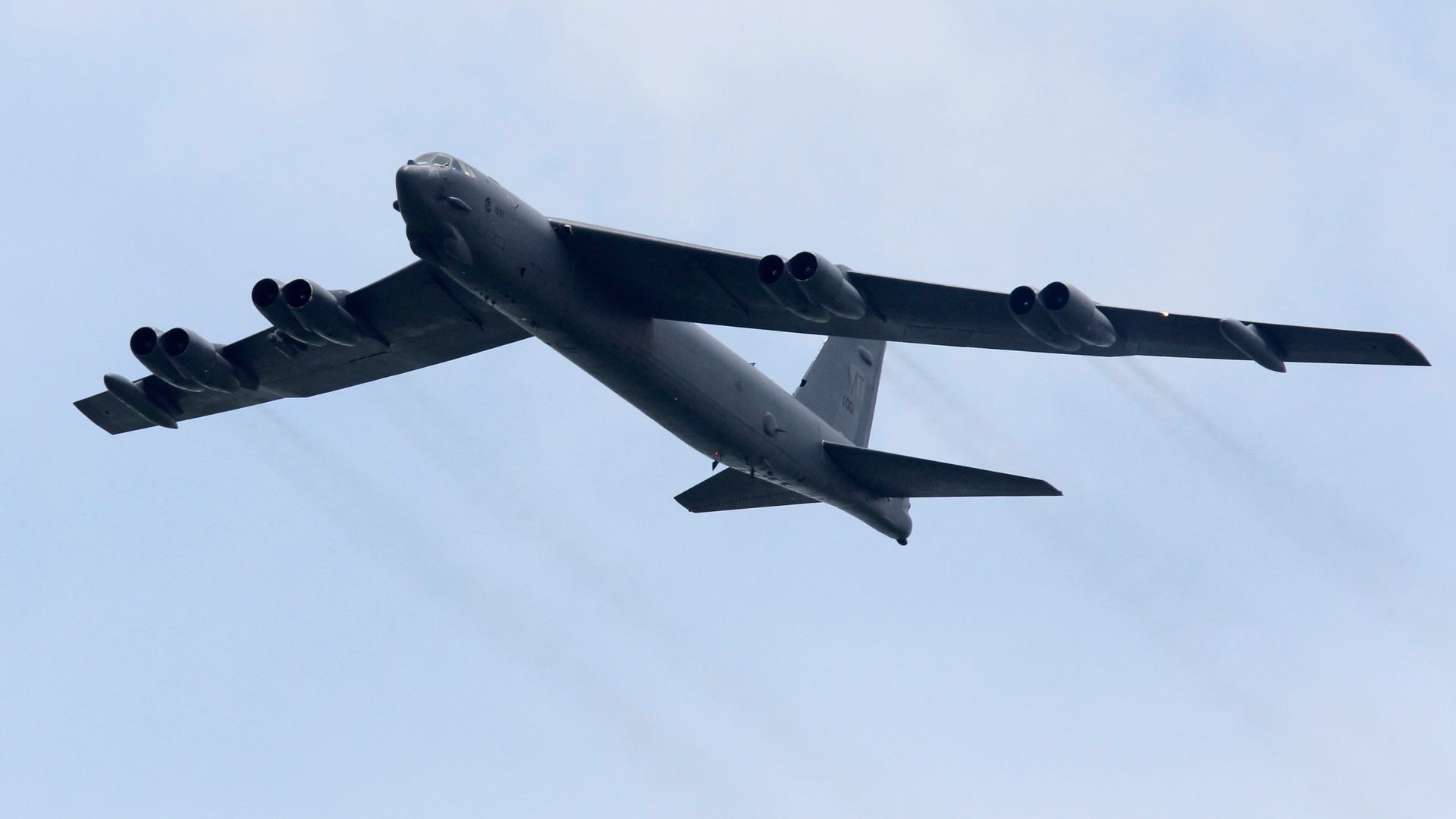
The rivets are the first thing you notice. They aren't the sleek, flush-mounted fasteners of a modern stealth fighter that cost more than a small nation’s GDP. These are proud, rounded, and defiant. They hold together a skin of aluminum that has been wrinkled by decades of stratospheric turbulence, a phenomenon aircrews affectionately call "oil canning."
When a B-52 Stratofortress sits on the tarmac, it looks tired. It saggs. Its wings, massive and heavy with fuel, droop toward the concrete like the shoulders of an old weightlifter who hasn't put the barbell down since 1952. But then the engines start—eight of them—and the black smoke of cold-starting turbines begins to clear. The sag vanishes. The physics of lift take over, and suddenly, the antique is an apex predator again.
We live in an era of disposable technology. You likely replace your phone every three years because the processor can no longer keep up with the software. The Pentagon usually works the same way. Billions are poured into "fifth-generation" marvels that can turn invisible to radar and calculate more data points in a second than a human could in a lifetime. Yet, the most important long-range bomber in the American arsenal is a plane that predates the internet, the moon landing, and the birth of the pilots currently flying it.
The US Air Force plans to keep the B-52 flying until 2050. That means a single airframe could remain in active service for nearly 100 years. Imagine your great-grandfather’s rotary phone being upgraded with fiber-optic internals and used to run a global corporate empire today. It sounds like a joke. It’s actually a masterpiece of engineering and cold, hard pragmatism.
Consider the cockpit of a BUFF—the Big Ugly Fat Fellow, as the crews call it. It isn't a glass-walled digital sanctuary. It is a dense, claustrophobic jungle of analog dials and toggle switches. To fly it is a physical act. You don’t just tap a touchscreen. You pull. You push. You feel the air pushing back.
The Mathematics of Staying Relevant
Why? Why keep a relic when we have the B-2 Spirit and the upcoming B-21 Raider? The answer lies in the brutal math of modern warfare. Stealth is expensive. It is fragile. A B-2 bomber is a masterpiece of low-observable technology, but it requires climate-controlled hangars and specialized maintenance that makes a Formula 1 pit crew look like hobbyists.
The B-52 is different. It is a truck. It is a flying warehouse.
In the early 1960s, the B-52 was a nuclear deterrent. It was designed to fly high and drop gravity bombs on the Soviet Union. When Soviet surface-to-air missiles (SAMs) got too good at shooting things down at high altitude, the B-52 adapted. It learned to fly low, hugging the terrain at 400 feet, its massive frame rattling as it punched through the thick, turbulent air of the lower atmosphere. When the Cold War ended, people thought the B-52 was done. They were wrong.
The plane’s greatest strength isn't its speed—it can’t even break the sound barrier. It isn't its stealth—it shows up on a radar screen like a flying barn door. Its strength is its sheer, unapologetic capacity.
Hypothetically, imagine a modern conflict in a "contested environment." A stealth fighter might sneak through the front door and kick it open, taking out the radar and the missile batteries. But once that door is open, you need volume. You need a platform that can stay in the air for 20 hours at a time, circling over a target area, waiting for a call for help. A B-52 can carry up to 70,000 pounds of ordnance. It can carry cruise missiles, sea mines, and "smart" bombs that find their targets with GPS.
It is the ultimate utility player. If the B-2 is a scalpel, the B-52 is a sledgehammer that can be used with surgical precision.
The Human Lineage
There is a unique culture inside the B-52 community. It’s a lineage. You find pilots whose fathers flew the exact same tail number over Vietnam. They might even be using the same physical throttle quadrant that their grandfather gripped during the Cuban Missile Crisis.
This isn't just nostalgia. It’s trust.
When you are 40,000 feet above the ocean, thousands of miles from the nearest runway, you want a machine that has seen it all. The B-52 has survived bird strikes that would have disintegrated a modern composite wing. It has flown with large chunks of its tail missing. It has been repaired with parts from planes sitting in "The Boneyard" in Arizona, machines that were retired decades ago but kept as organ donors for their surviving siblings.
Engineers are currently working on a massive overhaul for the fleet. They are replacing the eight aging engines with modern Rolls-Royce F130s. They are ripping out the old analog radar and replacing it with the same high-tech systems used in the F-18. They are turning the "relic" into a digital powerhouse.
But beneath the new electronics and the more efficient engines, it is still the same 1950s steel and aluminum.
The B-52 is a lesson in the difference between "new" and "effective." We are obsessed with the latest version of everything. We equate age with obsolescence. But in the world of strategic power, reliability is the only currency that matters. A B-52 arriving in a region doesn't just deliver bombs; it delivers a message. It is a visible, loud, and terrifying reminder of a century of military might.
When a stealth bomber flies over, you might not even know it’s there. When a B-52 arrives, you feel it in your teeth.
The Invisible Stakes of Longevity
There is a quiet irony in the way we view technology. We marvel at the B-21 Raider, a plane that looks like something from a science fiction film, while ignoring the B-52 parked next to it. Yet, the B-52 is the reason the B-21 is possible. By handling the "truck" work—the long-duration patrols, the massive payload deliveries—it allows the specialized stealth assets to remain held in reserve for the specific, high-risk missions they were built for.
If the B-52 were retired today, the US military would lose its most flexible tool. It is the only plane that can fly from Louisiana, bomb a target on the other side of the planet, and return home without ever touching foreign soil. It is the ultimate expression of global reach.
The cost of replacing the B-52 with a completely new "non-stealth" bomber would be astronomical. Why design a new truck when the one you have has been perfectly maintained and can still haul the heaviest loads? It is the smartest fiscal move the Department of Defense has ever made.
Every time a B-52 takes off, it is a miracle of maintenance. It is a testament to the mechanics who spend hours for every one hour of flight time, reaching into the guts of the machine to replace seals that were designed during the Eisenhower administration. They aren't just mechanics; they are curators of a flying museum that happens to be a weapon of war.
The B-52 reminds us that greatness isn't always about being the most advanced. Sometimes, greatness is about being the most enduring. It is about a design so fundamentally sound that it outlives the ideologies of the men who built it.
The sky is a harsh place. It freezes you. It batters you with wind. It tries to shake you apart. Most planes eventually give up. Their frames crack, their systems fail, and they are dragged to the desert to rust under the sun. But not the Stratofortress. It simply asks for a new coat of paint and a fresh set of engines.
As we look toward 2050, the world will change in ways we can't predict. Artificial intelligence will pilot wings of drones. Space-based sensors will track every movement on the ground. Energy weapons might replace traditional missiles.
But somewhere, high above the clouds, there will still be a B-52. Its eight engines will leave long, white contrails across the blue. Inside, a crew of five will be surrounded by the same thick smell of hydraulic fluid and recycled air that their predecessors knew. They will look out through the small, reinforced windows and see the world passing below, secure in the knowledge that they are flying a ghost that refuses to rest.
The old man of the sky is still the strongest person in the room.