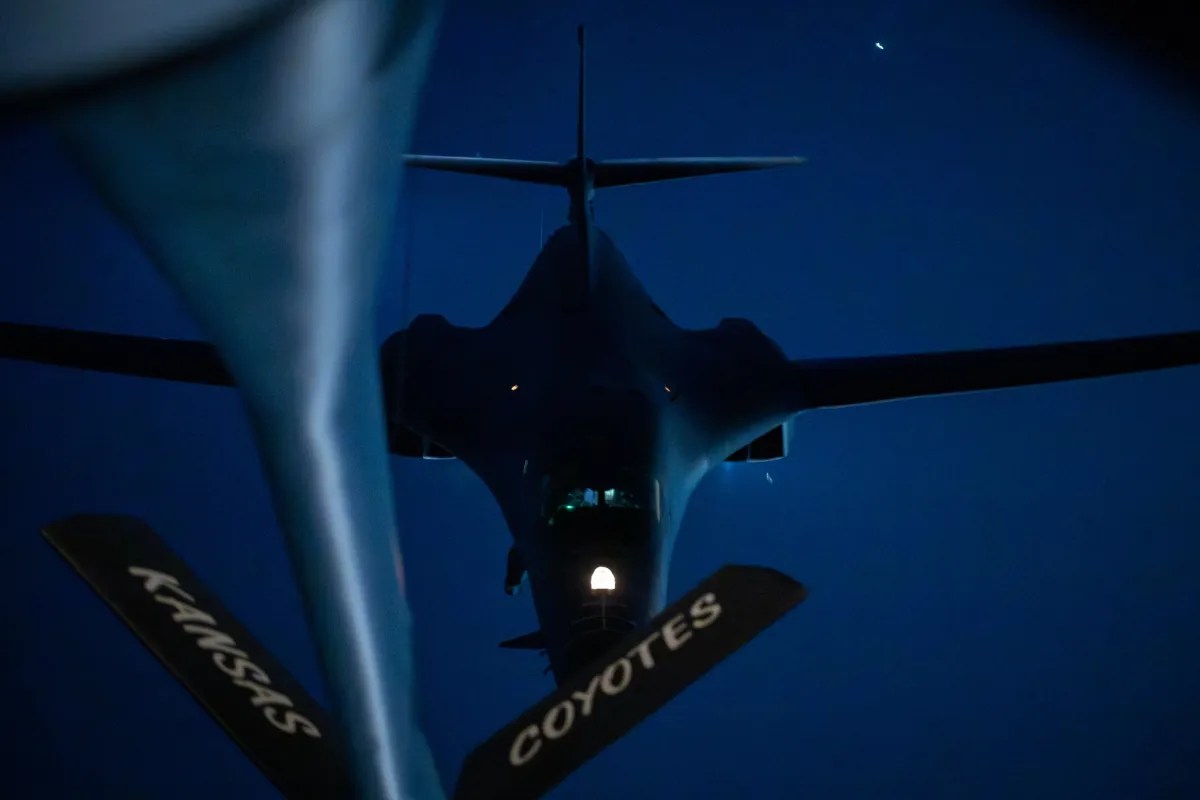
The air at thirty thousand feet is thin, cold, and indifferent to the squabbles of men. Up there, the world looks like a map, stripped of the messy emotions that define life on the ground. But for the person sitting in a pressurized cockpit or a remote control station, the silence is a lie. They are cradling a machine designed to move faster than the speed of sound, a sliver of titanium and software that can end a conversation halfway around the globe before the speaker even hears the engine’s roar.
This isn't about a simple airplane. It is about the B-1B Lancer, a relic of the Cold War that has evolved into something far more predatory. Recently, the narrative surrounding this supersonic giant shifted. It moved from the technical manuals of military enthusiasts into the whispered halls of geopolitical power. When reports surfaced about its deployment in the Middle East, specifically aimed at Iranian leadership targets like Ali Khamenei, the world didn't just see a plane. It saw a message.
The Sound of a Falling Hammer
Imagine standing in a crowded market in Tehran. The hum of life is everywhere—the scent of saffron, the honking of old Paykan cars, the urgent bartering over silk rugs. You don't see the B-1B. You don't hear it coming. That is the point. By the time the sonic boom shatters the windows, the payload has already been delivered.
The Lancer, affectionately or perhaps terrifyingly known as the "Bone," carries the largest conventional payload of any bomber in the U.S. arsenal. It doesn't just drop bombs; it rearranges the landscape. When we talk about "supersonic weapons," we often get lost in the math of Mach numbers and fuel consumption. But the real story is about time. A supersonic bomber erases the luxury of a head start. It turns a thousand miles into a short commute. It makes the distance between a decision in Washington and a consequence in Iran feel dangerously small.
The engineering behind this machine is a testament to human ingenuity and our darker impulses. Its wings sweep back like a bird of prey, reducing drag to slice through the atmosphere. At low altitudes, it hugs the terrain, hiding in the "clutter" of hills and valleys to evade radar. It is a ghost with a heavy hand.
The Weight of the Invisible
Why does this matter to someone who will never see a cockpit? Because these machines dictate the boundaries of global peace. When the U.S. positions a B-1B within striking distance of a high-value target, it is practicing a form of "kinetic diplomacy." It is a physical manifestation of a threat.
Think about the psychological toll on those on the receiving end. For leadership in a country like Iran, the B-1B represents a threat that is both omnipresent and invisible. It is a constant reminder that the sky is no longer a ceiling, but a door that can be kicked down at any moment. This isn't just about the explosive yield of a GBU-31 Joint Direct Attack Munition. It is about the loss of sleep. It is about the way a person looks at a clear blue sky and wonders if something is staring back.
But the B-1B is not invincible. It is an aging lion. Maintaining these planes is a Herculean task of logistics and sweat. For every hour spent in the air, dozens are spent on the ground by mechanics with grease-stained hands, replacing parts that were manufactured before they were born. This is the human cost of power: the endless, grueling work required to keep a 1980s machine relevant in a 2026 world.
The Cold Logic of Modern Warfare
Modern conflict is moving toward a place where humans are increasingly removed from the physical act of destruction. We use words like "surgical" and "precision" to sanitize the reality. But there is nothing surgical about a bomber. It is a blunt instrument guided by sophisticated eyes.
The B-1B’s role in the Middle East is a high-stakes chess move. By deploying it, the U.S. signaled that it was willing to bypass the traditional escalatory ladder. Usually, you send a drone. Then you send a fighter jet. Sending a supersonic heavy bomber is like bringing a sledgehammer to a knife fight. It changes the temperature of the room.
If we look past the headlines about "Khamenei's life under threat," we find a deeper truth about how we perceive safety. We live in an era where technology has outpaced our moral frameworks. We can build a machine that flies faster than sound and carries enough firepower to level a city block, yet we still haven't figured out how to sit across a table and talk without the shadow of that machine looming over us.
The Pilot in the Machine
Let’s consider a hypothetical figure: a young captain, maybe thirty years old, strapped into the seat of a Lancer. They are surrounded by glowing screens and the rhythmic breathing of their oxygen mask. To them, the mission is a series of coordinates and checklists. They aren't thinking about the geopolitics of the Persian Gulf. They are thinking about their fuel levels, their wing sweep, and the landing they have to nail back at Diego Garcia.
This disconnect is the most frightening part of modern warfare. The person who pulls the trigger is thousands of feet away, insulated by layers of glass and steel. The target is a set of pixels on a screen. The human element—the fear, the screaming, the dust—is filtered out.
The B-1B was originally built to carry nuclear weapons, to be the harbinger of the end of the world. It was repurposed for conventional wars, dropping bombs on insurgents who had no way of fighting back. Now, it finds itself back in the center of a potential clash between two powerful nations. It has lived many lives, but its purpose remains the same: to project power through the sheer, terrifying capability of speed and destruction.
The Cost of the deterrent
There is a financial cost, of course. Flying a B-1B costs tens of thousands of dollars per hour. But the real cost is the erosion of certainty. In a world where a supersonic bomber can reach its target in a fraction of the time it takes for a diplomatic cable to be read, the margin for error disappears. One miscommunication, one over-eager sensor, one technical glitch—and the narrative shifts from a "show of force" to an accidental war.
The B-1B is a masterpiece of aeronautics. It is beautiful in a way that only things designed for violence can be. Its silhouette is iconic, its engines a roar that vibrates in your marrow. But we should be careful about falling in love with the machinery of our own destruction.
Behind the technical specs and the Mach speeds is a very simple reality. We have spent decades and billions of dollars perfecting the art of reaching out and touching someone across the world with a high-explosive greeting. The Lancer is just the most efficient way we’ve found to do it.
As the sun sets over the desert, somewhere a B-1B is likely circling, a dark shape against the stars. It doesn't care about the names of the people below. It doesn't care about the history of the soil it flies over. It only cares about the mission. And as long as we continue to rely on the shadow of the bomber to maintain the peace, we will all continue to live in the silence that precedes the boom.
The sky remains empty, until suddenly, it isn't.