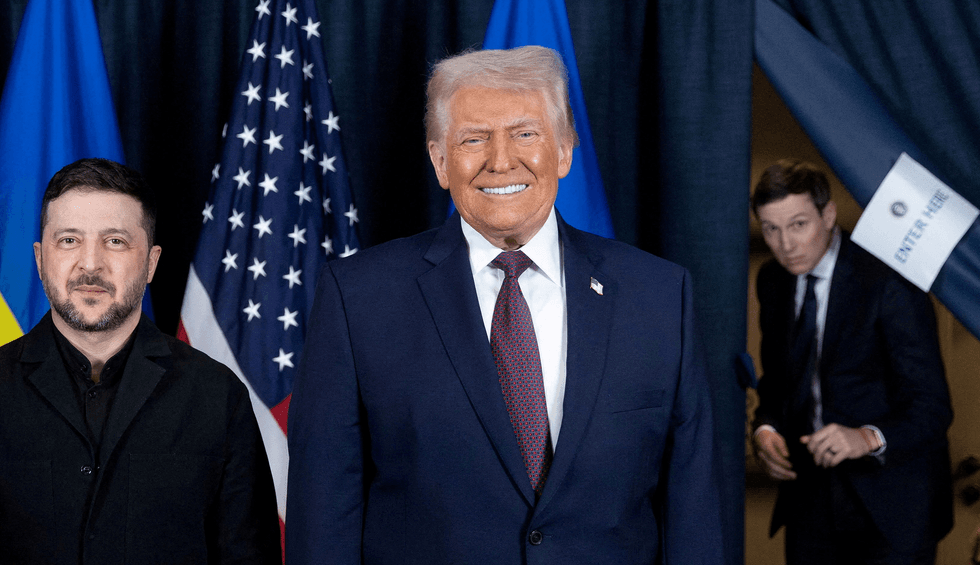
The air in the high-stakes world of private equity is usually sterile, scented with expensive espresso and the metallic tang of climate-controlled server rooms. But when Jared Kushner walks into a room, the atmosphere shifts. It isn't just about the money. It’s about the shadow of a flag that seems to follow him, a residue of power that doesn't wash off just because an administration ended.
Kushner’s firm, Affinity Partners, is currently a vacuum cleaner for global capital. He is seeking $5 billion. That is not a typo. Five thousand million dollars. Most of it is coming from foreign governments, primarily in the Middle East, who seem eager to bet on a man whose primary financial qualification, critics argue, is his proximity to the ultimate seat of American power.
The Architecture of Influence
Imagine you are a fund manager. To get a billion dollars from a sovereign wealth fund, you usually need decades of "alpha"—the industry term for outperforming the market. You need a track record that bleeds black ink. You need to prove you can see around corners that others haven't even turned yet.
Kushner bypassed the decades.
In the immediate wake of his time as a senior advisor to the President of the United States, he secured a $2 billion investment from the Saudi Arabian Public Investment Fund. This happened despite the fund’s own screening panel reportedly raising eyebrows at his lack of experience. They were overruled. When the check is that large, the signature at the bottom isn't just about a return on investment. It's a down payment on a relationship.
This isn't a simple case of "business as usual." In the traditional sense, business is a transaction of value. In the world of Affinity Partners, the value being traded is harder to quantify on a balance sheet. It is the value of access. It is the value of a phone call that gets answered at 3:00 AM.
The Middleman in the Desert
To understand why $5 billion is flowing toward a single firm in Miami, you have to look at the map of the Abraham Accords. Kushner was a central architect of those deals, which normalized relations between Israel and several Arab nations.
On the surface, it was a diplomatic triumph. But beneath the surface, a new financial ecosystem was born. Consider a hypothetical official in a Gulf monarchy. Let’s call him Omar. Omar doesn't care if Kushner knows how to read a complex real estate pro-forma as well as a Blackstone analyst. Omar cares that Kushner sat across from his King. He cares that Kushner understands the delicate ego of regional geopolitics.
When Omar’s government puts $500 million into Affinity Partners, they aren't just looking for a 12% return. They are buying a seat at a table that might be occupied by the next President of the United States.
The ethics are murky. The optics are blinding.
A Vacuum of Oversight
In a standard corporate environment, there are guardrails. If a CEO started taking billions from foreign entities that their father-in-law used to regulate, the board would be in a state of cardiac arrest. But private equity is the Wild West of the financial world. It is opaque by design.
We are seeing a blurring of the lines between public service and private gain that would make the Gilded Age tycoons blush. It’s a revolving door that has been replaced by a high-speed elevator.
The $5 billion target is a signal. It tells the world that the "Kushner Brand" is more than just a name on a building in Jersey City. It is a geopolitical asset. The "mind-boggling" nature of the corruption isn't found in a suitcase full of cash under a park bench. It’s found in the legal, documented, and celebrated transfer of billions of dollars through investment vehicles that are legally shielded from the prying eyes of the American public.
The Invisible Stakes
Why should a person working a 9-to-5 job care about a billionaire’s fundraising goals? Because the currency being traded isn't just dollars. It’s American foreign policy.
When a former—and potentially future—government official is financially beholden to foreign powers, the "America First" slogan starts to feel like a thin veneer. If a crisis breaks out in the Middle East, and the man advising the President has $2 billion of Saudi money in his pocket, whose interests are being served?
It’s a conflict of interest so massive it has its own gravitational pull.
The story of Affinity Partners is a story of how the elite have learned to monetize the prestige of the United States government. They have figured out how to turn a four-year stint in Washington into a multi-generational fortune.
The Silence of the Paper Trail
If you look for the specific investments Affinity is making, you’ll find a patchwork of deals. A Balkan real estate project here, a tech firm there. But the specifics almost don't matter. The money is already in the bank. The management fees alone—the 2% that firms typically charge just for holding the money—are enough to ensure Kushner never has to worry about a mortgage again.
On a $5 billion fund, a 2% management fee is $100 million a year.
Just for existing. Just for being Jared.
The complexity is the point. If it were simple, it would be easy to regulate. By burying the influence in the jargon of "carried interest," "limited partners," and "sovereign wealth allocations," the participants can look the public in the eye and claim they are simply participating in the global marketplace.
The Long Shadow
The sun sets over the Biscayne Bay, glinting off the windows of the offices where these deals are inked. Inside, the talk is of "synergy" and "regional stability." But the reality is much older and much simpler.
It is the story of the gatekeeper.
Throughout history, there have always been people who stood at the door between the powerful and the wealthy. They charge a toll. Sometimes that toll is paid in gold, sometimes in land, and sometimes in the form of a $5 billion investment fund.
The "mind-boggling" part isn't that it's happening. The mind-boggling part is that we are watching it happen in real-time, under the bright lights of the global stage, and the gate remains wide open.
Kushner is still walking through it. And he isn't alone. He is just the one who figured out how to make the door bigger.
The ink on the next contract is drying. The wire transfers are pending. The shadow of the flag is still there, but it’s getting harder to tell if it belongs to the country he served or the investors who bought the rights to the memory of that service.
Money doesn't just talk. It silences the questions that should have been asked a long time ago.