The fluorescent hum of a 4:00 AM airport terminal is a specific kind of purgatory. It is the sound of stale air, floor polish, and the quiet desperation of travelers caught between time zones. In these pre-dawn hours, the boundaries of reality soften. You walk past the closed shutters of duty-free perfume stalls and luxury watch boutiques, your reflection ghosting across the glass. Everything is curated. Everything is plastic. Everything is safe.
Then you reach the gift shop.
It is a sanctuary of the quintessentially Australian—a sea of plush, polyester fauna. There are rows of wide-eyed koalas with Velcro paws. There are kangaroos in green-and-gold jerseys. There are wombats that have been softened and rounded until they bear no resemblance to the muscular, earth-moving tanks of the outback. For the weary traveler, these are not just toys; they are last-minute apologies for a missed birthday or a tangible "I was there" for a grandchild.
But in a quiet corner of an airport in Adelaide, the artifice cracked.
Among the stiff, synthetic fur and the uniform black beads of plastic eyes, something shifted. It didn't have a price tag. It didn't have a "Made in China" label stitched into its side. It breathed.
The Camouflage of the Commonplace
A staff member was performing the morning ritual—straightening the ranks of souvenir wildlife, ensuring the ears of the stuffed dingoes were perkily aligned. It is a mindless task, the kind that allows the brain to drift. You see the pattern, not the object. You see the shelf, not the individual.
Then, the pattern broke.
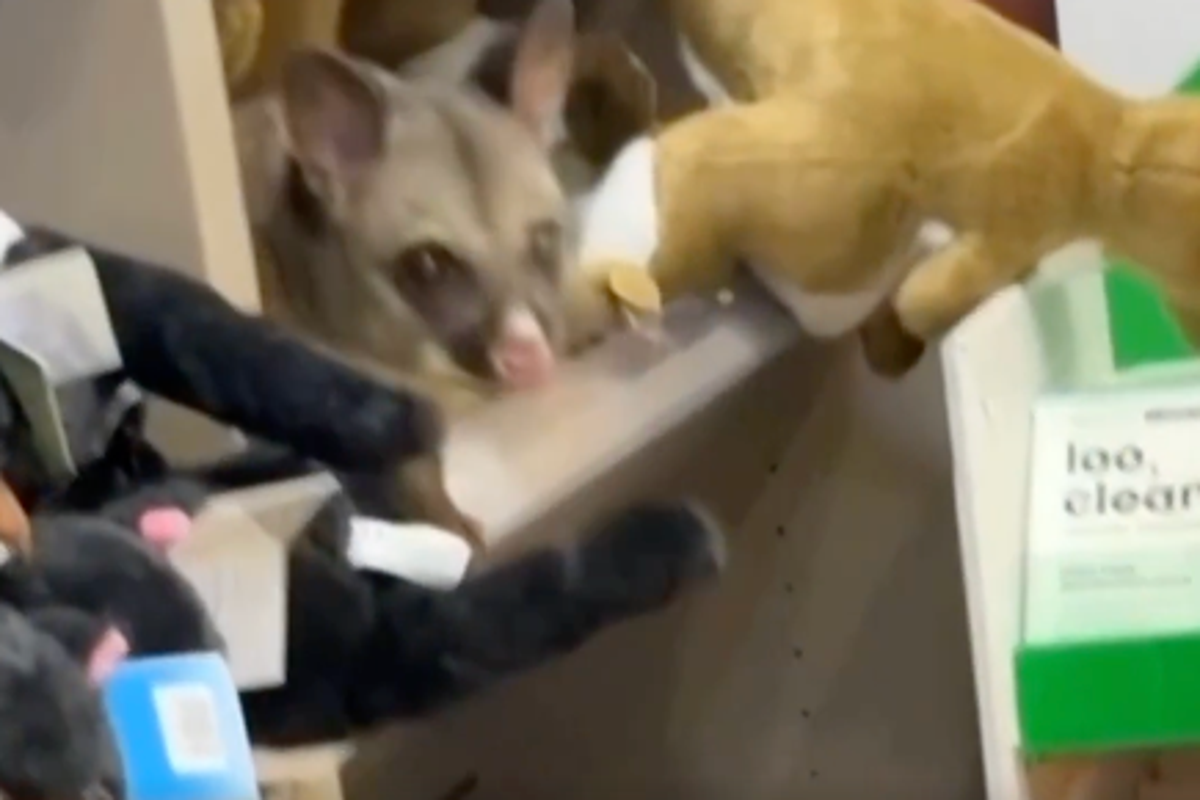
One of the "toys" was the wrong shade of silver-grey. Its fur lacked the suspiciously high sheen of polyester. It was denser, more chaotic. When the staff member reached out, the toy didn't just sit there. It twitched.
A wild common brushtail possum had infiltrated the ranks.
It had climbed into the display, wedging itself between its inanimate cousins. It sat perfectly still, a living gargoyle in a temple of consumerism. For a moment, the barrier between the wild, unforgiving Australian bush and the sterile, climate-controlled vacuum of the terminal vanished.
Consider the sheer audacity of the choice. The possum didn't hide in the vents. It didn't scurry behind the industrial refrigerators in the food court. It chose the one place where its existence would be interpreted as a commodity. It leveraged our own human tendency to see what we expect to see. We expect to see stuffed animals in a gift shop, so the possum became a stuffed animal.
It was the ultimate camouflage.
The Invisible Stakes of the Concrete Jungle
Why does this matter beyond a "quirky news" headline? Because it exposes the fragile thread of our relationship with the world we’ve built.
We live in a world of barriers. We build glass walls and steel gates to keep the "outside" from leaking into our "inside." We want nature, but only on our terms—as a screensaver, a potted plant, or a plush toy that won't bite. We have sanitized the wild until we can't recognize it when it’s sitting six inches from our hand.
The brushtail possum is a creature of immense adaptability, a survivor that has watched us pave over its world and decided, quite stubbornly, to stay. In the suburbs, they live in our roof cavities, their heavy footsteps sounding like burglars in the night. They eat our roses. They hiss at our cats. They are the friction in our smooth, urban lives.
In the airport, that friction became a spark.
The staff didn't see a pest. They saw a miracle of displacement. There is a specific kind of adrenaline that hits when you realize the "thing" you thought was an object is actually a "who." It is a jolt to the system, a reminder that we are never as alone or as in control as we think. The airport, a monument to human logistics and scheduled precision, had been breached by a small, furry anarchist who simply wanted a soft place to sleep.
The Human Element in the Machine
Think of the person who found it.
Imagine the transition from the boredom of a shift-start to the primal realization that you are staring into the eyes of a wild animal. In that second, the airport disappears. The flight schedules to Sydney, the boarding calls for London, the price of a flat white—it all falls away. There is only the heartbeat of the possum and the heartbeat of the human.
We often talk about "wildlife management" as a clinical, distance-based science. We use words like relocation and containment. But in the gift shop, it was personal. The staff had to call in the experts, but for those few minutes before the professionals arrived, there was a shared space.
The possum didn't move. It didn't attack. It stayed in its role, playing the part of the souvenir. It was a silent witness to our rituals of travel. It watched people hurry toward their gates, burdened by luggage and stress, entirely unaware that a piece of the ancient world was watching them from behind a row of discounted magnets.
The Cost of Displacement
There is a sadness beneath the humor of the story.
The possum ended up in the airport because the airport was likely built on what was once its territory. We often forget that airports are ecological dead zones by design. We clear the land, drain the wetlands, and install sonic deterrents to keep birds away from engines. We create a fortress of tarmac.
When a creature like this possum makes it inside, it is a glitch in the Matrix.
It reminds us that the wild doesn't just go away because we’ve labeled a map "International Terminal." It waits at the edges. It looks for the cracks. It finds the one door left ajar by a delivery driver and it walks in, seeking the same things we seek: shelter, safety, and perhaps a bit of quiet.
The rescue was handled with the kind of gentle care that restores your faith in the species. No nets were swung with malice. No sirens blared. The possum was eventually ushered into a specialized carrier, away from the bright lights and the smell of Cinnabon, back to a world where the trees don't have price tags.
But the shop felt different afterward.
The staff reported a lingering sense of the surreal. Every time they looked at the shelf of toys, they looked a little closer. They checked for the rise and fall of a chest. They looked for the wet glint of a real eye. The line between the real and the replica had been permanently blurred.
The Mirror in the Gift Shop
We are obsessed with the authentic. We pay premiums for "organic" food and "handcrafted" goods, yet we spend the majority of our lives in environments that are entirely synthetic. We travel thousands of miles to "see the world," often without ever touching the soil of the places we visit. We move from the pressurized cabin of a plane to the air-conditioned interior of a rental car, to the sanitized room of a hotel.
The possum was a reminder of what we’ve traded away.
It was a small, grey mirror held up to our faces. It asked: Do you even know what is real anymore? Can you tell the difference between a life and a product?
Most of the travelers who passed the shop that morning never knew. they were worried about their gate numbers or their battery percentages. They were trapped in the digital hum. Only a few people saw the truth. Only a few people saw the animal that refused to be a toy.
As the sun finally rose over the Adelaide tarmac, hitting the glass of the terminal with a blinding, golden light, the gift shop returned to normal. The plush toys were back in their neat rows. The barcodes were scanned. The credit cards were swiped.
But if you look closely at the faces of the people who work there, you might see a different kind of light in their eyes. It’s the look of someone who has seen the ghost in the machine. It’s the look of someone who knows that even in the most sterile, controlled, and commercialized corners of our lives, the wild is just waiting for us to blink.
The next time you find yourself in an airport gift shop, don't just look at the souvenirs.
Look at the shadows between them.
Reach out, but do so with caution. Because somewhere, amidst the polyester and the plastic, a heart is beating.
Would you like me to research the specific ecological impact of urban sprawl on Australian marsupials to add more depth to this perspective?


