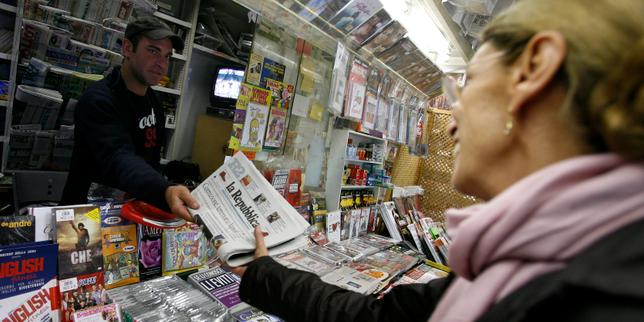
The coffee bar near the corner of Largo Fochetti in Rome has a specific kind of morning rhythm. It is a clatter of ceramic cups, the hiss of steam, and the rhythmic snapping open of broadsheet newspapers. For decades, the most common sound was the crisp unfold of La Repubblica. It wasn't just a paper. It was a secular prayer book for the Italian left, a bastion of intellectual resistance, and a noisy, proud symbol of Roman journalistic defiance.
But lately, the snap of the paper sounds different. It sounds like paper thinning out.
When news broke that the Greek shipping and media titan, Alter Ego Media—controlled by the formidable Vangelis Marinakis—was moving to acquire a controlling stake in GEDI Gruppo Editoriale’s crown jewel, the shockwaves didn't just hit the stock market. They hit the desks of reporters who have spent thirty years chasing the ghosts of the Mafia and the scandals of the Palazzo Chigi.
Italy is a country built on the "piazza." Whether physical or metaphorical, the piazza is where power is held to account. For half a century, La Repubblica was the loudest voice in that square. Now, the keys to the piazza have been handed to a man from across the Ionian Sea, and the silence in the newsroom is heavy with a question no one wants to ask aloud: what happens to a nation's soul when its primary mirror is sold to the highest bidder?
The Architecture of an Empire
To understand why this sale matters, you have to look at what La Repubblica represents. Founded in 1976 by Eugenio Scalfari, the paper was designed to be a "journal-party." It didn't just report the news; it organized a worldview. It was the intellectual spine of a modern, European Italy that wanted to move past the dusty parochialism of the post-war years.
Under the Agnelli family’s stewardship via Exor, and later within the GEDI group, the paper remained a titan. But the digital age hasn't been kind to titans. Circulation numbers that once peaked in the hundreds of thousands began to bleed. The move to Greek ownership isn't just a change in the masthead. It is a fundamental shift in the geography of Mediterranean influence.
Vangelis Marinakis is not a name associated with the quiet, contemplative world of editorial retreats. He is a man of ships, of Nottingham Forest and Olympiacos football clubs, and of a media empire in Athens that knows how to swing a heavy hammer. When a shipping magnate buys a newspaper, he isn't buying a business model. He is buying a megaphone.
The Reporter at the Back of the Room
Imagine a veteran journalist named Claudio. He has worked at the paper since the days of lead type. He remembers when a single editorial by Scalfari could make a Prime Minister sweat through his suit. Today, Claudio sits at a sleek workstation, watching the ticker. He isn't worried about his pension—not yet. He is worried about the "line."
In Italian journalism, "the line" is everything. It is the invisible boundary that dictates how hard you can push against certain interests. When the ownership is domestic, you know where the lines are. You know which industrialist is friends with your boss. You know the dance.
But when the owner is an international conglomerate with interests in maritime logistics, energy, and sports across multiple borders, the lines become invisible. They become a fog. Does a reporter in Rome hesitate to investigate port regulations in Brindisi because the owner’s tankers dock there? Does an editorial on EU maritime policy get softened to protect a fleet?
This is the hidden cost of the acquisition. It isn't measured in Euros. It is measured in the stories that never get written because the author felt a sudden, unexplained chill.
The Greek Connection
The acquisition by Alter Ego Media represents a broader trend of "media consolidation as diplomacy." For the Greek group, acquiring a piece of the Italian establishment provides an instant seat at the table of European influence. Italy and Greece share more than just a sea; they share a volatile economic destiny and a complex relationship with the centers of power in Brussels and Berlin.
By owning La Repubblica, Marinakis doesn't just own a newspaper; he owns a portal into the Italian psyche.
The facts of the deal are stark. GEDI, the previous parent company, has been slimming down for years, selling off local titles and tightening its belt. The sale to the Greek group is a white flag. It is an admission that the old guard of Italian capitalism—the names like Agnelli and De Benedetti—no longer sees the "prestige press" as a viable or necessary shield. They are pivoting to tech, to cars, to global finance. They are leaving the messy business of democratic discourse to the newcomers.
The Ghost in the Printing Press
There is a specific smell to a newspaper printing plant—ink, hot metal, and damp pulp. It is the smell of industrial-scale truth. But as ownership moves further away from the streets where the paper is sold, that truth becomes an abstraction.
A newspaper is a local contract. It is an agreement between the people who live in a place and the people who report on it. When that contract is sold to an entity with no historical or emotional ties to the Quirinale or the streets of Trastevere, the contract is breached.
Consider the hypothetical case of a local election in a small Italian town. Under traditional ownership, the paper might care about a zoning scandal because the editors live in that world. Under a multinational shipping magnate, that town is just a coordinate on a map. The granular, painful, essential work of local accountability is the first thing to evaporate when "synergy" and "efficiency" become the guiding lights of a newsroom.
The Weight of the Mediterranean
We often speak of the "globalization of media" as if it is a natural, inevitable force, like gravity. We are told that it doesn't matter who owns the platform as long as the content is "high quality." This is a lie we tell ourselves to feel better about the crumbling of our institutions.
Ownership is destiny.
In Greece, Marinakis’s media outlets have been central to the national conversation, often embroiled in the fierce, tribal politics of Athens. Bringing that "combative" style of media ownership to Italy—a country already defined by its polarized political landscape—is like pouring gasoline onto a slow-burning fire.
The stakes are invisible until they are suddenly, violently visible. They appear when a labor strike at a port is buried on page sixteen. They appear when a corruption probe into a maritime insurance firm is met with a curious editorial silence. They appear when the paper that once stood for the common man begins to speak with the polished, detached voice of a boardroom.
The Empty Piazza
In the coming months, there will be grand announcements. There will be talk of "digital transformation," of "Mediterranean media hubs," and of "strengthening the voice of the South in Europe." There will be glossy launch parties in Milan and Athens.
But back at the coffee bar in Largo Fochetti, the old men will look at the front page and wonder if the ink still stains their fingers the same way.
The real story of the sale of La Repubblica is not a business story. It is a story of retreat. It is the story of an Italian elite that has grown tired of the burden of the public square, and a foreign titan who sees that exhaustion as an opportunity. It is a reminder that independence is not a static state; it is a muscle that atrophies if it isn't used.
As the sun sets over the Tiber, the lights stay on in the newsroom. Reporters are still typing. The presses will still run. But the ghost of Scalfari, with his fedora and his fierce, uncompromising pen, seems a little further away today.
Italy has always been a land of beautiful façades. We are experts at maintaining the appearance of things long after the substance has rotted away. La Repubblica will still look like La Repubblica. It will have the same font, the same layout, the same red logo. But the heart of a newspaper is not its design. It is its courage.
And courage is very hard to maintain when your paycheck is signed in a language you don't speak, by a man who views the world from the bridge of a ship, looking at the horizon for the next port to conquer.
The snap of the paper in the morning breeze. A single, sharp sound. Then, the long, slow rustle of a page being turned, as a city waits to see if it still has a voice, or if it has merely been assigned a new echo.