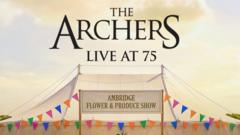
The air in the village hall usually smells of floor wax and damp coats. It is a scent of permanence, of a Britain that exists in the amber of our collective memory. For over seventy years, a specific frequency has carried the pulse of a fictional village named Ambridge into the kitchens and cars of millions. We call it The Archers. To the uninitiated, it is a soap opera about farmers. To the devoted, it is a lifeline, a mirror, and a constant companion through the changing seasons of a life.
There is a unique alchemy in radio. It requires a silent contract between the listener and the broadcast. Unlike television, which dictates every visual detail, radio provides only the spark—the clink of a pint glass at The Bull, the low lowing of cattle in the Brookfield barn, the crunch of gravel under a Land Rover’s tires. The listener’s imagination builds the rest. Every fan carries a different version of Ambridge in their mind, yet we all feel we are walking the same narrow lanes.
Now, that invisible world is breaking its banks.
The news that a special, secret episode will be recorded as part of the upcoming Archers tour has sent a ripple through the community that rivals any scandal involving the Grundys or the Aldridges. This isn't just a promotional stunt. It is a rare moment where the veil between the imagined and the real becomes thin enough to touch.
The Weight of Seven Decades
Consider a listener named Margaret. She isn't real, but she represents thousands. Margaret began listening in 1951, perhaps while leaning over a wireless set in a post-war kitchen. She has heard the deaths of protagonists, the birth of dynasties, and the slow, agonizing evolution of rural life from horse-drawn plows to GPS-guided tractors. For Margaret, the characters are more than voices; they are witnesses to her own passage through time. When she loses a friend in the real world, the steady, unchanging rhythm of the Borsetshire countryside offers a strange, sturdy comfort.
The upcoming tour, and specifically the recording of a special episode in front of a live audience, represents a seismic shift for people like Margaret. For the first time, the "ghosts" in the radio will have faces. They will have physical presence.
The technical challenge of this is immense. In the controlled environment of a BBC studio, "spot effects" are a fine art. An actor might simulate a walk through a field by stepping into a tray of dried heather. A heavy door closing is often just a miniature wooden box with a latch. In a live tour setting, the artifice is stripped away. The audience becomes part of the soundscape. Their breath, their gasps, and their laughter will be baked into the very fabric of the episode.
The Invisible Stakes of a Live Mic
Why does a "special episode" matter so much? Because The Archers operates on a foundation of absolute realism. It is recorded in "real time," meaning if it is raining in the English Midlands on a Tuesday, it is likely raining in Ambridge on Tuesday. This tether to reality is what makes the drama so piercing. When Helen Archer stood trial or when Nigel Pargetter fell from the roof of Lower Loxley, the nation didn't just watch—it mourned and debated as if these were neighbors.
By taking the show on the road and recording a special installment, the producers are playing with fire. They are inviting the "real world" into the sacred, quiet space of the fictional village. There is a risk that the magic might dissipate once you see the actor behind the voice, or once you hear the acoustic footprint of a theater rather than the cozy confines of a farm kitchen.
But the reward is something deeper: catharsis.
Live performance creates a communal energy that a solo listener at home can never replicate. Imagine being in that room when the iconic theme tune, "Barwick Green," begins to play. It is a folk dance that signals a return to center. In a world that feels increasingly fractured and digital, the tour is a physical manifestation of a shared culture. It is a reminder that we are still capable of gathering to hear a story told well.
The Mechanics of the Magic
The "special episode" is rumored to be a departure from the standard linear narrative, or perhaps a deep dive into a specific character’s psyche. In the trade, these are often referred to as "bottle episodes" or "standalones." They allow the writers to stretch their wings, moving away from the daily grind of milk yields and parish council meetings to explore the emotional core of the show.
The logistics are a nightmare of cables and cues.
- Microphone Placement: Capturing the intimacy of a whisper while managing the roar of a crowd.
- Pacing: Radio actors rely on scripts, but a live audience requires "air"—seconds of silence to allow a joke to land or a shock to register.
- The Unforeseen: A cough in the third row or a dropped program becomes part of the canon.
This is the beauty of the tour. It acknowledges that the audience isn't just a passive recipient of the story. They are the guardians of it. The fans know the history of Every person in Ambridge better than they know their own distant cousins. They remember the exact year a specific field was sold or who was driving the car during a 1980s fender-bender.
The Human Heart of the Matter
We live in an age of "content"—disposable, high-speed, and often soulless. The Archers is the antithesis of content. It is a slow-cooked narrative. It understands that human change doesn't happen in a ninety-minute movie arc; it happens over decades of small decisions, morning coffees, and long walks in the rain.
The special episode on this tour is a celebration of that longevity. It is a thank-you note to the people who have kept the lights on in Ambridge for three-quarters of a century. It acknowledges that while the world outside the radio dial may grow cold and unrecognizable, there is a place where the tea is always brewing and the sheep are always in need of shearing.
When the actors take the stage, they aren't just performing. They are stepping into a responsibility. They are carrying the weight of millions of memories. As the red "On Air" light glows in the darkened theater, the distance between the listener in the front row and the farmer in the fictional field will vanish entirely.
The village isn't on a map. It never was. It exists in the space between a broadcast and a human ear. And for one night on the road, that space will be filled with the sound of a thousand hearts beating in sync with the rhythm of a rural world that refuses to fade away.
The story continues, as it must, one heartbeat at a time.
Would you like me to look up the specific dates and locations for the upcoming tour so you can see when it might be passing through your area?