The United States Department of Defense’s decision to provide armed escorts for commercial vessels transiting the Strait of Hormuz represents a fundamental shift from regional deterrence to direct operational intervention. This policy aims to neutralize Iran’s "grey zone" tactics—seizures and harassment of tankers—by altering the cost-benefit calculus of the Islamic Revolutionary Guard Corps Navy (IRGCN). To understand the strategic implications, one must move beyond the headlines and analyze the three structural pillars of this maritime confrontation: the geography of the chokepoint, the mechanics of the escort mission, and the escalatory ladder of naval engagement.
The Geographic Constraint: A Bottleneck of Global Energy
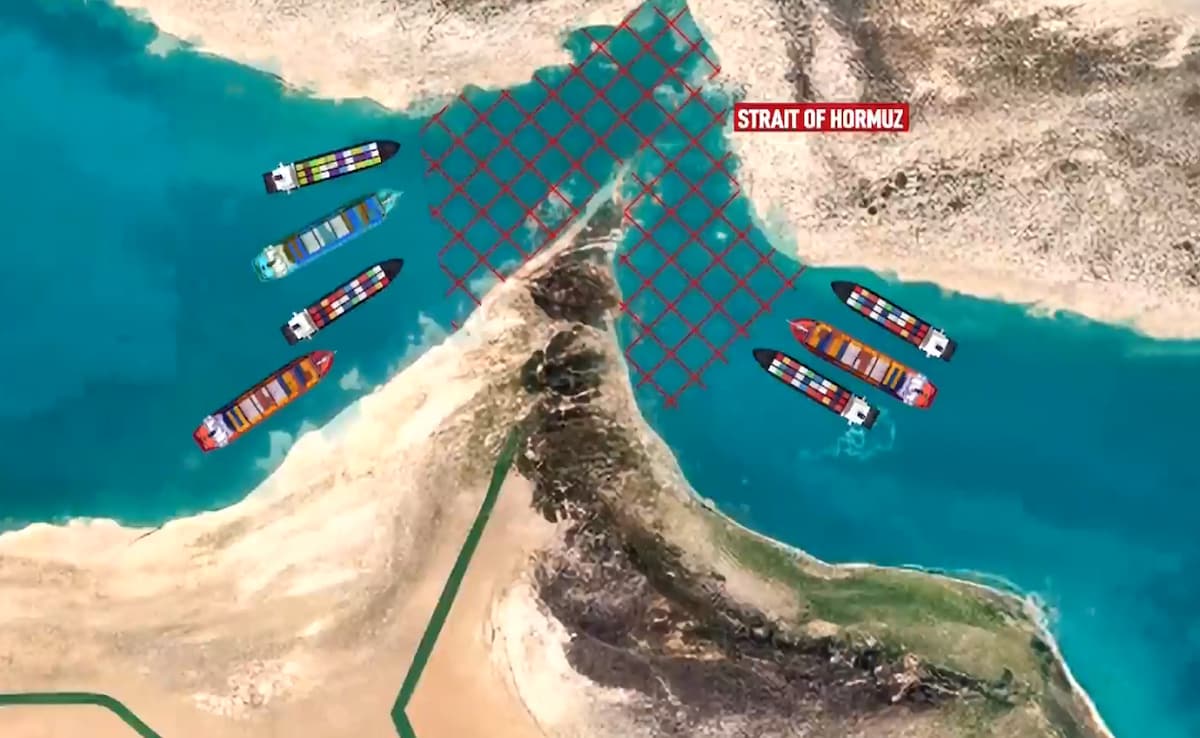
The Strait of Hormuz is not merely a waterway; it is a physical constraint on global energy liquidity. At its narrowest point, the shipping lanes consist of two 2-mile-wide channels for inbound and outbound traffic, separated by a 2-mile-wide buffer zone. This proximity to Iranian territory—specifically the islands of Abu Musa and the Greater and Lesser Tunbs—means that commercial vessels are constantly within the effective range of land-based anti-ship cruise missiles (ASCMs) and fast-attack craft.
The strategic vulnerability is a function of "Transit Density." Approximately 20% of the world's total oil consumption and one-third of total seaborne traded oil pass through this 21-mile-wide throat daily. Iran’s strategy relies on the Asymmetric Friction Model, where the goal is not to win a conventional naval war but to increase the insurance premiums and operational risks of shipping to a level that forces diplomatic concessions from the West.
The Mechanics of Kinetic Escort
The transition to active escorting changes the Rules of Engagement (ROE). Previously, US and coalition forces operated under a "monitor and respond" framework. This created a temporal gap—the time between an Iranian boarding attempt and the arrival of a Western destroyer or UAV—which the IRGCN exploited to complete seizures before intervention was legally or physically possible.
The Escort Cost Function
Providing a direct escort involves a massive allocation of "Hull Days." A single Arleigh Burke-class destroyer (DDG) assigned to a convoy is a DDG removed from wider Persian Gulf surveillance or Red Sea operations. The efficiency of the escort mission is governed by three variables:
- Convoy Grouping: The number of commercial vessels a single warship can effectively defend against simultaneous "swarm" attacks.
- Detection Horizon: The distance at which a warship’s Aegis Combat System can distinguish a legitimate threat from routine dhow traffic in a crowded maritime environment.
- Counter-Boarding Latency: The speed at which an Embarked Security Force (ESF) can be deployed via helicopter to a commercial deck once a threat is identified.
The US Navy is not just using ships; it is deploying Marines and Navy personnel directly onto commercial tankers. This creates a "Tripwire Effect." By placing US service members on a third-party flagged vessel (e.g., a Marshall Islands or Panamanian tanker), any Iranian attempt to board becomes an act of war against US personnel, rather than a mere legal dispute over maritime "infringements."
The Escalatory Ladder: IRGCN Swarm Tactics vs. Aegis
Iran’s naval doctrine is built on mass and expendability. The IRGCN utilizes hundreds of fast-attack craft (FAC) and fast inshore attack craft (FIAC) armed with rockets, torpedoes, or suicide payloads. These vessels are designed to overwhelm a high-tech adversary through saturation.
The Saturated Defense Threshold
The primary technical challenge for a US escort is the Target Discrimination Limit. In a swarm scenario, the warship’s radar and crew must track dozens of small, high-speed targets simultaneously. While the Phalanx Close-In Weapon System (CIWS) and the Mk 38 25mm machine gun are effective, they have finite ammunition and can be "cycled" by a persistent enemy.
The second layer of the Iranian threat is the use of Loitering Munitions (suicide drones). These provide a low-cost way to strike the superstructure of a tanker, causing fires and navigation failure without requiring a full boarding party. The US response involves integrated electronic warfare (EW) to jam drone command links, but the density of the Strait makes "soft kill" measures difficult due to the potential for interference with civilian infrastructure on the coast.
The Economic Impact of Deterrence Failures
The naval presence is a direct subsidy to global energy markets. Without these escorts, the "War Risk" surcharge on tankers would spike. We quantify this through the Risk-Premium Multiplier:
- Stage 1 (Baseline): High traffic, low tension. Insurance is calculated on standard hull and machinery values.
- Stage 2 (Harassment): Iran threatens seizures. Insurance premiums rise by 5–10% per transit.
- Stage 3 (Kinetic Escort): The presence of the US Navy stabilizes the premium, but the cost is shifted from the private sector to the US taxpayer in the form of increased operational tempo (OPTEMPO) costs.
This shift represents a "Security Externalities" problem. The US Navy provides the security, but the beneficiaries are often state-owned oil companies in Asia or European refineries. The strategic question is how long the US can sustain this "Security-as-a-Service" model in a theater that is no longer the primary focus of the National Defense Strategy, which emphasizes the Indo-Pacific.
Legal Ambiguity and the Right of Innocent Passage
Iran justifies its actions by citing UNCLOS (United Nations Convention on the Law of the Sea), specifically claiming the right to police the shipping lanes within its territorial waters for "environmental" or "legal" violations. While the US does not recognize Iran’s expansive interpretation of these rules, the legal friction provides the "gray zone" in which Iran operates.
The escort mission strips away this legal veneer. By maintaining a continuous presence, the US asserts the "Right of Transit Passage," which is more permissive than "Innocent Passage." Under Transit Passage, ships and aircraft may move through international straits in their "normal mode" of operation, which includes the flight of carrier-based aircraft and the deployment of defensive systems.
Strategic Forecast: The Shift to Autonomous Surveillance
The current destroyer-heavy escort model is unsustainable. The US Navy’s long-term play involves Task Force 59, which utilizes unmanned surface vessels (USVs) and AI-driven sensor nets.
Instead of a $2 billion destroyer following a tanker, the strategy will evolve into a persistent mesh of sensors:
- Persistent ISR: Saildrone Explorers and MARTAC T-38 Devils providing 24/7 video feeds of Iranian ports.
- Automated Triggering: AI algorithms detecting "abnormal" IRGCN deployment patterns (e.g., the simultaneous engine start-up of fifty speedboats) and alerting manned QRF (Quick Reaction Force) assets.
This transition reduces the "Human-in-the-Loop" requirement for routine monitoring while maintaining the "Human-on-the-Trigger" capability for actual engagement.
The immediate strategic move for the US involves three specific actions:
- Hardening Commercial Assets: Encouraging (or mandating) that tankers transiting the Strait install standardized mounting points for US Navy security teams and non-lethal acoustic hailing devices.
- Multilateral Burden Sharing: Forcing a "Coalition of the Willing" where major oil-importing nations (specifically India and South Korea) provide their own hull-to-hull escorts to dilute the IRGCN’s focus.
- Proportional Kinetic Response: Establishing a clear, public threshold that any attempt to board a vessel with US personnel on board will result in the immediate destruction of the originating IRGCN base facility, moving the consequence from the sea to the land.
The conflict in the Strait of Hormuz is no longer a series of isolated incidents; it is a permanent state of managed friction where naval technology and political willpower are the only variables preventing a total cessation of traffic. The deployment of escorts is a high-stakes bet that the IRGCN will blink before the US Navy’s budget or political appetite for Persian Gulf involvement runs out.