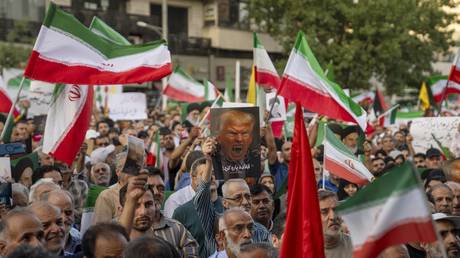
The death of Supreme Leader Ali Khamenei via coordinated U.S. and Israeli kinetic strikes represents the first total decapitation of a nuclear-threshold state’s ideological and administrative apex in the modern era. While initial reports focus on the immediate military success, the structural reality is a shift from a centralized theocratic autocracy to a fragmented power struggle among three competing internal factions. The stability of the Middle East now rests on the management of the "Secessionist Friction" within the Islamic Revolutionary Guard Corps (IRGC) and the speed of transition in the global energy supply chain.
The Tri-Pillar Power Structure in Post-Khamenei Iran
To analyze the probability of a return to diplomatic talks, one must first deconstruct the internal architecture of the Iranian state. Power is not monolithic; it is a precarious balance between three distinct vectors.
- The Praetorian Guard (IRGC): This entity controls approximately 30% to 50% of the Iranian economy through various engineering and telecommunications conglomerates. With the Supreme Leader removed, the IRGC’s primary incentive is the preservation of its economic assets. Diplomatic talks are viewed by this faction as a threat to their "Resistance Economy" model, which thrives on black-market circumventing of sanctions.
- The Bureaucratic Clerisy: These are the institutionalists who manage the day-to-day governance through the Assembly of Experts. Their legitimacy is tied to the Velayat-e Faqih (Guardianship of the Jurist). The removal of Khamenei creates a theological crisis: if the successor lacks the perceived "divine mandate," the entire legal framework of the state dissolves.
- The Technocratic Underground: Comprising the remaining civilian government and the urban middle class, this group views the decapitation as an opening for reintegration into the SWIFT banking system.
The tension between these pillars creates a "Decision-Making Paralysis." World leaders urging a return to talks are operating under the false assumption that there is a coherent "Side B" to negotiate with. Until one of these three factions achieves dominance, any diplomatic engagement is technically impossible as no entity can guarantee the enforcement of a treaty.
The Calculus of Kinetic Deterrence
The U.S. and Israeli strikes utilized a combination of signals intelligence (SIGINT) and low-observable aerial platforms to bypass the S-300 and domestically produced Bavar-373 air defense systems. This operation reveals a significant degradation in Iranian electronic warfare capabilities.
From a strategic consulting perspective, the "Cost of Retaliation" for Iran is currently prohibitively high. The IRGC faces a binary choice:
- Asymmetric Escalation: Utilizing proxies like Hezbollah or the Houthis to disrupt the Bab al-Mandab strait or the Strait of Hormuz.
- Strategic Patience: Absorbing the blow to prevent a full-scale ground invasion that would end the regime's existence.
The "Proximate Risk Factor" here is the Command and Control (C2) integrity of Hezbollah. Without a direct line of credit and ideological direction from the Office of the Supreme Leader, proxy groups often fragment into localized militias. This decentralization makes diplomatic de-escalation harder, not easier, because there is no "kill switch" for the regional violence.
Supply Chain Volatility and Energy Realignment
The immediate market reaction to the strike was a $12 increase in Brent Crude per barrel, reflecting a "Geopolitical Risk Premium." However, the long-term impact is governed by the elasticity of production in the Permian Basin and the spare capacity of OPEC+ members, specifically Saudi Arabia and the UAE.
The structural bottleneck is the Kharg Island Terminal. Iran exports roughly 90% of its crude through this single point of failure. If the IRGC attempts to block the Strait of Hormuz in retaliation, they effectively commit economic suicide by halting their own revenue stream. This creates a "Mutually Assured Economic Destruction" (MAED) scenario. Analysts should monitor the "Dark Fleet" of tankers; a sudden dispersal of these vessels would indicate a preparation for prolonged maritime conflict.
The Assembly of Experts and the Succession Bottleneck
Article 107 of the Iranian Constitution dictates that the Assembly of Experts must elect a new leader. However, the process is historically opaque. The current candidates face a legitimacy gap that Khamenei filled for over three decades.
- Mojtaba Khamenei: The son of the late leader. His selection would signal a move toward a hereditary monarchy masked as a theocracy, likely triggering mass civil unrest.
- Alireza Arafi: Representing the traditionalist clerics. His selection would signal a retreat into isolationism.
The "Succession Lag" is the period between the death of the leader and the consolidation of his successor. During this window, the risk of a "Horizontal Coup" by IRGC generals is at its peak. Western intelligence services are currently tracking the movement of the 15th Khordad Division and other elite units near Tehran as a proxy for internal stability.
Why "Return to Talks" is a Sophomoric Objective
International calls for diplomacy fail to account for the Agency Problem. In game theory, diplomacy requires two parties with the authority to bind their respective principals to an agreement. Currently, Iran has no principal.
The "Diplomatic Friction" is compounded by the Nuclear Program. With the head of the National Security Council likely in hiding or neutralized, the technical teams at Natanz and Fordow are operating without a "Red Line." This creates a "Breakout Capability" risk. If the technical staff perceive a regime collapse is imminent, they may accelerate enrichment to 90% (weapons-grade) as a final deterrent or a "poison pill" for the incoming administration.
Strategic Forecast: The Balkanization of the IRGC
The most probable outcome is not a democratic revolution or a new Supreme Leader, but the "Balkanization" of the Iranian security apparatus. We are likely to see the emergence of "Regional Power Centers" where IRGC commanders in various provinces act as autonomous warlords, controlling local resources and borders.
For global stakeholders, the strategic play is not to seek a grand bargain or a renewed JCPOA. Those frameworks died with Khamenei. The focus must shift to Containment and Micro-Diplomacy:
- Establishing De-confliction Channels: Direct lines between the U.S. Central Command (CENTCOM) and regional IRGC commanders to prevent accidental escalation in the Persian Gulf.
- Targeted Economic Incentivization: Offering sanctions waivers to specific Iranian industrial sectors that distance themselves from the hardline IRGC elements.
- Cyber-Kinetic Monitoring: Using advanced heuristics to track the movement of IRGC-linked digital assets and crypto-wallets, which will be used to fund shadow operations during the power vacuum.
The removal of Ali Khamenei has liquidated the central clearinghouse of Middle Eastern instability. The resulting volatility cannot be managed through 20th-century diplomatic summits. It requires a granular, data-driven approach to regional power fragmentation. The era of the "Grand Bargain" is over; the era of "Chaos Management" has begun.