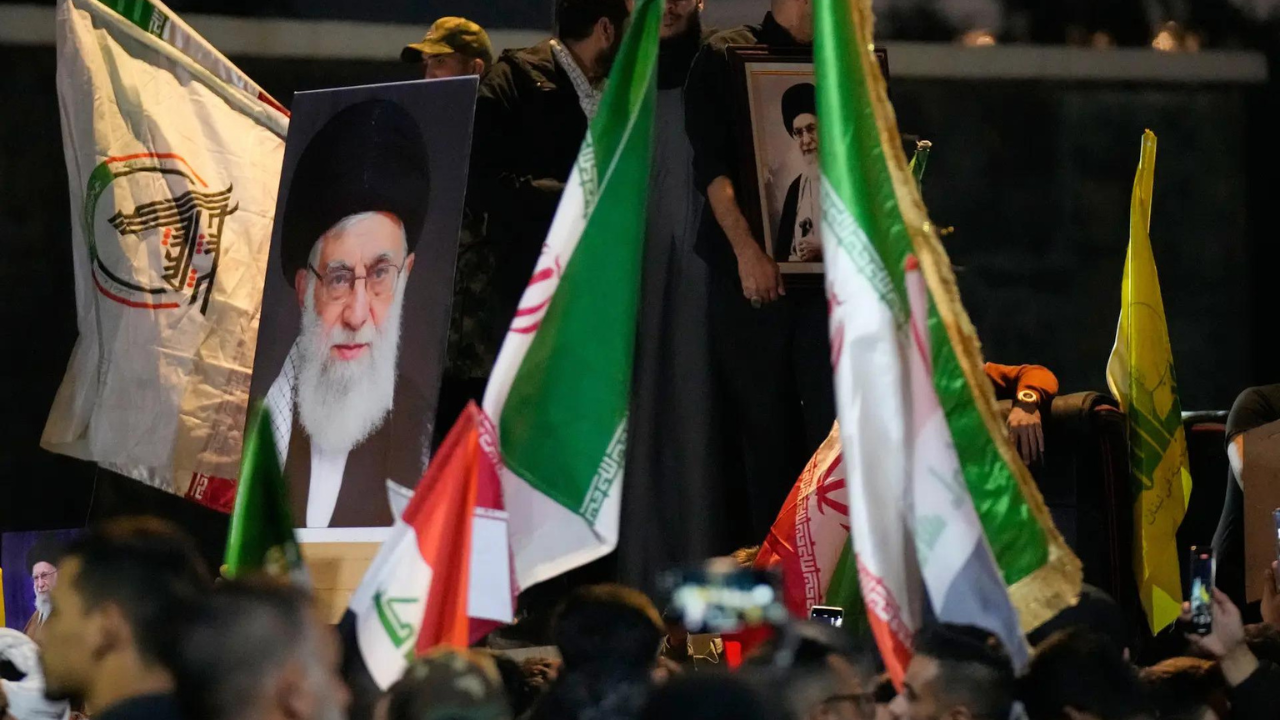
Ali Khamenei’s tenure as Supreme Leader has been defined by a transition from traditional statecraft to a distributed, asymmetrical power model designed to offset structural weaknesses in Iran’s conventional military and economic base. This "Forward Defense" doctrine is not merely an ideological pursuit; it is a calculated response to the geographic and technological constraints of the Persian Gulf. By exporting the friction of conflict away from Iranian soil and into a network of non-state actors, Tehran has successfully decoupled its regional influence from its domestic GDP.
The Tri-Pillar Architecture of Iranian Power
The Iranian strategic model rests on three distinct but interconnected pillars that allow for the projection of force while maintaining plausible deniability.
1. The Proxy Franchise Model
Unlike traditional alliances, which rely on treaties between sovereign states, Iran utilizes a franchise model. This involves the transfer of "sovereignty-lite" to local actors such as Hezbollah in Lebanon, the Houthis in Yemen, and various militias in Iraq. The mechanism of control is centered on a supply chain of specialized military hardware rather than direct command-and-control.
- Logic of Scalability: By providing the technical blueprints for local assembly (specifically in drone and missile tech), Iran reduces the logistical footprint of its support.
- The Attribution Gap: By ensuring that the "fingerprints" on a strike belong to a local group, Iran forces its adversaries into a complex legal and political calculus regarding retaliation.
2. Missile and Drone Proliferation as a Great Equalizer
Faced with an aging air force and international sanctions, the Iranian military establishment prioritized the development of precision-guided munitions (PGMs) and Unmanned Aerial Vehicles (UAVs). This is a textbook example of asymmetric investment: the cost to produce a Shahed-136 drone is several orders of magnitude lower than the cost of the interceptor missiles (such as those used in Patriot or Iron Dome systems) required to down it.
3. The Ideological-Bureaucratic Synergy
The Office of the Supreme Leader functions as the ultimate clearinghouse for both religious legitimacy and strategic direction. This bypasses the traditional friction found in democratic or even standard autocratic systems where the military and the executive might diverge. In Iran, the Islamic Revolutionary Guard Corps (IRGC) serves as both a military wing and a massive economic conglomerate, ensuring that the financial incentives of the elite are perfectly aligned with the expansionist goals of the state.
The Internal Friction of Forward Defense
While the strategy has been successful in creating a "Ring of Fire" around its regional rivals, it has created a profound decoupling from the Iranian domestic economy. The "Guns vs. Butter" trade-off in Iran is extreme.
The cost function of maintaining a regional shadow empire requires a continuous flow of hard currency. When sanctions tighten, the state must prioritize its external "franchisees" to maintain its deterrent. This creates a recurring cycle of domestic inflation, currency devaluation, and civil unrest. The strategic risk is that the "Forward Defense" becomes so expensive that the home front—the very thing it is meant to protect—becomes the primary point of failure.
Technical Analysis of the Iranian Defense Industry
Iran’s domestic industrial base has achieved a high level of "sanction-resilience" by focusing on dual-use technologies and reverse engineering. The development of the Fateh-110 missile family demonstrates a shift from sheer quantity to high-precision accuracy.
- Guidance Systems: Early iterations relied on rudimentary inertial navigation. Current models incorporate GPS/GLONASS and electro-optical seekers, allowing for a Circular Error Probable (CEP) of less than 10 meters.
- Solid-Fuel Transition: The move from liquid-fuel to solid-fuel engines has decreased the "launch-ready" window, making Iranian batteries harder to detect via satellite before they fire.
- The Swarm Logic: Iranian naval and aerial doctrine emphasizes "saturation attacks." By overwhelming an adversary's radar and fire-control systems with a high volume of low-cost targets, they ensure that a percentage of the payload will inevitably reach the objective.
The Strategic Bottleneck of Succession
The greatest vulnerability to the current Iranian trajectory is not external military intervention, but the upcoming transition of power. Ali Khamenei has spent decades centralizing the "Forward Defense" logic within the Office of the Supreme Leader.
The institutionalization of this strategy within the IRGC means that a change in leadership is unlikely to result in a pivot toward Western-style liberalization. Instead, the risk is a period of "Strategic Paralysis" or internal power struggles between the clerical establishment and the military-industrial complex. If the next leader lacks the religious credentials to maintain the ideological cohesion of the proxy network, the "Franchise Model" could fracture into independent, uncontrollable actors.
Operational Constraints and the Limits of Influence
Despite the perceived "arc of influence" from Tehran to the Mediterranean, there are hard limits to Iranian power:
- Ethnic and Sectarian Boundaries: Iran’s influence is largely confined to Shia or marginalized groups. This creates a natural ceiling for their expansion in the broader Sunni world.
- The Reconstruction Deficit: Iran is excellent at providing the tools of war but lacks the capital to fund post-conflict reconstruction. In Syria and Iraq, this has led to a "Frozen Influence" where Iran holds military sway but cannot convert it into long-term economic integration.
- Technological Parity: As regional adversaries like Saudi Arabia and the UAE invest heavily in advanced AI-driven missile defense and offensive cyber capabilities, the "low-cost" advantage of Iranian asymmetric warfare is beginning to erode.
The Necessary Strategic Pivot
The current trajectory suggests that Iran will continue to double down on its asymmetric capabilities while seeking a "Nuclear Threshold" status. This status provides the ultimate insurance policy for the regime while allowing its proxy network to operate with even greater impunity.
For global stakeholders, the focus must shift from attempting to "de-escalate" via traditional diplomacy to a strategy of "Asymmetric Containment." This involves disrupting the illicit financial networks that fund the IRGC’s commercial interests and providing regional partners with the low-cost kinetic tools necessary to negate the Shahed-class drone threat. The goal is to raise the cost of the Forward Defense strategy to a level that forces the Iranian leadership to choose between their regional ambitions and the survival of the state itself.
The Iranian model has proven that a mid-tier power can dominate a region through technological ingenuity and a high tolerance for risk. However, the system is now operating at its maximum tension. Any further expansion will require an economic base that the current regime is structurally unable to provide. The next decade will not be defined by Iran's growth, but by how it manages the inevitable contraction of its overextended borders.