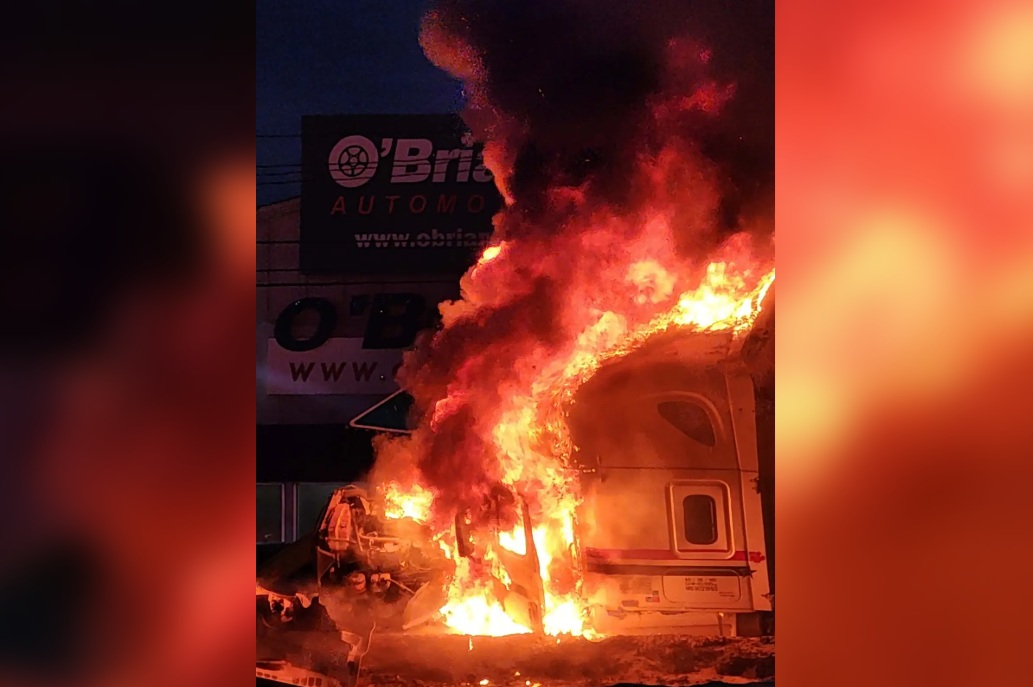
The morning commute in Saskatoon is usually a predictable grind of winter slush and bridge delays. That changed at 7:04 a.m. on Tuesday when a tandem semi-truck slammed into a light standard and overhead signage near the Millar Avenue off-ramp. Within minutes, the cab was a skeletal ruin of twisted steel and orange light, sending a pillar of toxic black smoke over the city’s north end. While the driver escaped with his life, the incident paralyzed the city's primary artery for nearly eight hours. This was not just a traffic accident; it was a systemic failure that exposed the fragility of the Circle Drive corridor and the rising risks in the provincial trucking sector.
The crash occurred on a critical stretch of Circle Drive East, where the speed limit is high and the industrial traffic is relentless. Early reports from the Saskatoon Police Service suggest the driver experienced a medical event behind the wheel. It is a terrifyingly common variable in an industry where aging demographics and grueling schedules are the norm. When a 60,000-pound machine loses its operator, physics takes over. The truck veered, took out the infrastructure that tells drivers where to go, and the impact ignited the tractor unit. By the time firefighters arrived, the cab was fully involved.
The Chaos of the North End Gridlock
The timing could not have been worse. The crash occurred just as the morning rush began to peak. Within 30 minutes, Circle Drive was backed up for nearly two kilometers in both directions. It was a domino effect of frustration and missed shifts. For the thousands of workers who commute into the north end industrial area, there are few viable alternatives when Circle Drive fails.
Rachelle Franklin, a worker at David’s Restaurant just down the street, watched as the usually busy breakfast rush evaporated. "It’s crazy just how many people are caught in traffic for hours," she said. Businesses in the area were effectively cut off. The city’s attempt to reroute traffic via Venture Crescent was a necessary measure, but one that quickly overwhelmed the smaller, industrial-focused streets.
The Hidden Risk of Ice and Fire
Extinguishing a semi-truck fire in a Saskatchewan winter is a battle against two elements. Firefighters used high-pressure hose lines to beat back the flames, a process that took an hour. The fire was declared out by 8:03 a.m., but the aftermath was just as dangerous as the blaze itself. The thousands of gallons of water used to douse the truck hit the frozen asphalt and immediately turned the roadway into an ice rink.
The city dispatched sanding trucks to the site, but the slick conditions remained a factor well into the afternoon. This is a recurring problem in northern logistics. You solve one crisis only to create another. The overhead signage and street lights that were knocked down had to be surgically removed by cranes before any lanes could be reopened.
Why Our Road Infrastructure is Vulnerable
This incident highlights a growing concern for Saskatoon: we are overly reliant on a single, aging loop. Circle Drive was built for a different era, one with fewer high-tonnage tandem trailers and a smaller population. When a major intersection like Circle and Millar goes down, the entire city feels the pressure.
Consider the following factors that made this crash a perfect storm:
- Infrastructure Design: The placement of large overhead sign structures makes them easy targets for runaway heavy vehicles. Once down, they require heavy machinery and hours of labor to clear.
- Medical Oversight: With an aging pool of long-haul drivers, the frequency of medical events behind the wheel is a statistical certainty that the industry has yet to fully address with technology like automatic braking or lane-keep assist in older fleets.
- Emergency Response Latency: While the fire department was on the scene within minutes, the recovery of a tandem trailer unit requires specialized equipment that isn't always sitting in a municipal garage ready to go.
A Pattern of Increasing Road Fatalities
While the driver survived this time, the province is trending in a dark direction. In 2025, Saskatchewan saw a dramatic increase in fatal collisions, with 11 people killed in just the first month of the year. The RCMP has pointed to poor weather as a major contributor, but the sheer volume of industrial traffic on roads like Highway 11 and Circle Drive cannot be ignored.
The investigation into Tuesday’s fire is ongoing, but the police have already indicated that no charges are anticipated. This points back to the "medical event" theory. It is a sobering reminder that the safety of our roads depends on the physical health of those behind the wheel of our supply chain.
The road restrictions were finally lifted at 2:40 p.m., but the residue of the crash—the scorched asphalt, the missing signage, and the lingering ice—will remain for days. If the city wants to prevent the next eight-hour standstill, it needs to look at more than just sanding the ice. It needs to look at the health of the people moving our goods and the resilience of the roads they use to do it.