While the first missiles were still in flight toward Tehran, a different kind of strike was already landing on the dashboards of professional speculators. On February 28, 2026, as the U.S. and Israel launched coordinated operations against Iranian targets, the digital ledger of the prediction market Polymarket began to glow with a series of suspiciously perfect bets.
This was not the "wisdom of the crowd" at work. It was something far more surgical. Blockchain analytics firm Bubblemaps identified six newly minted accounts that poured thousands into "Yes" contracts on a strike occurring by the end of February—some just hours before the sirens went off. These six wallets walked away with a combined $1.2 million in profit. In the cold language of the trade, they had achieved a "perfect fill." In the language of the street, they had turned a looming war into a private ATM.
The sudden surge in volume—Polymarket hit a staggering $478 million in a single day—has shattered the illusion that these platforms are merely high-tech versions of a political poll. They have become a shadow intelligence agency where the price of a "Yes" contract on an assassination or a bombing run moves faster than a cable news ticker. While the platforms defend their existence as a tool for "unbiased forecasting," the reality is shifting. We are no longer just predicting the news; we are incentivizing the leakage of state secrets for a payout.
The Proxy Market on Death
For years, the Commodity Futures Trading Commission (CFTC) tried to kill the concept of event contracts, labeling them "contrary to the public interest." They lost that fight in a D.C. District Court last year. The ruling essentially told the regulator that if an activity isn't explicitly illegal under state law, the CFTC can’t just ban it because it feels "gross."
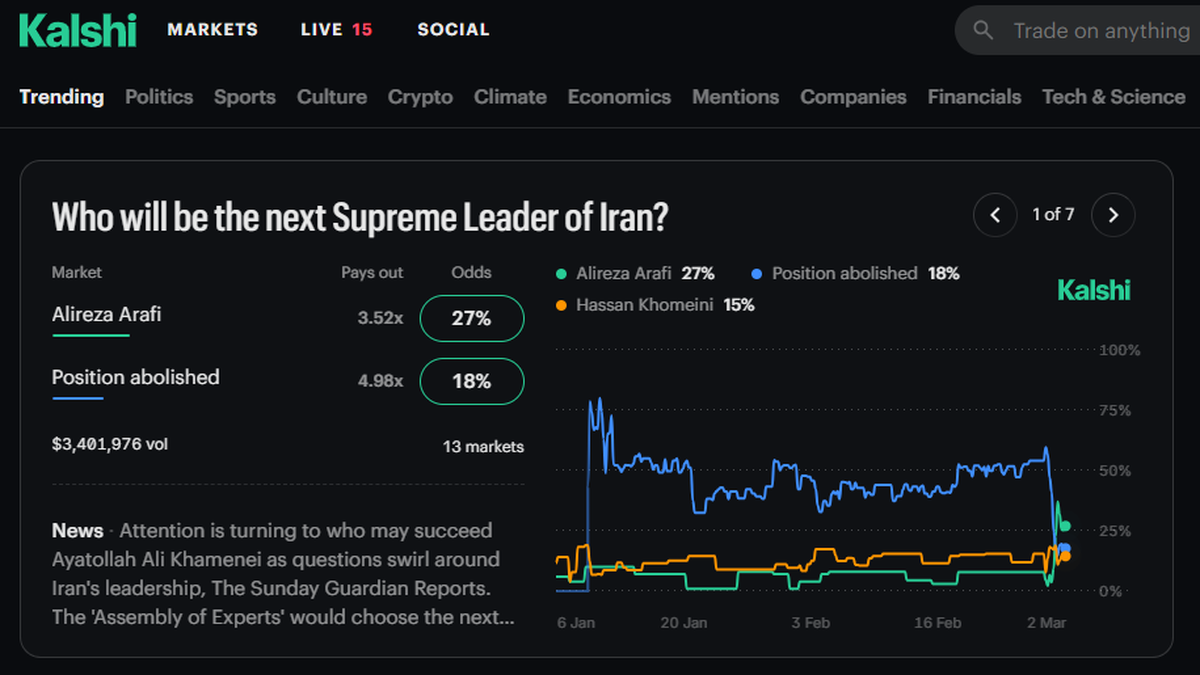
That legal vacuum has been filled with the most macabre instruments imaginable. Take the Kalshi contract titled "Ali Khamenei out as Supreme Leader?" It sounds like a geopolitical forecast. In practice, it functioned as a proxy market on the death of a head of state.
Kalshi, which operates under U.S. regulation, attempted to sanitize the ethics with a "death carveout." If Khamenei were to die, the market would resolve not at the full $1 payout, but at the last traded price before his demise. It is a distinction without a difference for a trader holding a position that moves from 10 cents to 90 cents on the rumor of a heart attack or a drone strike. Whether you win the "full" dollar or just a 800% profit on the volatility, the incentive remains the same: find out when he dies before anyone else does.
Insider Trading in Broad Daylight
The core problem isn't the betting; it's the information asymmetry. In a traditional stock market, if you trade on non-public information about a merger, the SEC comes for your house. In the world of "war betting," the information being traded isn't a corporate earnings report—it's a classified military schedule.
Senator Chris Murphy of Connecticut recently called the situation "insider trading in broad daylight." He isn't wrong. When a user under the name "Magamyman" clears nearly $600,000 by timing the exact window of a military operation, we have to ask where that data came from. The federal government is a sieve of contractors, staffers, and military personnel. A $100,000 profit on a "Yes" contract is a powerful incentive for a low-level analyst to whisper a date to a friend with a crypto wallet.
Unlike the New York Stock Exchange, Polymarket is decentralized and pseudo-anonymous. You don’t need to provide a Social Security number to bet on whether a city will be leveled by Friday. You just need a wallet and a VPN. This makes the "audit trail" the CFTC recently promised to enforce look more like a suggestion than a rule.
The High Stakes of Accuracy
Advocates like Kalshi CEO Tarek Mansour argue that these markets provide "truth" in an era of propaganda. They point to the 2024 election, where prediction markets caught the shift toward Donald Trump long before the traditional pollsters admitted their models were broken. The logic is simple: people don't lie when their own money is on the line.
But there is a fundamental difference between betting on a ballot box and betting on a bomb.
- Market Manipulation: If enough money flows into a "Yes" contract for a strike, does it create a psychological or political pressure for the event to happen?
- Operational Security: If a "No" contract on a military strike suddenly collapses in price, an adversary doesn't need a spy in the Pentagon. They just need to look at the screen. The market becomes a real-time leak of tactical intent.
- Moral Hazard: We are creating a class of "conflict whales" who have a direct financial interest in the failure of diplomacy.
The platforms claim they are merely "aggregating information." But when that information is the start time of a war, the act of aggregation is itself a national security risk.
The Regulation Trap
The current administration is in a bind. Under President Trump, the CFTC has pulled back its claws, dropping several legal challenges against these platforms. Meanwhile, Wall Street is moving in. The parent company of the New York Stock Exchange (ICE) recently took a $2 billion stake in Polymarket. This is no longer a fringe crypto experiment; it is being integrated into the plumbing of global finance.
The CFTC released an "Advisory" in late February 2026, claiming it has the authority to police "artifice to defraud" on these exchanges. They are trying to apply Rule 180.1—the commodities version of the SEC's anti-fraud rules—to event contracts. It’s a desperate attempt to use 20th-century laws to catch 21st-century ghosts.
If a trader uses a classified briefing to buy a contract on an Iran strike, who is the victim of the "fraud"? In a stock trade, the victim is the person on the other side of the trade who didn't have the info. In a prediction market, the "victim" might be the entire concept of national security.
The "Blood Money Loophole" exists because we have decided to treat war as just another "event," no different from the Oscars or the weather. But a hurricane doesn't check the betting odds before it hits the coast. A general might. As long as we allow the timing of state-sponsored violence to be a tradable commodity, we aren't just predicting the future—we are selling it to the highest bidder.
Would you like me to investigate the specific blockchain signatures of the "six insiders" flagged by Bubblemaps to see if they link back to known institutional entities?