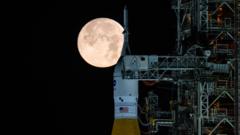
NASA claims the Artemis II mission is "on track" for an April 1 launch. That date is more than a deadline; it is a punchline. To the uninitiated, sending four humans to loop around the lunar surface and return home looks like progress. It looks like the 1960s with better cameras. To anyone who has spent a decade watching the procurement cycles and the "cost-plus" rot of the aerospace industrial complex, Artemis II is something else entirely: a $4 billion lap of honor for a propulsion system that should have been in a museum twenty years ago.
The "lazy consensus" pushed by legacy media is that we are "going back to the Moon." We aren't. We are going near the Moon to justify the existence of the Space Launch System (SLS). If you want to understand why this mission is actually a strategic pivot away from efficient space exploration, you have to look at the hardware, not the PR gloss. In other updates, we also covered: The Hollow Classroom and the Cost of a Digital Savior.
The SLS is a Frankenstein Monster of 1970s Leftovers
The core of the SLS—the rocket supposed to "unleash" our future—is built on the back of the Space Shuttle. Those four RS-25 engines at the base? They are literally refurbished Shuttle engines. NASA took a reusable engine, spent billions "modifying" it to be expendable, and now they are going to throw them into the Atlantic Ocean after one use.
Imagine buying a vintage Ferrari, taking out the engine, and then driving it off a cliff just to see if the airbags work. That is the fiscal logic of Artemis. Engadget has analyzed this critical subject in great detail.
The solid rocket boosters are five-segment versions of the Shuttle boosters. The entire architecture is designed to keep specific contractors in specific congressional districts employed, not to get us to the Moon efficiently. When you hear that the mission is "on track," understand that the track was laid in the 1970s and we are still paying for the maintenance.
The Orion Life Support Delusion
The "People Also Ask" section of your search results will tell you that the biggest risk to the crew is radiation. That’s the clean, scientific answer. The brutal reality is that the Orion capsule’s life support system is a terrifyingly complex gamble that hasn't been tested with human metabolic loads in deep space.
During Artemis I, the uncrewed test, the heat shield eroded differently than the models predicted. "Char" came off in chunks rather than wearing down smoothly. NASA’s internal response was to label this as "expected variability." In any other high-stakes engineering environment, that’s called a "failure of imagination." Pushing four people into a high-apogee orbit with a heat shield that behaves "unpredictably" isn't bravery; it’s a desperate attempt to meet a political schedule.
High Earth Orbit is a Waiting Room Not a Destination
The mission profile for Artemis II is a "hybrid free-return trajectory." It sounds sophisticated. In reality, it’s a safety net. The crew will spend the first 24 hours in a High Earth Orbit (HEO) just to make sure the ship doesn't break before they commit to the Trans-Lunar Injection.
If we were serious about lunar occupation, we wouldn't be doing a figure-eight around the Moon. We would be testing orbital refueling. We would be testing long-term cryogenic fuel storage. But the SLS cannot do those things. It is a "single-shot" heavy lifter in a world that has moved toward reusable, rapid-cadence flight.
The $100 Billion Sunk Cost Fallacy
I have seen companies blow millions on "legacy" software because the CEO was too embarrassed to admit the new startup’s $50-a-month subscription did the job better. NASA is doing this on a planetary scale.
By the time Artemis III actually puts boots on the ground—if it ever does—the program will have cost over $90 billion. For context, the entire Apollo program cost roughly $257 billion in today’s dollars. But Apollo built everything from scratch. Artemis is using recycled parts and somehow charging triple for the privilege.
The true "counter-intuitive" truth? If we cancelled Artemis II today and handed the remaining budget to the private sector with a strict "no-pay-unless-you-land" contract, we would have a permanent base on the lunar south pole by 2028. Instead, we are settling for a flyby.
The Logistics of a Flyby are a Mathematical Dead End
Let's look at the Delta-V requirements.
$$\Delta v = v_e \ln \frac{m_0}{m_f}$$
The Tsiolkovsky rocket equation doesn't care about your press release. The SLS has a massive $m_0$ (initial mass) but its $m_f$ (final mass) delivered to the Moon is pathetic compared to what is possible with orbital assembly. By insisting on a single-launch mission architecture, NASA is fighting a war against physics that it has already lost.
We are sending a crew of four—including the incredibly talented Victor Glover and Christina Koch—to sit in a tin can for ten days, look out a window, and come home. It is a glorious, multi-billion dollar selfie.
The Hidden Risk: The Heat Shield Gap
The most egregious "nuance" the media misses is the gap between the Orion pressure vessel and the thermal protection system. During the reentry of Artemis I, the spacecraft experienced "skipping" maneuvers to bleed off velocity. This is a smart way to manage G-loads, but it subjects the structure to prolonged thermal soak.
If the Artemis II heat shield behaves like its predecessor, the "spallation" (the fancy word for the shield falling apart in chunks) could potentially damage the parachute deployment bags. NASA knows this. They are betting that the "variability" stays on the right side of the bell curve.
Stop Asking "When" and Start Asking "Why"
The public is obsessed with the April 1 date. They ask, "Will they make it?"
The question you should be asking is: "Why are we using a 19th-century procurement model for 21st-century exploration?"
We are using a rocket that costs $2 billion per launch. It cannot be recovered. It cannot be mass-produced. It is a bespoke, artisanal relic. Every time an SLS launches, we are effectively burning a mid-sized aircraft carrier's worth of capital.
If you want to actually understand the "status quo," look at the engine testing stands at Stennis Space Center. They are testing the RS-25s. They are proud of them. They should be—they are masterpieces of engineering. But they are masterpieces belonging to an era that ended in 2011.
The Actionable Truth for the Space Industry
The unconventional advice for anyone looking to invest in or work in the space sector is simple: Ignore the "Moon Launch" headlines. The real work isn't happening in the Orion capsule. It is happening in the development of orbital propellant depots.
The moment a private company proves it can transfer liquid methane or oxygen in zero-G, the SLS and the entire Artemis II mission profile become obsolete overnight. Artemis II is the last gasp of "Old Space." It is the final parade of the dinosaurs before the asteroid hits.
NASA is checking boxes to satisfy a 2010 mandate. They are not building a bridge to the stars; they are building a monument to their own bureaucracy. The crew of Artemis II are heroes, but they are heroes being asked to fly a museum piece into a vacuum.
If the mission launches on April 1, don't cheer for the "return to the Moon." Cheer for the fact that we are finally using up the last of the Shuttle parts so we can eventually start building something that actually makes sense.
The Moon isn't the goal. The goal is a transportation system that doesn't require a Congressional act to fund a single tank of gas. Until we have that, we’re just tourists in our own backyard.
Check the telemetry. Watch the heat shield. And stop pretending this is 1969. We should be much further along than a ten-day loop-de-loop.