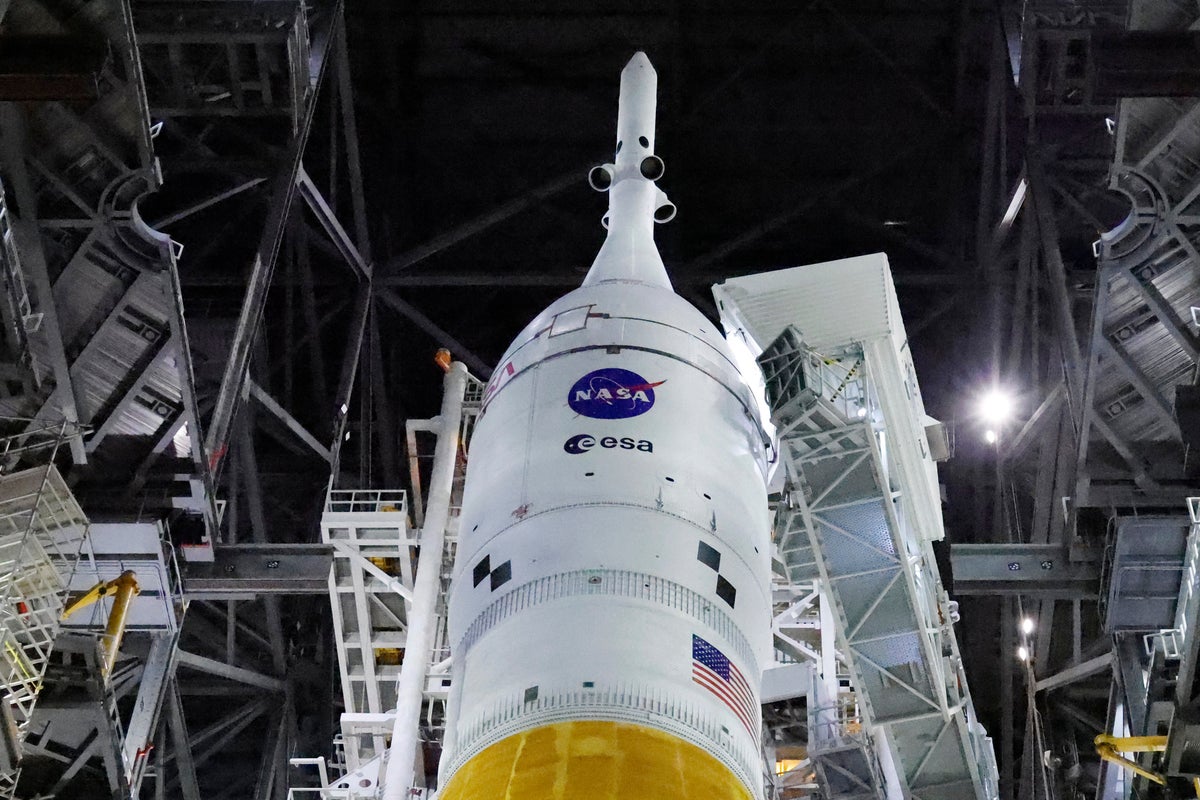
The transition from theoretical orbital mechanics to the physical integration of the Space Launch System (SLS) represents the highest-stakes bottleneck in modern aerospace. While public discourse focuses on the binary outcome of a launch date, the internal logic of the Artemis II mission is governed by a rigid three-pillar framework: hardware certification, life-support redundancy, and the mitigation of heat shield erosion variables. NASA’s recent decision to delay the crewed circumlunar flight is not a setback in the traditional sense; it is a calculated response to the thermal and electrical telemetry gathered during the uncrewed Artemis I re-entry.
The Mechanics of Integrated Flight Hardware
The SLS core stage, currently undergoing final assembly at Michoud Assembly Facility and Kennedy Space Center, serves as the primary propellant housing for 2.3 million liters of liquid hydrogen and liquid oxygen. Unlike commercial satellite launches, the crewed configuration of the SLS (Block 1) requires a "man-rating" certification that exponentially increases the required safety margins.
The assembly sequence follows a critical path where the Core Stage integration must synchronize with the Solid Rocket Booster (SRB) stacking. These boosters, provided by Northrop Grumman, have a limited "stack life." Once the segments are joined, the propellant grain begins a chemical clock; if the launch does not occur within a specified window, the boosters must be destacked and inspected—a process that introduces months of additional delay. This creates a "launch pressure" where the hardware itself dictates the viability of the schedule.
The Orion Heat Shield Variance
The most significant technical hurdle emerging from the Artemis I flight data is the non-uniform ablation of the Orion capsule's heat shield. During re-entry from lunar velocities—approximately 40,000 kilometers per hour—the Avcoat material is designed to char and erode, carrying heat away from the cabin.
Analysis of the recovered Artemis I capsule revealed "skipping" or unexpected liberation of small pieces of the heat shield rather than a smooth, predictable ablation. In a crewed environment, this variance is unacceptable. The physics of re-entry involves temperatures reaching 2,760°C. If the ablation rate is inconsistent, it creates the risk of localized "hot spots" where the thermal protection system (TPS) could breach. NASA’s current engineering phase involves a root-cause analysis of the Avcoat chemistry and the application process, ensuring that the Artemis II shield can maintain structural integrity during the high-velocity "skip entry" maneuver required for a precise splashdown.
Life Support Systems and the Oxygen Loop
Artemis II marks the first time the Orion Environmental Control and Life Support System (ECLSS) will be fully operational with humans on board. The complexity of this system is often underestimated. It is not merely an air tank; it is a closed-loop chemical plant.
- Nitrogen-Oxygen Mixing: Maintaining a sea-level atmospheric pressure (101.3 kPa) while managing partial pressures to prevent hypoxia or oxygen toxicity.
- CO2 Scrubbing: Utilizing amine-based swing beds to remove carbon dioxide. Any failure here leads to hypercapnia, impairing crew cognitive function within hours.
- Humidity Control: Managing the moisture exhaled by four astronauts to prevent electrical shorts and fungal growth in the avionics bays.
The delay allows for more rigorous "string testing" of these systems. Engineers are currently simulating thousands of hours of life-support operation to identify infant mortality failures in the valves and pumps—components that cannot be repaired once the spacecraft departs Earth's orbit.
The Economic Function of Mission Delays
In deep space exploration, the cost of failure is not just the loss of the vehicle (roughly $4.1 billion per launch) but the total loss of political and public capital for the entire lunar program. The "Artemis Accords," which involve international partnerships, rely on the perception of NASA as a reliable system integrator.
The delay serves as a hedge against the "normalization of deviance"—a phenomenon identified after the Challenger and Columbia disasters where minor technical anomalies are accepted as routine until they cause a catastrophic failure. By pausing the Artemis II integration to address the heat shield and battery circuitry issues, NASA is signaling a return to a "test-as-you-fly" philosophy. This strategy prioritizes long-term program viability over short-term milestone achievements.
Electrical Architecture and Battery Redundancy
A secondary but critical factor in the schedule revision involves the Orion capsule’s battery string. During pre-flight testing, engineers identified a design flaw in the circuitry responsible for the abort motor and parachute deployment.
The Orion uses a series of high-capacity lithium-ion batteries. The failure mode identified involves the potential for a "latent defect" where a single cell failure could propagate through the entire string. Given that the parachutes are the only mechanism for a safe return, the reliability of the firing circuits must be near-unity. The current engineering workaround involves redesigning the isolation switches to ensure that a power surge cannot disable the primary and backup deployment controllers simultaneously.
The Lunar Flyby Trajectory as a Stress Test
Artemis II is not a landing mission; it is a Hybrid Free-Return Trajectory. The crew will use Earth’s gravity and a single large burn from the Interim Cryogenic Propulsion Stage (ICPS) to sling around the Moon.
- The High Earth Orbit (HEO) Phase: The mission begins with a 24-hour orbit around Earth to test systems before the Trans-Lunar Injection (TLI). This is the "safe zone" where the crew can still abort and return to Earth within hours.
- The TLI Burn: Once the TLI is executed, the crew is committed to a multi-day journey.
- The Pericynthion: The point of closest approach to the Moon (roughly 7,400 km).
This trajectory is designed specifically to test the Deep Space Network (DSN) communications and the spacecraft's ability to handle the radiation environment of the Van Allen belts and solar energetic particles without the protection of Earth's magnetosphere.
Strategic Recommendations for Mission Readiness
The path to a successful Artemis II launch requires a shift from assembly-speed to verification-depth. Stakeholders must accept that the 2025/2026 window is a variable, not a constant.
- Accelerate Digital Twin Integration: Use the data from Artemis I to create high-fidelity simulations of the heat shield's non-linear ablation. This will allow for "virtual" test flights that can predict thermal stresses across a wider range of re-entry angles.
- Decouple Component Testing from Vehicle Integration: To prevent the "booster clock" from expiring, NASA should perform sub-system upgrades (like the battery circuitry) in parallel with core stage testing, rather than waiting for the vehicle to be fully stacked.
- Formalize the "No-Go" Criteria: Clearly communicate to the executive and legislative branches that specific technical gates—specifically the heat shield char rate and the life-support valve MTBF (Mean Time Between Failures)—are the only metrics that matter for launch approval.
The Artemis II mission is the gateway to the Lunar Gateway and the eventual Mars transit. Compromising the integrity of this "Alpha" crewed flight for the sake of a calendar date introduces a systemic risk that could end the program entirely. The current delay is the most rational strategic move available to ensure the transition from a single-planet species to a multi-planetary one remains a viable engineering objective.
Maintain the current rigorous testing cadence for the Orion life support loops and prioritize the redesign of the heat shield application process over any attempt to meet a politically driven launch window. Only through the absolute quantification of re-entry variables can the mission transition from a high-risk experiment to a repeatable operational framework.